The Phenomenon of Code-Mixing of Phu Thai Language and Isan Language in the Society of Phu Thai Native Speakers
Abstract
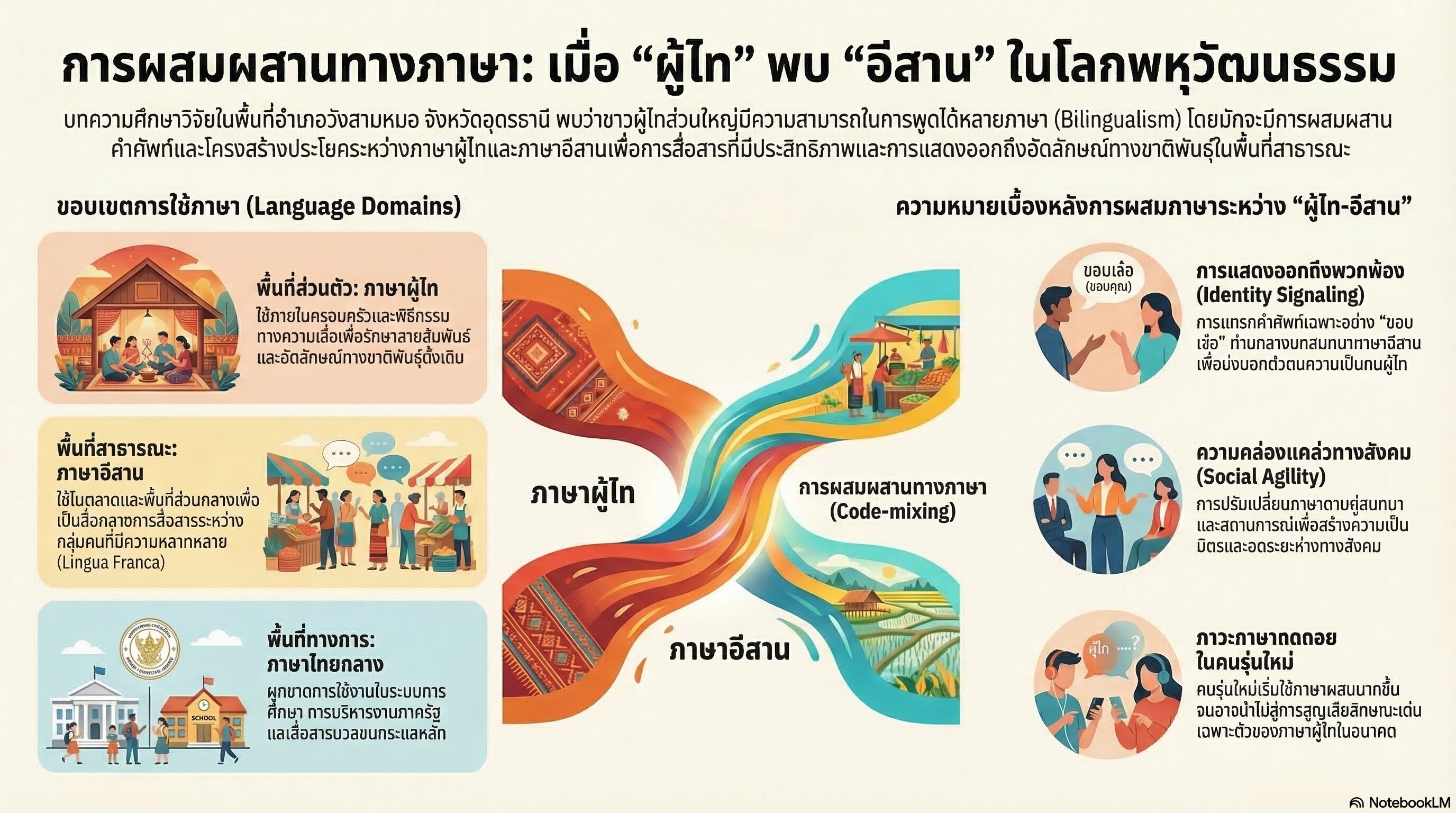
This article explores the sociolinguistic dynamics of code-mixing between Phu Thai and Isan speakers in northeastern Thailand, focusing on the bilingual community in Nongyasai Subdistrict, Wang Sam Mo District, Udon Thani Province. Rooted in the Southwestern Tai language family, the Phu Thai dialect serves as a vehicle of ethnic identity and cultural transmission, yet faces increasing pressure from the dominance of Standard Thai in formal domains and the widespread use of Isan in public life. Through qualitative data from interviews, natural speech recordings, and field observations, the study examines the structural patterns, functional domains, and sociocultural motivations for code-mixing among bilingual speakers. The author presents the code-mixing frequently occurs in informal and semi-formal settings such as markets, family interactions, and community events, with lexical borrowing and pragmatic adaptation serving to express identity, negotiate social relationships, and facilitate communication across dialects. The phenomenon reflects both linguistic resilience and shifting language ecologies, highlighting the role of everyday speech in balancing tradition and modernity. This research contributes to the fields of contact linguistics and minority language maintenance by demonstrating how multilingual speakers actively shape their communicative repertoires in response to social, cultural, and institutional pressures.
References
Diller, A., Edmondson, J. A., & Luo, Y. (2008). The Tai-Kadai languages. Routledge.
Enfield, N. J. (2007). A grammar of Lao. Walter de Gruyter.
Fishman, J. A. (1972). The sociology of language: An interdisciplinary social science approach to language in society. Newbury House.
Fishman, J. A. (1991). Reversing language shift: Theoretical and empirical foundations of assistance to threatened languages. Multilingual Matters.
Gumperz, J. J. (1982). Discourse strategies. Cambridge University Press.
Hymes, D. (1974). Foundations in sociolinguistics: An ethnographic approach. University of Pennsylvania Press.
Miller, C. (2007). Language shift and language maintenance in Thailand’s minority groups. International Journal of the Sociology of Language, 186, 99–123. https://doi.org/10.1515/IJSL.2007.060
Rappa, A. L., & Wee, L. (2006). Language policy and modernity in Southeast Asia: Malaysia, the Philippines, Singapore, and Thailand. Springer.
Smalley, W. A. (1994). Linguistic diversity and national unity: Language ecology in Thailand. University of Chicago Press.
Tingsanchali, T. (2001). Language contact and language choice in a Thai-Lao bilingual community in Thailand. In D. Bradley & M. Bradley (Eds.), Language endangerment and language maintenance: An active approach (pp. 211–218). RoutledgeCurzon.
Trudgill, P. (2000). Sociolinguistics: An introduction to language and society (4th ed.). Penguin Books.
Wardhaugh, R., & Fuller, J. M. (2015). An introduction to sociolinguistics (7th ed.). Wiley-Blackwell.
Downloads
Published
How to Cite
License
Copyright (c) 2026 Journal of Buddhist Education and Research (JBER)

This work is licensed under a Creative Commons Attribution-NonCommercial-NoDerivatives 4.0 International License.