Problems and Proposed Strategies for Solving the English Problems of Thai Staff Working at a European Airline Call Center
คำสำคัญ:
กลยุทธ์ที่เสนอ, ปัญหาภาษาอังกฤษบทคัดย่อ
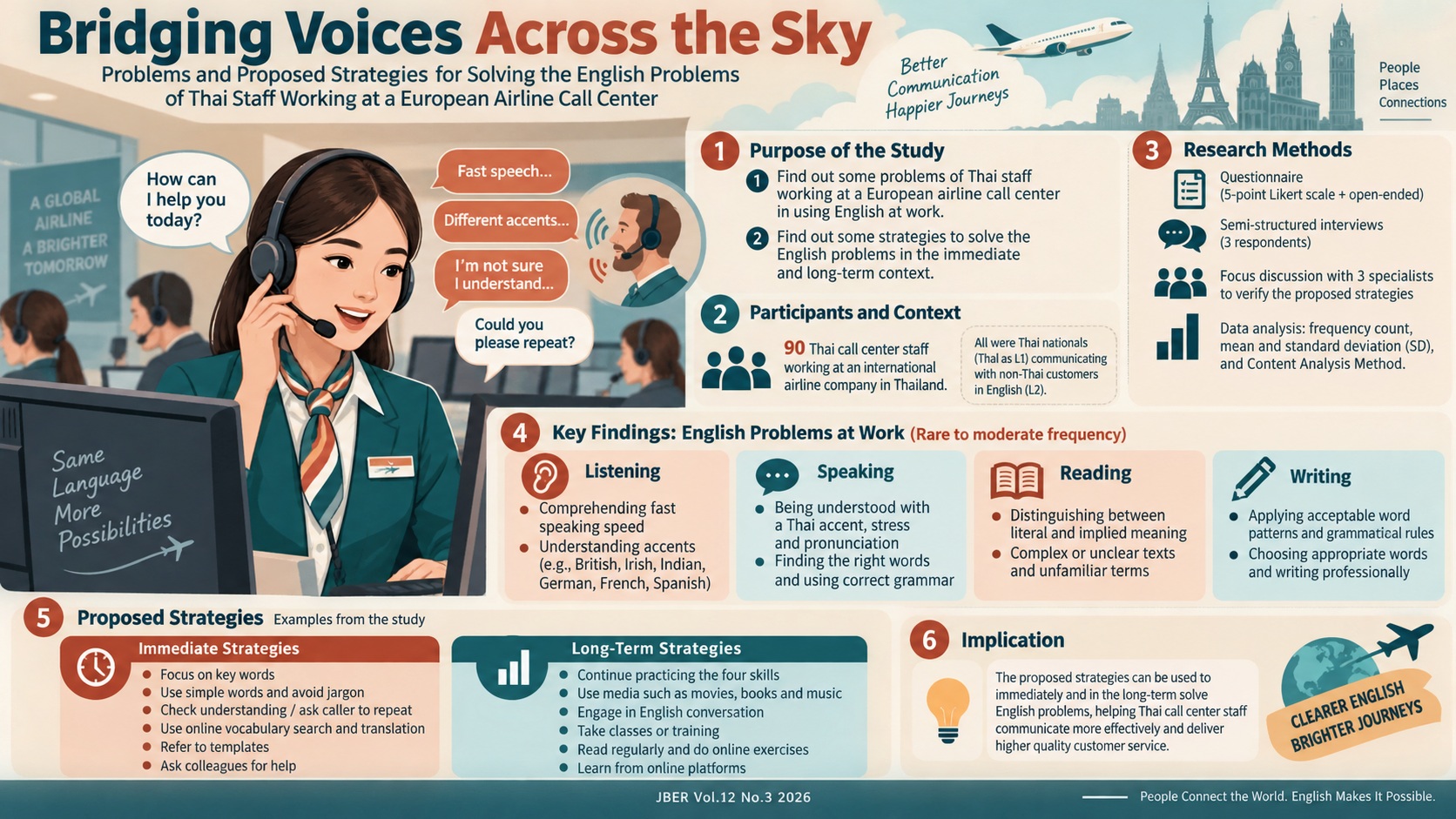
The objectives of this research were: 1) to find out some problems of the Thai staff working at a European airline call center in using English at work, and 2) to find out some strategies to solve the English problems in the immediate and long-term context. The respondents were 90 call center staff working at an international airline company in Thailand. In this study, there were 2 main research instruments; namely, 1) a questionnaire composed of the five-point Likert scale and open-ended questions which was employed to collect the data and information, along with semi-structured interviews with three respondents, and 2) a set of questions employed in the focus discussion meeting among the three specialists for the approval of the correctness and suitability of the proposed strategies for solving the English problems in the immediate and long-term context . The data and information collected through the questionnaire were analyzed and presented in terms of frequency count, mean ( ) and standard deviation (SD). In addition, the data and information collected from the focus group discussion meeting towards correctness and suitability of the proposed strategies were analyzed through the Content Analysis Method (Twin, 2025). The results indicated rare to moderate frequency of problems in the four language skills, including understanding caller accents for listening, application of appropriate wording for speaking, distinguishing between literal and implied meaning for reading, and applying acceptable word patterns and grammatical rules for writing. In addition, the results also indicated some proposed strategies for the Thai staff at a European airline call center to consult for immediately solving problems in using English at work were focusing on key words, using simple words, avoiding jargon, conducting online vocabulary search and translation, referring to templates and asking colleagues for help. In addition, some proposed strategies used for long-term solving problems were continuous practicing of skills and the use of media such as movies, books and music (Oxford, 1990a).
เอกสารอ้างอิง
Anthony, L. (2018). Introducing English for specific purposes.Routledge.
Boonkit, K. (2010). Enhancing the development of speaking skills for non-native speakers of English. Procedia -Social and Behavioral Sciences, 2(2), 1305–1309. https://doi.org/10.1016/j.sbspro.2010.03.191
Brown, H. D., & Abeywickrama, P. (2019). Language assessment: Principles and classroom practices(3rd ed.). Pearson Education.
Dudley-Evans, T., & St John, M. J. (1998). Developments in English for specific purposes: A multi-disciplinary approach.Cambridge University Press.
Ganiyu, R. A. (2017). Customer satisfaction and loyalty: A study of interrelationships and effects in Nigerian domestic airline industry. Oradea Journal of Business and Economics, 2(1), 7–20. https://doi.org/10.47535/1991ojbe013
Lazaraton, A. (2014). Second language speaking. In M. Celce-Murcia, D. M. Brinton, & M. A. Snow (Eds.), Teaching English as a second or foreign language(4th ed., pp. 106– 120). National Geographic Learning.
Oo, Y. K. (2025). The state of English language learning in Thailand: Challenges and future directions. Journal of Asian Language Teaching and Learning, 6(2), 43–50. https://so10.tci-thaijo.org/index.php/jote/article/view/2978
Oxford, R. L. (1990). Language learning strategies: What every teacher should know.Heinle & Heinle.
Robinson, P. (1991). ESP today: A practitioner’s guide.Prentice Hall.
Rubin, J. (1975). What the “good language learner” can teach us. TESOL Quarterly, 9(1), 41– 51. https://doi.org/10.2307/3586011
Srisang, K. (2017). A survey of the needs of English communication skills and communication problems between Thai customer service staff and non-Thai passengers[Independent study, Thammasat University]. https://digital.library.tu.ac.th/tu_dc/frontend/Info/item/dc:137738
Twin, E. E. (2025). Motivation and attitudes towards learning English among Thai students. Journal of Asian Language Teaching and Learning, 6(2), 57–61. https://so10.tci- thaijo.org/index.php/jote/article/review/2983
Weigle, S. C. (2014). Considerations for teaching second language writing. In M. Celce- Murcia, D. M. Brinton, & M. A. Snow (Eds.), Teaching English as a second or foreign language(4th ed., pp. 222–237). National Geographic Learning.
Woydack, J., & Lockwood, J. (2020). Affordances for language learning in a call centre. English for Specific Purposes, 60, 159–178. https://doi.org/10.1016/j.esp.2020.04.005
ดาวน์โหลด
เผยแพร่แล้ว
รูปแบบการอ้างอิง
สัญญาอนุญาต
ลิขสิทธิ์ (c) 2026 Journal of Buddhist Education and Research (JBER)

อนุญาตภายใต้เงื่อนไข Creative Commons Attribution-NonCommercial-NoDerivatives 4.0 International License.