Buddhist Principles, Media Literacy, and Positive Online Traits Among Buddhist University Students in Thailand: A Quantitative Study
คำสำคัญ:
Buddhist principles, media literacy, online traits, digital citizenship, Trisikkha, Buddhist university students, Thailandบทคัดย่อ
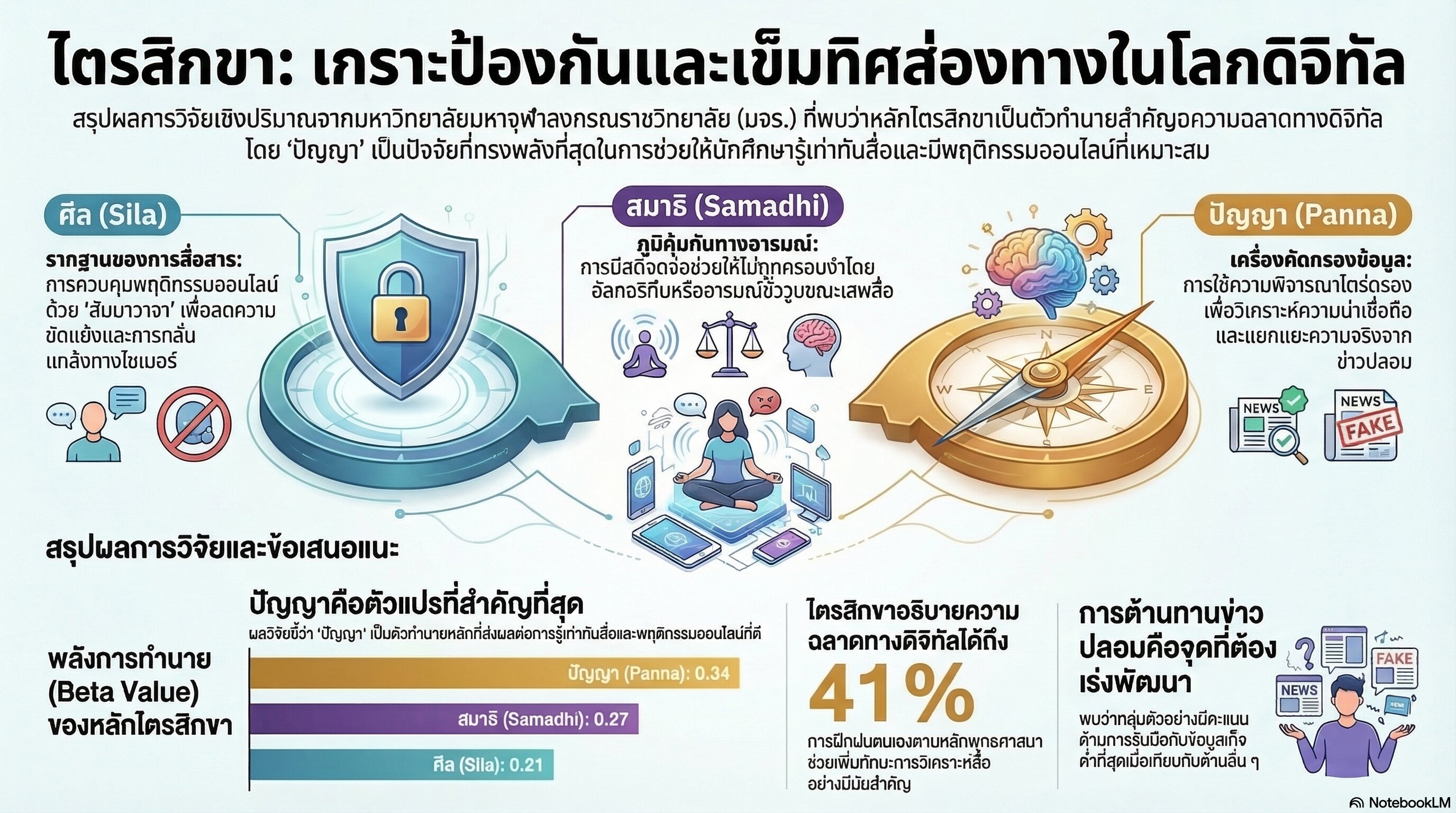
This study investigated the relationships between Buddhist principles (Sila, Samadhi, and Panna), media literacy competency, and positive online traits among Buddhist university students in Thailand. Using a quantitative cross-sectional survey design, data were collected from 359 undergraduate students at Mahachulalongkornrajavidyalaya University (MCU), Khon Kaen Campus. Instruments included validated scales for Buddhist principled living (Trisikkha scale), media literacy (adapted from the NAMLE framework), and positive online traits including respectful communication, online empathy, and resistance to misinformation. Descriptive statistics, Pearson correlation, and multiple linear regression were employed for analysis. Results revealed that all three Buddhist principles significantly and positively correlated with both media literacy (r = .48–.59) and positive online traits (r = .44–.55). Multiple regression analysis indicated that Panna (wisdom discernment) was the strongest predictor of media literacy (Beta = .34, p < .001) and positive online traits (Beta = .33, p < .001), followed by Samadhi (mindfulness concentration) and Sila (moral conduct). The combined model explained 41% of variance in media literacy and 37% in positive online traits. Daily social media usage showed a modest negative association with all study variables. Findings suggest that Buddhist education integrating the Trisikkha framework can effectively cultivate digital citizenship competencies relevant to contemporary media environments.
เอกสารอ้างอิง
Analayo, B. (2020). Mindfulness in early Buddhism: Characteristics and functions. Mindfulness, 11(3), 549–561. https://doi.org/10.1007/s12671-019-01290-x
Aufderheide, P. (1993). Media literacy: A report of the national leadership conference on media literacy. Aspen Institute.
Bahl, S., Milne, G. R., Ross, S. M., Mick, D. G., Grier, S. A., Chugani, S. K., Chan, S. S., Gould, S., Cho, Y. N., Dorsey, J. D., Schindler, R. M., Murdock, M. R., & Boesen-Mariani, S. (2016). Mindfulness: Its transformative potential for consumer, societal, and environmental well-being. Journal of Public Policy & Marketing, 35(2), 198–210.
Bandura, A. (1986). Social foundations of thought and action: A social cognitive theory. Prentice-Hall.
Bhikkhu Bodhi. (2000). The connected discourses of the Buddha: A translation of the Samyutta Nikaya. Wisdom Publications.
Bodhi, B. (2011). What does mindfulness really mean? A canonical perspective. Contemporary Buddhism, 12(1), 19–39.
Chen, L., & Li, W. (2020). Self-regulation, social media literacy, and social media use. Social Behavior and Personality: An International Journal, 48(4), 1–12.
Electronic Transactions Development Agency. (2024). Thailand internet user profile 2024. ETDA. https://www.etda.or.th
Hair, J. F., Black, W. C., Babin, B. J., & Anderson, R. E. (2019). Multivariate data analysis (8th ed.). Cengage Learning.
Hobbs, R. (2010). Digital and media literacy: A plan of action. Aspen Institute.
Jenkins, H., Purushotma, R., Weigel, M., Clinton, K., & Robison, A. J. (2009). Confronting the challenges of participatory culture: Media education for the 21st century. MIT Press.
Kongsri, S., & Wongsopa, W. (2022). Media literacy competencies of Thai university students: A multi-dimensional assessment. Journal of Education and Learning, 11(4), 87–98.
Krejcie, R. V., & Morgan, D. W. (1970). Determining sample size for research activities. Educational and Psychological Measurement, 30(3), 607–610.
Lee, Y., & Kim, J. (2022). Ethical self-concept, moral disengagement, and fake news sharing in South Korea. Computers in Human Behavior, 127, 107047.
Long, C. R., & Christian, M. S. (2015). Mindfulness buffers retaliatory responses to injustice: A regulatory approach. Journal of Applied Psychology, 100(5), 1409–1422.
Mihailidis, P., & Viotty, S. (2017). Spreadable spectacle in digital culture: Civic expression, fake news, and the role of media literacies in post-fact society. American Behavioral Scientist, 61(4), 441–454.
National Association for Media Literacy Education. (2021). Media literacy defined. NAMLE. https://namle.net/resources/media-literacy-defined
Office of the Higher Education Commission. (2022). Higher education standards framework B.E. 2565. Ministry of Higher Education, Science, Research and Innovation.
Piyapan, P., Sukrit, K., & Wongpat, S. (2021). Buddhist values and moral reasoning among Thai Buddhist university students: A structural equation modeling approach. Journal of Moral Education, 50(2), 201–216.
Potter, W. J. (2016). Media literacy (8th ed.). Sage.
Ribble, M. (2015). Digital citizenship in schools: Nine elements all students should know (3rd ed.). International Society for Technology in Education.
Ruangsan, N. (2023). Panna as critical wisdom: Reconceptualizing Buddhist discernment in contemporary educational frameworks. Journal of Buddhist Education and Research, 9(2), 112–128.
Sribuakaew, P., & Treerat, N. (2023). Moral reasoning and misinformation sharing behavior among Thai undergraduate students. Thai Journal of Public Administration, 21(1), 45–60.
Srisuwan, A., Phromchana, N., & Tippawan, C. (2022). Digital literacy of Thai higher education students: Levels, gaps, and educational implications. Kasetsart Journal of Social Sciences, 43(2), 401–408.
Twenge, J. M., Campbell, W. K., & Gentile, B. (2018). Increases in depressive symptoms, suicide-related outcomes, and suicide rates among U.S. adolescents after 2010 and links to increased new media screen time. Clinical Psychological Science, 6(1), 3–17.
Valenzuela, S., Bacallao-Pino, L. M., & Orellana, I. (2018). Selective exposure in social media. In G. Mazzoleni et al. (Eds.), International encyclopedia of political communication (Vol. 3, pp. 1–6). Wiley.
Van Zalk, M. H. W., Branje, S., Denissen, J., Van Aken, M. A. G., & Meeus, W. H. J. (2021). Who benefits from chatting, and why? The roles of extraversion and supportiveness in online chatting. Personality and Social Psychology Bulletin, 37(9), 1202–1215.
ดาวน์โหลด
เผยแพร่แล้ว
รูปแบบการอ้างอิง
ฉบับ
ประเภทบทความ
สัญญาอนุญาต
ลิขสิทธิ์ (c) 2026 Author(s)

อนุญาตภายใต้เงื่อนไข Creative Commons Attribution-NonCommercial-NoDerivatives 4.0 International License.