พฤติกรรมความตั้งใจที่จะเดินทางด้วยอากาศยานซึ่งไม่มีนักบิน: กรณีศึกษาในเขตกรุงเทพมหานครและปริมณฑล
คำสำคัญ:
พฤติกรรมการเดินทาง, การเดินทางด้วยอากาศยานซึ่งไม่มีนักบิน, อากาศยานซึ่งไม่มีนักบินบทคัดย่อ
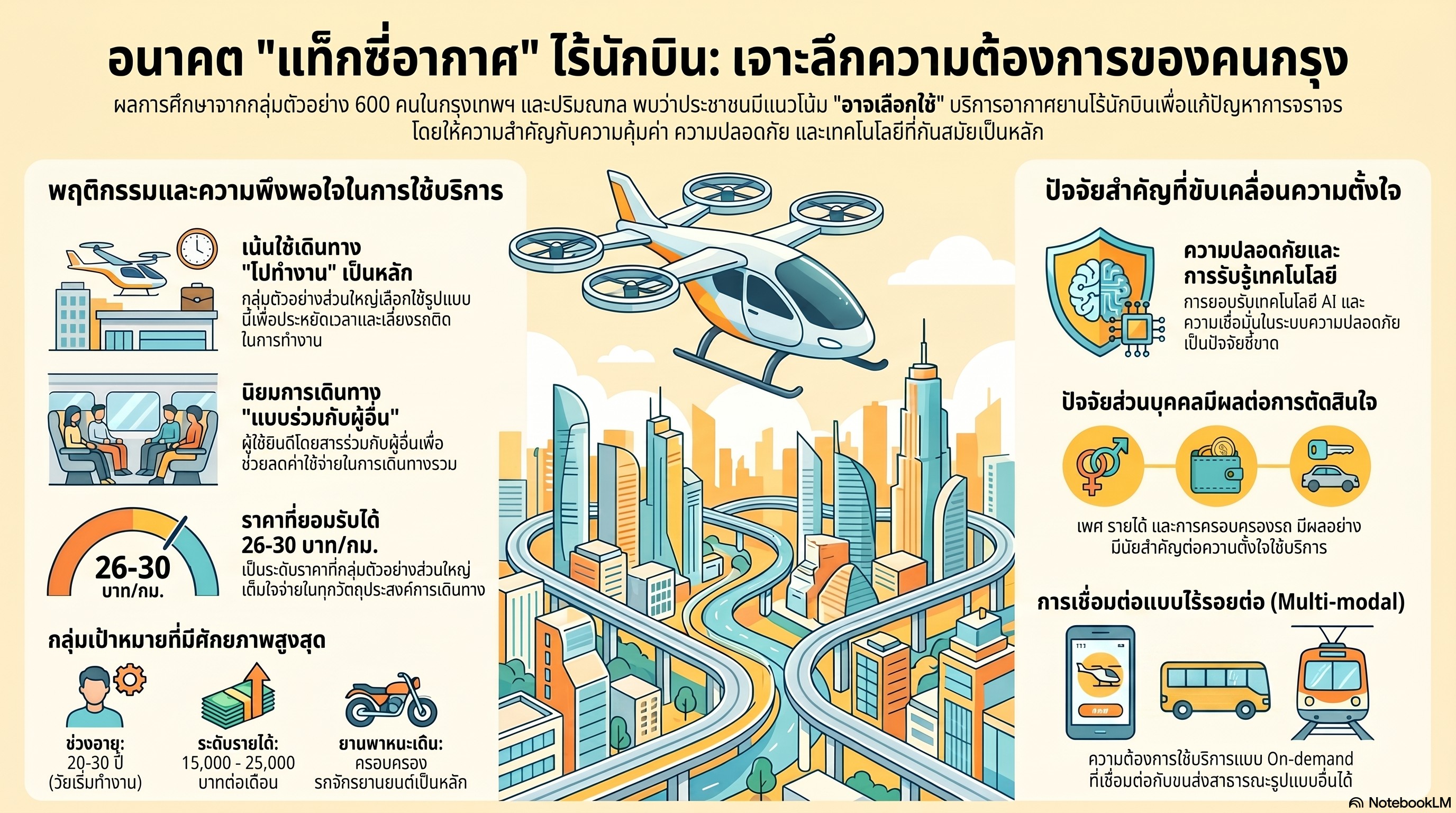
การวิจัยนี้มีวัตถุประสงค์เพื่อศึกษาพฤติกรรมความตั้งใจที่จะเดินทางด้วยอากาศยานซึ่งไม่มีนักบิน ของประชากรในเขตกรุงเทพและปริมณฑล โดยกลุ่มตัวอย่างจำนวน 600 คน ได้มาจากการสุ่มตัวอย่างแบบกลุ่มใช้สถิติเชิงพรรณนาในการวิเคราะห์พฤติกรรมความตั้งใจที่จะเดินทางด้วยอากาศยานซึ่งไม่มีนักบินใน 2 รูปแบบ ได้แก่ การเดินทางไปทำงาน และการเดินทางเพื่อวัตถุประสงค์อื่น ผลการศึกษาพบว่า กลุ่มตัวอย่างส่วนใหญ่มีแนวโน้มเลือกใช้การเดินทางรูปแบบนี้เพื่อไปทำงาน โดยสามารถเดินทางร่วมกับผู้อื่นได้และเต็มใจที่จะจ่ายค่าบริการในราคา 26-30 บาทต่อกิโลเมตรในทุกวัตถุประสงค์ของการเดินทาง เนื่องจากช่วยลดค่าใช้จ่ายในการเดินทาง ผลการเปรียบเทียบความแตกต่างและความสัมพันธ์ระหว่างปัจจัยบุคคลกับพฤติกรรมการเดินทางตามวัตถุประสงค์ของการเดินทางของกลุ่มตัวอย่างส่วนใหญ่ไม่มีความแตกต่างกันและมีความสัมพันธ์กัน อย่างมีนัยสำคัญที่ระดับ .05 ทั้งนี้อาจเนื่องจากมีการรับรู้ในเทคโนโลยีใหม่ ๆ ประโยชน์ที่จะได้รับ ความปลอดภัย ความเต็มใจและพึงพอใจ เพื่อตอบสนองความต้องการและความตั้งใจที่จะเดินทางด้วยอากาศยานซึ่งไม่มีนักบินในอนาคต
เอกสารอ้างอิง
Charoensook, C., Jirathammawat, N., Yuenchon, B., Ratanabutchai, V., & Monthong, S. (2025). Expectations of people in Bangkok regarding using drones for goods delivery. Journal of Buddhist Education and Research (JBER), 11(2), 721–729.
Ahmed, S., Fountas, G., Eker, U., Still, S. E., & Anastasopoulos, P. C. (2021). An exploratory empirical analysis of willingness to hire and pay for flying taxis and shared flying car services. Journal of Air Transport Management, 90, 101963. https://doi.org/10.1016/j.jairtraman.2020.101963
Ajzen, I. (1991). The theory of planned behavior. Organizational Behavior and Human Decision Processes, 50(2), 179–211. https://doi.org/10.1016/0749-5978(91)90020-T
Ajzen, I. (2020). The theory of planned behavior: Frequently asked questions. Human Behavior and Emerging Technologies, 2(4), 314–324. https://doi.org/10.1002/hbe2.195
Anwari, N., Ahmed, M. T., Islam, M. R., Hadiuzzaman, M., & Amin, S. (2021). Exploring the travel behavior changes caused by the COVID-19 crisis: A case study for a developing country. Transportation Research Interdisciplinary Perspectives, 9, 100334. https://doi.org/10.1016/j.trip.2021.100334
Bloom, B. S. (1975). Taxonomy of educational objectives. David McKay.
Das, S., Boruah, A., Banerjee, A., Raoniar, R., Nama, S., & Maurya, A. K. (2021). Impact of COVID-19: A radical modal shift from public to private transport mode. Transport Policy, 109, 1–11. https://doi.org/10.1016/j.tranpol.2021.05.005
Davis, F. D. (1989). Perceived usefulness, perceived ease of use, and user acceptance of information technology. MIS Quarterly, 13(3), 319–340. https://doi.org/10.2307/249008
International Civil Aviation Organization. (2015). Manual on remotely piloted aircraft systems (RPAS) (Doc 10019/AN/507) (1st ed.). ICAO.
Mouratidis, K., Ettema, D., & Næss, P. (2019). Urban form, travel behavior, and travel satisfaction. Transportation Research Part A: Policy and Practice, 129, 306–320. https://doi.org/10.1016/j.tra.2019.09.002
National Aeronautics and Space Administration. (2019). Urban air mobility grand challenge. https://www.nasa.gov/uamgc
Park, S. W. (2021). Social acceptability of urban air mobility by aircraft category and autonomous phases (Doctoral dissertation). KDI School.
Rajendran, S., & Srinivas, S. (2020). Air taxi service for urban mobility: A critical review of recent developments, future challenges, and opportunities. Transportation Research Part E: Logistics and Transportation Review, 143, 102090. https://doi.org/10.1016/j.tre.2020.102090
Rajendran, S., Srinivas, S., & Grimshaw, T. (2021). Predicting demand for air taxi urban aviation services using machine learning algorithms. Journal of Air Transport Management, 92, 102020. https://doi.org/10.1016/j.jairtraman.2021.102020
Rice, S., Winter, S. R., Mehta, R., & Ragbir, N. K. (2019). What factors predict the type of person who is willing to fly in an autonomous commercial airplane? Journal of Air Transport Management, 75, 131–138. https://doi.org/10.1016/j.jairtraman.2018.12.008
Rice, S., Winter, S. R., Capps, J., Trombley, J., Robbins, J., Milner, M. N., & Lamb, T. (2020). The creation of two valid scales: Willingness to fly in an aircraft and willingness to pilot an aircraft. The International Journal of Aviation, Aeronautics, and Aerospace, 7(1), Article 5. https://doi.org/10.15394/ijaaa.2020.1462
Straubinger, A., Verhoef, E. T., & de Groot, H. L. F. (2021). Will urban air mobility fly? The efficiency and distributional impacts of UAM in different urban spatial structures. Transportation Research Part C: Emerging Technologies, 127, 103124. https://doi.org/10.1016/j.trc.2021.103124
Uber Elevate. (2018). Fast-forwarding to the future of on-demand urban air transportation. https://www.uber.com/info/elevate/
Venkatesh, V., Morris, M. G., Davis, G. B., & Davis, F. D. (2003). User acceptance of information technology: Toward a unified view. MIS Quarterly, 27(3), 425–478. https://doi.org/10.2307/30036540
Wickens, C. D., & Hollands, J. G. (2000). Engineering psychology and human performance (3rd ed.). Prentice Hall.
Williams, K., Jenks, M., & Burton, E. (2000). Achieving sustainable urban form. Taylor & Francis.
Winter, S. R., Rice, S., & Lamb, T. L. (2020). A prediction model of consumers’ willingness to fly in autonomous air taxis. Journal of Air Transport Management, 89, 101926. https://doi.org/10.1016/j.jairtraman.2020.101926
Yamane, T. (1967). Statistics: An introductory analysis (2nd ed.). Harper & Row.
Zhang, X., Guan, H., Zhu, H., & Zhu, J. (2019). Analysis of travel mode choice behavior considering the indifference threshold. Sustainability, 11(19), 5495. https://doi.org/10.3390/su11195495
ดาวน์โหลด
เผยแพร่แล้ว
รูปแบบการอ้างอิง
สัญญาอนุญาต
ลิขสิทธิ์ (c) 2026 Journal of Buddhist Education and Research (JBER)

อนุญาตภายใต้เงื่อนไข Creative Commons Attribution-NonCommercial-NoDerivatives 4.0 International License.