The The Effects of an Attention Enhancement Program Using Board Games Based on Constructionism Theory among Lower Secondary School Students
Keywords:
Attention, Board Game, ConstructionismAbstract
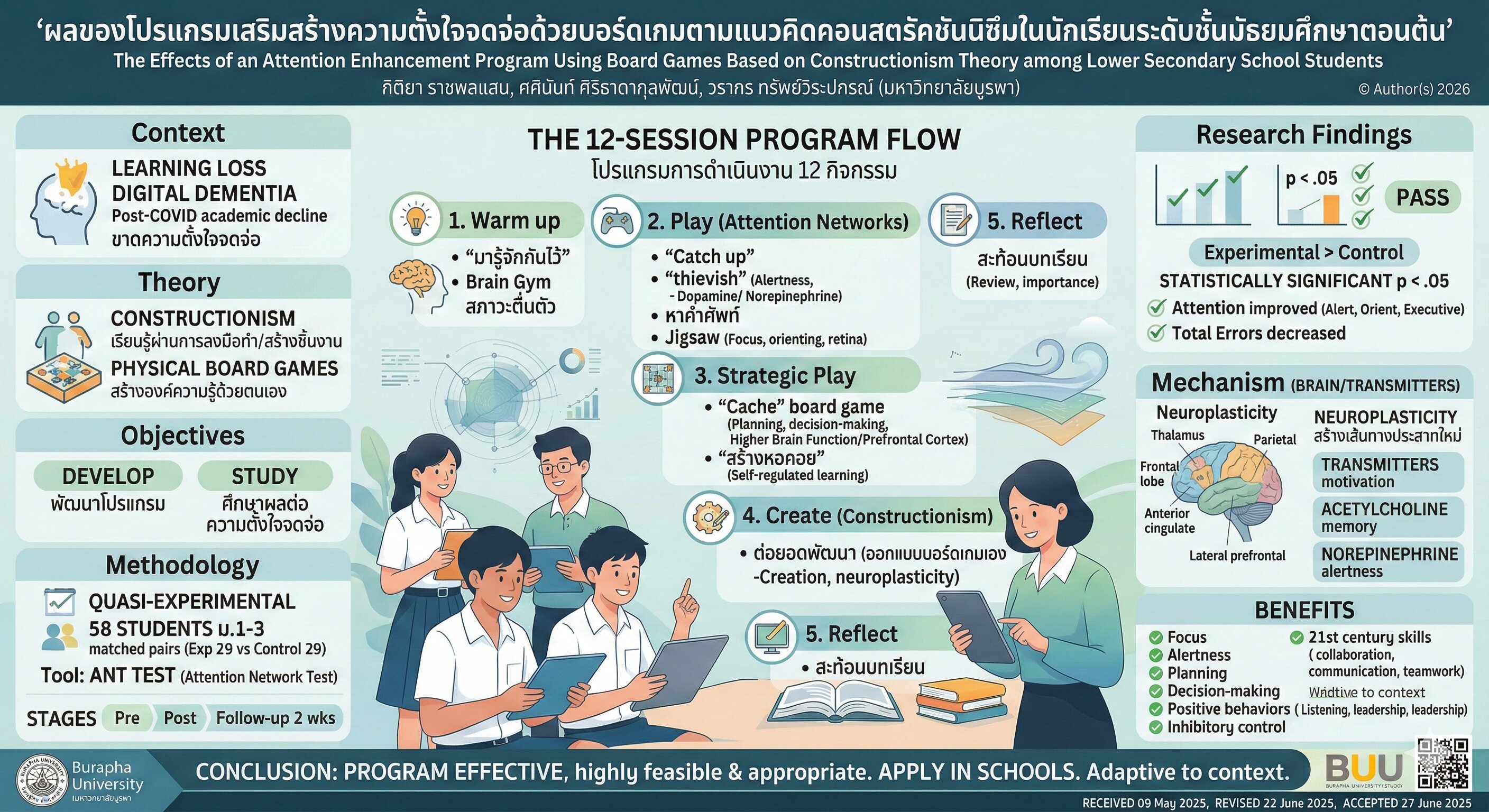
This quasi-experimental study aimed to examine the effectiveness of a board game-based learning program grounded in constructionism theory in enhancing attention among lower secondary school students. The participants were 58 students enrolled in the 2024 academic year, equally divided into experimental and control groups. They were selected through matched-pair sampling based on low scores on the Attention Network Test (ANT), which was used to measure their level of attention at three time points: before the intervention, after the intervention, and two weeks post-intervention. The experimental group received a 12-session intervention over four weeks, with three 90-minute sessions per week, while the control group received no intervention. Data was analyzed using repeated-measures ANOVA with one between-subjects factor and one within-subjects factor. Bonferroni pairwise comparisons were used to examine significant differences. The findings revealed that: 1) students in the experimental group demonstrated significantly higher attention scores than those in the control group (p < .05); 2) the differences remained statistically significant at follow-up; 3) post-intervention scores within the experimental group were significantly higher than pre-intervention scores; and 4) follow-up scores were also significantly higher than baseline scores (p < .05). These results suggest that a board game-based instructional approach aligned with constructionism may be beneficial in promoting attention among lower secondary school students. students.
References
ชลมาศ คูหารัตนากร. (2560). บอร์ดเกมกับการพัฒนาทักษะสมอง. เข้าถึงได้จากhttps://web.facebook.com/PlayAcademyTH/posts/1288519341203435:0?_rdc=1&_rdr
ดุสิต โพธิ์พันธุ์. (2559). การเพิ่มความใส่ใจของนักเรียนจ่านาวิกโยธิน โดยใช้โปรแกรมคอมพิวเตอร์ฝึกการเคลื่อนไหวของตาแบบติดตามวัตถุ: การศึกษาศักย์ไฟฟ้าสมองสัมพันธ์กับเหตุการณ์. วิทยานิพนธ์ศึกษาศาสตรดุษฎีบัณฑิต. วิทยาลัยวิทยาการวิจัยและวิทยาการปัญญา มหาวิทยาลัยบูรพา.
ทศพร สร้างนานอก. (2561). การพัฒนาเกมเสริมสร้างความตั้งใจจดจ่อในนักเรียนชั้นประถมศึกษา. วารสารพยาบาลทหารบก, 21(1).
นภวรรณ อุบลธรรม และคณะ. (2562). ผลของโปรแกรมสมอง จิตใจ และการเรียนรู้เพื่อเสริมสร้างความตั้งใจจดจ่อในนักเรียนชั้นประถมศึกษา. วารสารการวัดผลการศึกษา มหาวิทยาลัยมหาสารคาม, 25(2).
ภัทรธิดา ไทยอุส่าห์. (2565). ก้าวต่ออย่างไร เมื่อเด็กไทยเรียนรู้ถดถอยจากการปิดโรงเรียนช่วงโควิด?. เข้าถึงได้จาก https://www.the101.world/kid-for-kids-learning-loss
ปรัชญา แก้วแก่น. (2555). กระบวนการความสนใจและการประยุกต์สำหรับการวิจัยทางวิทยาการปัญญา. วารสารวิทยาการวิจัยและวิทยาการปัญญา, 10(1).
วชรวรรธน์ ปิยะรัตนมงคล. (2563). การประยุกต์ใช้บอร์ดเกมในการฝึกอบรมที่ส่งผลต่อความคิดเชิงระบบและการเรียนรู้ของหัวหน้า. วิทยานิพนธ์ศึกษาศาสตรดุษฎีบัณฑิต. สาขาวิชาการศึกษาตลอดชีวิตและการพัฒนามนุษย์. ภาควิชาการศึกษาตลอดชีวิต บัณฑิตวิทยาลัย มหาวิทยาลัยศิลปากร.
วิลัยภรณ์ ปิยะวงค์. (2562). การออกแบบเกมการเรียนรู้ที่ปรับเปลี่ยนตามความสนใจของผู้เรียนเพื่อเสริมสร้างความยึดมั่นผูกพันในการเรียนเรื่องสถิติ. วิทยานิพนธ์ศึกษาศาสตรมหาบัณฑิต. สาขาวิชาวิทยาการเรียนรู้และนวัตกรรมการศึกษา คณะวิทยาการเรียนรู้และศึกษาศาสตร์ มหาวิทยาลัยธรรมศาสตร์.
ปราง เกียรติสูงส่ง. (2566). การพัฒนาการตระหนักรู้ในตนเองด้วยบอร์ดเกมผ่านกระบวนการคิดเชิงออกแบบในการเรียนรู้. วารสารรัชต์ภาคย์, 17(50)
ศูนย์สมองและระบบประสาท. (2023). ภาวะสมองเสื่อมจากดิจิทัล: หน้าจอและอุปกรณ์ดิจิทัลส่งผลต่อความจำอย่างไร. เข้าถึงได้จาก https://www-neurocenternj-com.translate
สำนักงานกองทุนสนับสนุนการสร้างเสริมสุขภาพ, & สถาบัน RLG. (2561). คู่มือพ่อแม่ พัฒนาทักษะสมอง EF-Executive Functions ตั้งแต่ปฏิสนธิ-3 ปี. เข้าถึงได้จาก https://www.thaihealth.or.th/wp-content/uploads/2020/02/617.pdf
Ameliasari, T., Harun, Himawan, P., Jefri, M., & Hanif, C. (2020). The Effects of MANSA Historical Board Game toward the Students’ Creativity and Learning Outcomes on Historical Subjects. European journl of edcational research, 9(4).
Bahar, T., Werner, S., & Heidi, S. (2016). Gamification in education: a board game approach to knowledge acquisition. Journal of Procedia Computer Science, 99.
Botvinick, M., Carter, C., Braver, T., Barch, D., & Cohen, J. (2001). Conflict monitoring and cognitive control. Journal of Psychological Review, 108(3).
Bouret, S., & Richmond, B. (2015). Sensitivity of locus coeruleus neurons to reward and effort in a monkey model of motivation. Journal of Neuroscience, 35(20).
Charlier, N., & De Fraine, B. (2013). Game-based learning as a vehicle to teach first aid content: A randomized experiment. Journal of School Health, 83.
Christoph, B., Amit, S., York, S., & Roland, K. (2004). WISE 2004 International Workshops, Brisbane, Australia. Proceedings: Springer.
Corey G. (2012). Theory and practice of counseling and psychotherapy (7th ed.). New York: Cengage learning.
Fan, J., McCandliss, B., Sommer, T., Raz, A., & Posner, M. (2002). Testing the efficiency and independence of attentional networks. Journal of Cognitive Neuroscience, 14(3).
Fan, J., Bruce, D., McCandliss, B., Fossclla, J., Flombaum, J., & Posner, M. (2005). The activation of attentional networks. NeuroImage: Elsevir.
Howell, D. (2012). Statistical methods for psychology. Wadsworth: Cengage Learning Press.
Johnson, K., Robertson, I., Barry, E., Mulligan, A., Daibhis, A., Daly, M., Watchorn, A., Gill, M., & Bellgrove, M. (2008). Impaired conflict resolution and alerting in children with ADHD: evidence from the Attention Network Task (ANT). Journal of Child Psychol Psychiatry, 49(12)
Jose, M., Lizbeth, E., & Monica, T. (2020). A BCI video game using neurofeedback improves the attention of children with autism. Journal of Multimodal User Interfaces, 15.
Katsantonis, N. (2025). From Pandemic Legacy to serious games: A systematic review of cooperative board games under the educational perspective. European Journal of Education, 60(1)
Papert, S. (1980). Mindstorms Children, Computers and Powerful Ideas. New York: Basic Books.
Poole, F. J., Clarke Midura, J., Sun, C., & Lam, K. (2019). Exploring the pedagogical affordances of a collaborative board game in a dual language immersion classroom. Foreign Language Annals, 52(3), 504–523.
Posner, M. (1980). Orienting of attention. Quarterly. Journal of Experimental Psychology, 32(1).
Petersen, S., & Posner, M. (2012). The attention system of the human brain: 20 years after. Journal of Annual Review of Neuroscience, 35.
Sescousse, G., Caldú, X., Segura, B., & Dreher, J. (2013). Processing of primary and secondary rewards: A quantitative meta-analysis and review of human functional neuroimaging studies. Journal of Neuroscience & Biobehavioral Reviews, 37(4).
Trilling, B., & Fadel, C. (2009). 21st century skills: Learning for life in our times. Jossey-Bass.
Zimmerman, B. (2002). Becoming a self-regulated learner: An overview. Journal of Theory into Practice, 41(2).
Downloads
Published
How to Cite
Issue
Section
Categories
License
Copyright (c) 2026 Journal of Buddhist Education and Research (JBER)

This work is licensed under a Creative Commons Attribution-NonCommercial-NoDerivatives 4.0 International License.