Guidelines for Prevention and Student Support of Harms on Social Media for Schools under the Secondary Educational Service Area Office
Keywords:
Prevention, Student support, Harms on social media, High schoolAbstract
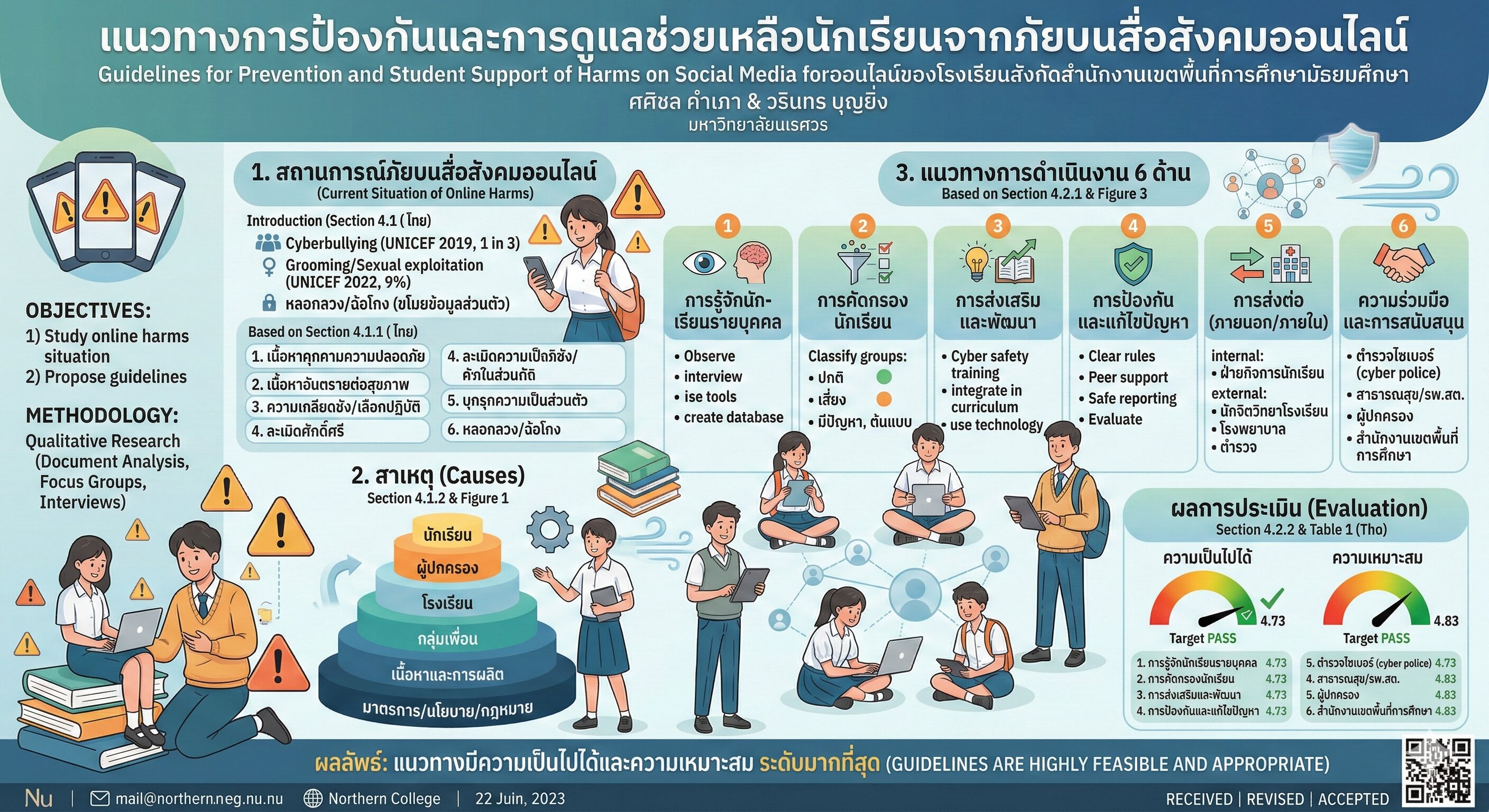
This research aimed to 1) study the situation of online harms faced by students in schools under the Phichit Secondary Educational Service Area Office; and 2) propose guidelines for preventing and assisting students from online harms in these schools. The research used a qualitative research method, divided into two stages: the first stage involved studying the harms on social media faced by students in schools under the Secondary Educational Service Area Office, and the second stage focused on proposing the guidelines for prevention and student support of harms on social media for school under the Secondary Educational Service Area Office. The research findings revealed that the issues of harms on social media faced by students in secondary schools under the Secondary Educational Service Area Office have increased compared to the past. The harms were categorized into threats to personal and community safety, harm to health and well-being, hate and discrimination, violation of dignity, invasion of privacy, and deception and manipulation. The causes of these harms were linked to the students, parents, schools, peer groups, content, content production on social media, as well as policies and laws. The impacts of these harms were felt by students, families, schools, and society. The guidelines for prevention and student support of harms on social media for school under the Secondary Educational Service Area Office consisted of six areas 1) knowing students individually, 2) screening students, 3) promoting and developing, 4) prevention and problem-solving, 5) referral, and 6) cooperation and support from relevant agencies and stakeholders. The evaluation results showed that these guidelines were highly feasible and appropriate for implementation.
References
กองทุนเพื่อความเสมอภาคทางการศึกษา. (2567, 14 พฤศจิกายน). รู้ทันกลโกงมิจจี้ 101: ตีแผ่กลโกงมิจฉาชีพที่คุณครูและผู้ปกครองต้องรู้. https://cct.eef.or.th/posts/tiptricks/cebbeb43-794b-4b6f-9016-341d25c7d085
ธเนศ เกษศิลป์ และ ฑิตฐิตา ธิติธรรมพฤกษ์. (2567). วงจรการกระทำผิดซ้ำ: การศึกษาวิเคราะห์สภาพแวดล้อมที่เอื้อต่อการกระทำผิดซ้ำของเด็กและเยาวชน. วารสารวิชาการอาชญาวิทยาและนิติวิทยาศาสตร์, 10(2), 207–226. https://so02.tcithaijo.org/index.php/forensic/article/view/272179
พระสมุห์ธนภัทร ธนภทฺโท (ทิพย์วงษ์), พระครูวุฒิสาครธรรม (สาคร สาคโร), และไพรัตน์ ฉิมหาด. (2566). ปัญหาและแนวทางบูรณาการการป้องกันปัญหายาเสพติดของเยาวชนในสถานศึกษา. วารสารมหาจุฬานาครทรรศน์, 10(11), 255–268. https://so03.tci-thaijo.org/index.php/JMND/article/view/273898
สำนักงานปลัดกระทรวงศึกษาธิการ. (2567, 14 กันยายน). ข่าว: ศธ. เตือนภัยนักเรียน หลังพบการหลอกลวงทางออนไลน์ แอบอ้างเป็นครูแนะแนวเพื่อขโมยข้อมูลส่วนตัวและทำธุรกรรมทางการเงิน. https://moe360.blog/2024/09/14/moe-cyber-crime/
Allen, B., and Waterman, H. (2024, April 29). Healthy Children: Stages of Adolescence. American Academy of Pediatrics. https://www.healthychildren.org/English/ages-stages/teen/Pages/Stages-of-Adolescence.aspx
Amankwa, E. (2021) Relevance of Cybersecurity Education at Pedagogy Levels in Schools. Journal of Information Security, 12, 233-249. doi: 10.4236/jis.2021.124013.
Bandura, A. (1971). Social Learning Theory. General Learning Press.
Boer, M., Stevens, G. W. J. M., Finkenauer, C., de Looze, M. E., and van den Eijnden, R. J. J. M. (2021). Social media use intensity, social media use problems, and mental health among adolescents: Investigating directionality and mediating processes. Computers in Human Behavior, 116, 106645. https://doi.org/10.1016/j.chb.2020.106645
Bronfenbrenner, U. (1979). The ecology of human development: Experiments by nature and design. Harvard University Press.
Campbell, M., Edwards, E. J., Pennell, D., Poed, S., Lister, V., Gillett-Swan, J., Kelly, A., Zec, D., and Nguyen, T.-A. (2024). Evidence for and against banning mobile phones in schools: A scoping review. Journal of Psychologists and Counsellors in Schools, 34(3), 242-265. https://doi.org/10.1177/20556365241270394
Cayli, B. (2024). Why temporality matters in collective resistance: Shifting civic norms in a post‐traumatic society. Sociological Forum, 39(2), 201–215. https://doi.org/10.1111/socf.12992
Celik, I., Muukkonen, H., and Dogan, S. (2021). A model for understanding new media literacy: Epistemological beliefs and social media use. Library & Information Science Research, 43(4), 101125. https://doi.org/10.1016/j.lisr.2021.101125
Christenson, S. L. (2004). The Family-School Partnership: An Opportunity to Promote the Learning Competence of All Students. School Psychology Review, 33(1 SPEC ISS.), 83-104. https://doi.org/10.1080/02796015.2004.12086233
El-Asam, A., Katz, A., Street, C., Nazar, N. M., and Livanou, M. (2021). Children’s services for the digital age: A qualitative study into current procedures and online risks among service users. Children and Youth Services Review, 122, 105872. https://doi.org/10.1016/j.childyouth.2020.105872
Giumetti, G. W., and Kowalski, R. M. (2022). Cyberbullying via social media and well-being. Current Opinion in Psychology, 45, 101314. https://doi.org/10.1016/j.copsyc.2022.101314
Griffin, R. (2022). New school speech regulation as a regulatory strategy against hate speech on social media: The case of Germany's NetzDG. Telecommunications Policy, 46(9), 102411. https://doi.org/10.1016/j.telpol.2022.102411
Hammer, M., Scheiter, K., and Stürmer, K. (2021). New technology, new role of parents: How parents' beliefs and behavior affect students’ digital media self-efficacy. Computers in Human Behavior, 116, 106642. https://doi.org/10.1016/j.chb.2020.106642
Hoover, S., and Bostic, J. (2021). Schools As a Vital Component of the Child and Adolescent Mental Health System. Psychiatric Services, 72(1), 37–48. https://doi.org/10.1176/appi.ps.201900575
Jamatia, P. L., and Gurumoorthy, R. (2024). The impact of unemployment on drug addiction in Tripura: An empirical investigation. Indian Journal of Natural Sciences, 15(84), https://www.researchgate.net.
Khan, S. A., and Khan, R. K. (2023). The Impact of Social Media Usage on Psychological Wellbeing, Mental Health, Social Capital, Social Isolation, and Family Relationships: A Quantitative Analysis. International Journal of Management Perspective And Social Research (IJMPSR), 2(1), 68–90. https://ijmpsr.salmaedusociety.com/index.php/ijmpsr/article/view/11/10
Lee, H.-C., and Fung, J. (2022). Associations between work–family conflict, psychological distress, and well-being among Taiwanese clergy. Journal of Religion and Health, 51(1), 288–305. https://doi.org/10.1177/00916471221099543
Luo, T., Chen, W., and Liao, Y. (2021). Social media use in China before and during COVID-19: Preliminary results from an online retrospective survey. Journal of Psychiatric Research, 140, 35–38. https://doi.org/10.1016/j.jpsychires.2021.05.057
Marsh, A. D., Newby, H., Storey, S., Yeung, D., Diaz, T., Baltag, V., Banerjee, A., Abduvahobov, P., Adebayo, E., Azzopardi, P. S., Ba, M. G., Bose, K., Cardona, M., Carvajal-Velez, L., Dastgiri, S., Fagan, L., Ferguson, B. J., Friedman, H. S., Hagell, A., Inchley, J., … Guthold, R. (2024). Indicators to Measure Adolescent Health at the Country, Regional, and Global Levels: Results of a Five-Year Selection Process by the Global Action for the Measurement of Adolescent Health. The Journal of adolescent health : official publication of the Society for Adolescent Medicine, 74(6), S31–S46. https://doi.org/10.1016/j.jadohealth.2024.02.010
Martín-Criado, J. M., Casas, J. A., and Ortega-Ruiz, R. (2021). Parental Supervision: Predictive Variables of Positive Involvement in Cyberbullying Prevention. International journal of environmental research and public health, 18(4), 1562. https://doi.org/10.3390/ijerph18041562
Matthes, J., Thomas, M. F., Stevic, A., and Schmuck, D. (2021). Fighting over smartphones? Parents' excessive smartphone use, lack of control over children's use, and conflict. Computers in Human Behavior, 116, 106618. https://doi.org/10.1016/j.chb.2020.106618
Midgett, A., Doumas, D. M., Myers, V. H., Moody, S., and Doud, A. (2021). Technology-Based Bullying Intervention for Rural Schools: Perspectives on Needs, Challenges, and Design. Rural mental health, 45(1), 14–30. https://doi.org/10.1037/rmh0000151
Paakkari, L., Tynjälä, J., Lahti, H., Ojala, K., and Lyyra, N. (2021). Problematic Social Media Use and Health among Adolescents. International Journal of Environmental Research and Public Health, 18(4), 1885. 1 https://doi.org/10.3390/ijerph18041885
Patton, D. U., Hong, J. S., Ranney, M., Patel, S., Kelley, C., Eschmann, R., and Washington, T. (2014). Social media as a vector for youth violence: A review of the literature. Computers in Human Behavior, 35, 548–553. https://doi.org/10.1016/j.chb.2014.02.043
Rahmatullah, A. S., Mulyasa, E., Syahrani, S., Pongpalilu, F., and Putri, R. E. (2022). Digital era 4.0: The contribution to education and student psychology. Linguistics and Culture Review, 6(S3), 89–107. 1 https://doi.org/10.21744/lingcure.v6nS3.2064
Sciacca, B., Laffan, D. A., O'Higgins Norman, J., and Milosevic, T. (2022). Parental mediation in pandemic: Predictors and relationship with children's digital skills and time spent online in Ireland. Computers in Human Behavior, 127, 107081. https://doi.org/10.1016/j.chb.2021.107081
Sumner, S. A., Ferguson, B., Bason, B., Dink, J., Yard, E., Hertz, M., Hilkert, B., Holland, K., Mercado-Crespo, M., Tang, S., and Jones, C. M. (2021). Association of Online Risk Factors With Subsequent Youth Suicide-Related Behaviors in the US. JAMA network open, 4(9), e2125860. https://doi.org/10.1001/jamanetworkopen.2021.25860
Throuvala, M. A., Griffiths, M. D., Rennoldson, M., and Kuss, D. J. (2021). Parental perceptions of intervention needs within schools to prevent problematic adolescent online use: A thematic analysis. International Journal of Environmental Research and Public Health, 18(9), 4522. https://doi.org/10.3390/ijerph18094522
Tin Tin, T., Wai Jian, K., Yu Kang, L., Kai Xiang, K., Zeng Ye, K. C., Aitizaz, A., Almaiah, M. A., Eaganathan, U., and Husin, W. N. A. (2024). Covariates of job opportunities and its impacts on crime among young adults. Pakistan Journal of Life and Social Sciences, 22(2), 12374–12392. https://doi.org/10.57239/PJLSS-2024-22.2.000885
UNICEF. (2019, September 3). UNICEF poll: More than a third of young people in 30 countries report being a victim of online bullying. https://www.unicef.org/press-releases/unicef-poll-more-third-young-people-30-countries-report-being-victim-online-bullying
UNICEF. (2022, February 21). Press release: Disrupting Harm Report in Thailand. UNICEF. https://www.unicef.org/thailand/press-releases/disrupting-harm-report-thailand
Vente, T., Daley, M., Killmeyer, E., and Grubb, L. K. (2020). Association of Social Media Use and High-Risk Behaviors in Adolescents: Cross-Sectional Study. JMIR pediatrics and parenting, 3(1), e18043. https://doi.org/10.2196/18043
Walsh, K., Pink, E., Ayling, N., Sondergeld, A., Dallaston, E., Tournas, P., Serry, E., Trotter, S., Spanos, T., and Rogic, N. (2022). Best practice framework for online safety education: Results from a rapid review of the international literature, expert review, and stakeholder consultation. International Journal of Child-Computer Interaction, 33, 1–12. https://doi.org/10.1016/j.ijcci.2022.100474
Wang, Z., and Jiang, S. (2022). Influence of parental neglect on cyberbullying perpetration: Moderated mediation model of smartphone addiction and self-regulation. Health & Social Care in the Community, 30(6), 2372-2382. https://doi.org/10.1111/hsc.13787
We Are Social & Hootsuite. (2024, February 23). Digital 2024: Thailand. https://datareportal.com/reports/digital-2024-thailand
World Economic Forum. (2023). Toolkit for Digital Safety Design Interventions and Innovations: Typology of Online Harms. World Economic Forum.
Wojciechowski, T. (2024). Examining deviant peer association in childhood as a predictor of marijuana use in early adolescence: The mediating role of dual systems model constructs. International Journal of Mental Health and Addiction. Advance online publication. https://doi.org/10.1007/s11469-024-01424-8
Downloads
Published
How to Cite
Issue
Section
Categories
License
Copyright (c) 2026 Journal of Buddhist Education and Research (JBER)

This work is licensed under a Creative Commons Attribution-NonCommercial-NoDerivatives 4.0 International License.