The Influence of Parent–Adolescent Attachment and Emotional Regulation Strategies on Aggressive Behavior in Chinese Middle School Students
Keywords:
middle school students, parent-adolescent attachment, emotional regulation strategies, aggressive behaviorAbstract
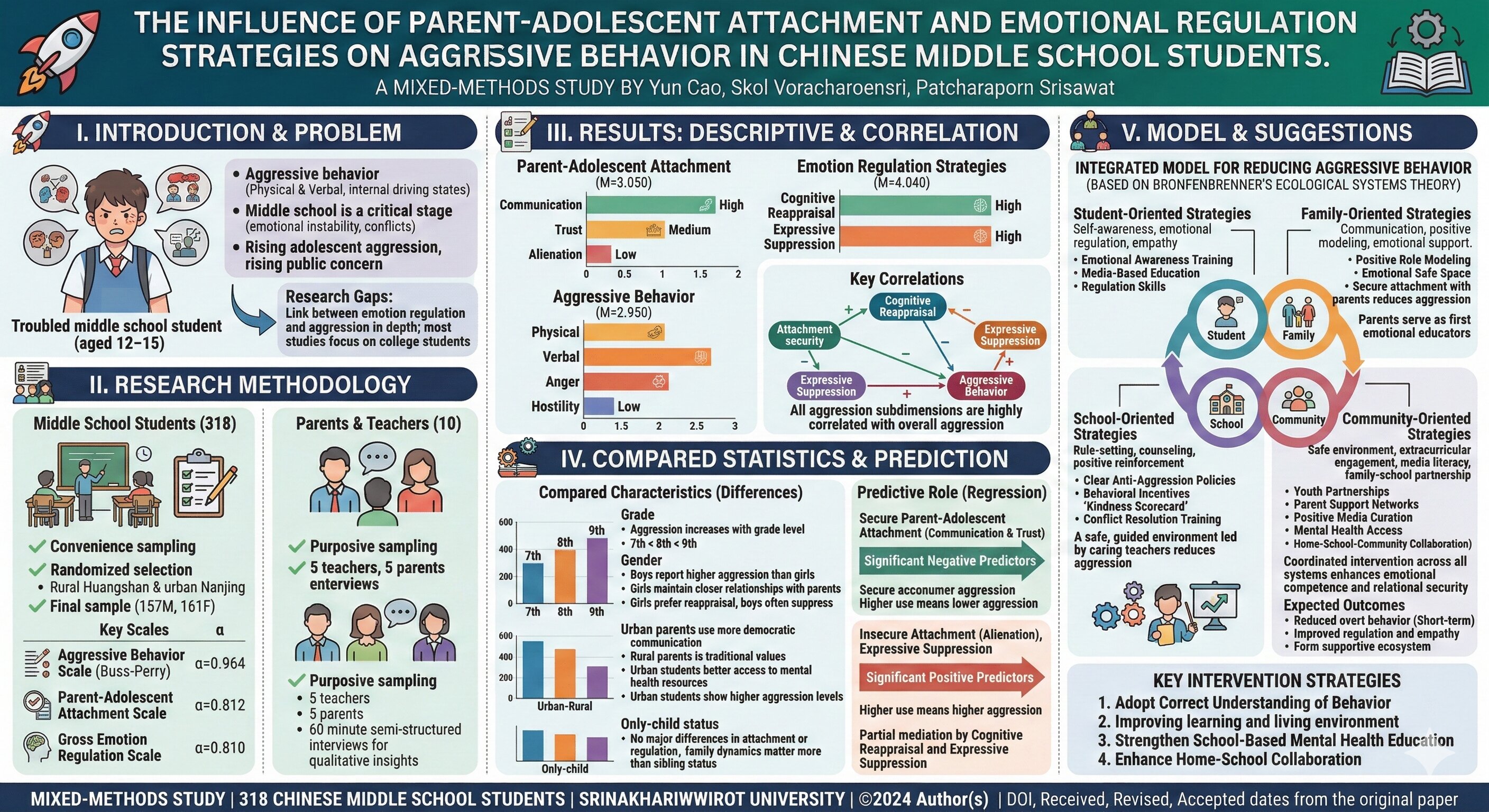
This mixed-methods study examined the relationship between parent-adolescent attachment, emotion regulation, and aggressive behavior among Chinese middle school students. Using convenience sampling, 318 students from the cities of Huangshan and Nanjing were surveyed. Standardized scales measured attachment (α=0.812), emotion regulation (α=0.810), and aggression (α=0.964). Semi-structured interviews were conducted with five parents and five teachers to provide qualitative insights for this study. Results showed that (1) Parent-adolescent attachment and emotion regulation are significantly correlated with aggression; higher attachment and cognitive reappraisal predict lower aggression, while expression suppression predicts higher aggression. (2) Attachment and emotion regulation are significant predictors of aggression. (3) Gender, grade, and region show substantial differences. (4) Interviews highlight home-school cooperation, early intervention, and sustained efforts as key strategies to reduce campus aggression and build a harmonious environment.
References
Allen, J. P., & Land, D. (1999). Attachment in adolescence. https://doi.org/record/1999-02469-015
Anderson, C. A., & Bushman, B. J. (2002). Human aggression. Annu Rev Psychol, 53(1), 27-51. https://doi.org/10.1146/annurev.psych.53.100901.135231
Archer, J. (2004). Sex differences in aggression in real-world settings: A meta-analytic review. Review of general psychology, 8(4), 291-322. https://doi.org/10.1037/1089-2680.8.4.291
Armsden, G. C., & Greenberg, M. T. (1987). The inventory of parent and peer attachment: Individual differences and their relationship to psychological well-being in adolescence. J Youth Adolesc, 16(5), 427-454. https://doi.org/10.1007/BF02202939
Bronfenbrenner, M. (1996). Macroeconomics (2nd ed.). Houghton Mifflin Company.
Buss, A. H., & Perry, M. (1992). The aggression questionnaire. J Pers Soc Psychol, 63(3), 452-459. https://doi.org/10.1037//0022-3514.63.3.452
Cheng, K. (2017). A study on the relationship between loneliness, class environment, and aggressive behavior among middle school students Hunan Normal University].
Collins, W. A., & Laursen, B. (2004). Changing relationships, changing youth: Interpersonal contexts of adolescent development. The Journal of Early Adolescence, 24(1), 55-62. https://doi.org/10.1177/0272431603260882
Durlak, J. A., Weissberg, R. P., Dymnicki, A. B., Taylor, R. D., & Schellinger, K. B. (2011). The impact of enhancing students’ social and emotional learning: A meta‐analysis of school‐based universal interventions. Child development, 82(1), 405-432. https://doi.org/10.1111/j.1467-8624.2010.01564.x
Falbo, T., & Poston Jr, D. L. (1993). The academic, personality, and physical outcomes of only children in China. Child development, 64(1), 18-35. https://doi.org/10.1111/j.1467-8624.1993.tb02893.x
Furman, W., & Buhrmester, D. (1992). Age and sex differences in perceptions of networks of personal relationships. Child development, 63(1), 103-115. https://doi.org/10.1111/j.1467-8624.1992.tb03599.x
Gross, J. J. (1998). The Emerging Field of Emotion Regulation: An Integrative Review. Review of general psychology, 2(3), 271-299. https://doi.org/10.1037/1089-2680.2.3.271
Gross, J. J., & John, O. P. (2003). Individual differences in two emotion regulation processes: implications for affect, relationships, and well-being. J Pers Soc Psychol, 85(2), 348-362. https://doi.org/10.1037/0022-3514.85.2.348
Li, D. Y., Wang, D. X., & Li, D. (2019). Analysis of Aggressive Behavior and Influencing Factors among Middle School Students in Macau, China. Chinese Journal of School Health, 40(11), 1682-1685.
Li, H. L., & Song, Y. W. (2004). New progress in intervention research on adolescent aggressive behavior. psychological science, 27(4), 1005-1009.
Li, K., Waters, T. E. A., & Bosmans, G. (2025). Late Adolescents' Early Maladaptive Schemas: Are They Longitudinally Linked with Middle Childhood Temperament Over and Above Attachment?.Res Child Adolesc Psychopathol, 53(1), 101-112. https://doi.org/10.1007/s10802-024-01256-z
Liu, J., & Meng, H. M. (2009). About Bronfenbrenner's Ecological Systems Theory of Developmental Psychology. Chinese Journal of Health Psychology, 17(2), 250-252.
Liu, J. R. (2006). A follow-up study on aggressive behavior of school-age children. Chinese school health, 27(1), 53-54.
Liu, Y. W., & Wang, G. P. (2012). Review and exploration of intervention research on aggressive behavior among primary and secondary school students. Journal of Hebei Normal University: Education Science Edition, 14(3), 92-96.
Pascuzzo, K., Cyr, C., & Moss, E. (2013). Longitudinal association between adolescent attachment, adult romantic attachment, and emotion regulation strategies. Attachment & human development, 15(1), 83-103. https://doi.org/10.1080/14616734.2013.745713
Ren, J. (2009). A Study on the Relationship between Life Satisfaction and Mental Health of Vocational High School Students. Education Guide (First Half)(6), 20-23.
Roberton, T., Daffern, M., & Bucks, R. S. (2012). Emotion regulation and aggression. Aggression and violent behavior, 17(1), 72-82. https://doi.org/10.1016/j.avb.2011.09.006
Steinberg, L. (2001). We know some things: Parent–adolescent relationships in retrospect and prospect. Journal of research on adolescence, 11(1), 1-19. https://doi.org/10.1111/1532-7795.00001
Wu, C. X., Zhang, Y. M., & Yu, Y. Z. (2018). The aggressive behavior and influencing factors of left behind children in rural schools in China. Chinese Journal of Public Health, 34(7), 977-982.
Yamane, T. (1973). Statistics: An introductory analysis.
Yang, J. P. (2020). Childhood maltreatment and bullying perpetration among Chinese adolescents: A moderated mediation model of moral disengagement and trait anger. Child Abuse & Neglect, 106, 104507. https://doi.org/10.1016/j.chiabu.2020.104507
Zhao, F. Q. (2017). Sibling relationships and their relationship to the social development of children and adolescents. Advances in Psychological Science, 25(5), 825. https://doi.org/10.3724/SP.J.1042.2017.00825
Zhu, D. M., Zhu, H. F., & Wang, J. (2019). Current status of research on intervention of aggressive behavior in children and adolescents. Chinese school health(2), 311-313.
Zimmermann, P., & Iwanski, A. (2014). Emotion regulation from early adolescence to emerging adulthood and middle adulthood: Age differences, gender differences, and emotion-specific developmental variations. International journal of behavioral development, 38(2), 182-194. https://doi.org/10.1177/016502541351
Downloads
Published
How to Cite
Issue
Section
Categories
License
Copyright (c) 2026 Journal of Buddhist Education and Research (JBER)

This work is licensed under a Creative Commons Attribution-NonCommercial-NoDerivatives 4.0 International License.