Determinants of Career Goals among Chinese Vocational College Students: Insights from Social Cognitive Career Theory in a Digital Learning Context
Keywords:
Social Cognitive Career Theory, Career Goals, Vocational Education, Digital Learning, Mobile Learning, ChinaAbstract
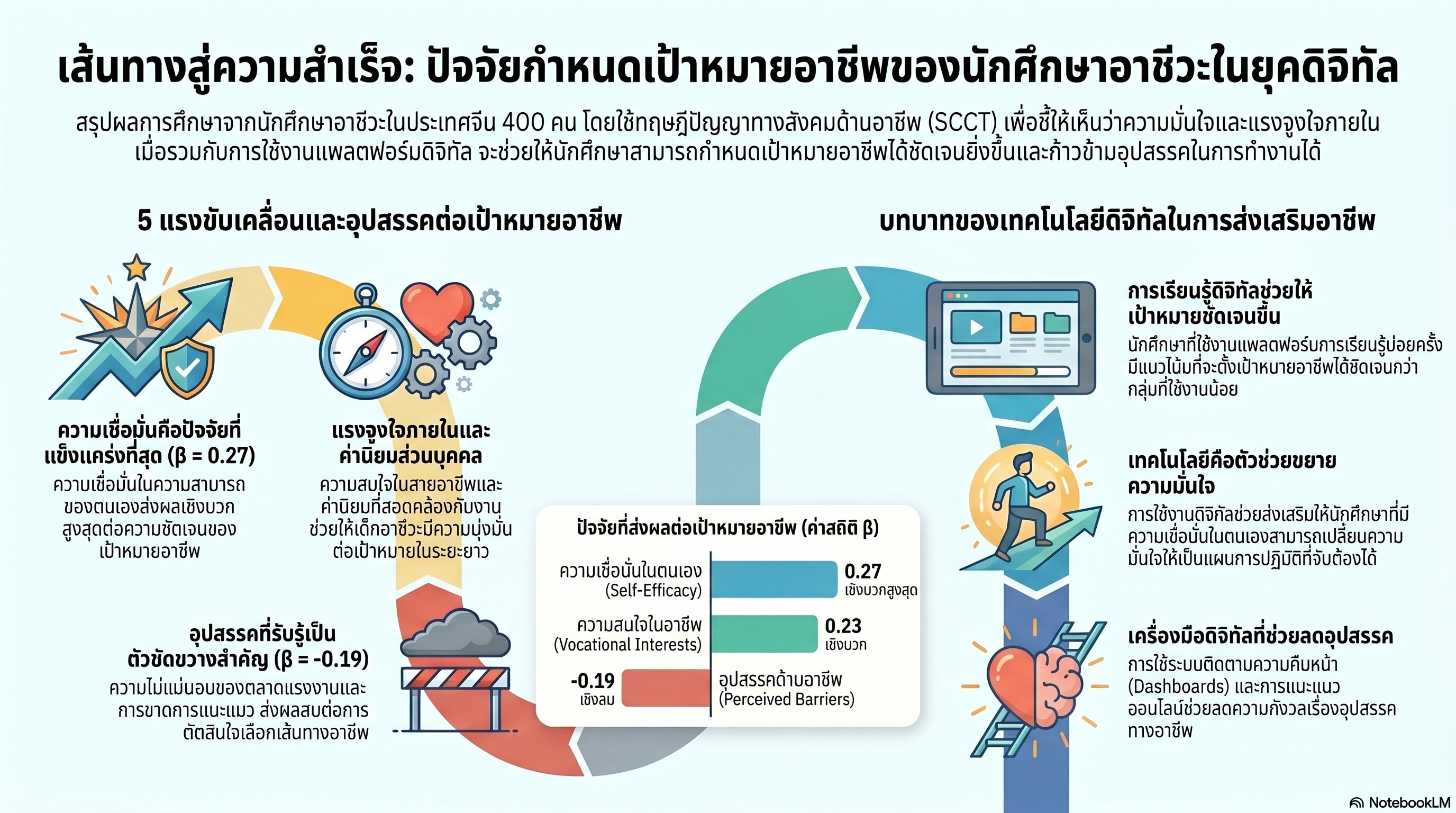
The formation of clear career goals is critical for vocational college students to successfully navigate the transition from education to employment. In the post‑pandemic era, digital learning platforms and blended learning environments have become integral to vocational education in China, offering new opportunities to support students’ professional development. Drawing on Social Cognitive Career Theory (SCCT), this study investigates the determinants of career goals among Chinese vocational college students in a digital learning context. Data were collected from 400 students in a vocational college in Zhejiang Province using a structured questionnaire measuring vocational interests, outcome expectations, career barriers, career self‑efficacy, career values, and career goals. Students’ participation in digital learning activities, including mobile learning platform usage and blended course engagement, was also recorded. Structural equation modeling (SEM) was employed to examine the hypothesized relationships. The results indicate that vocational interests, outcome expectations, career self‑efficacy, and career values positively influence career goals, while career barriers exert a significant negative effect. Students with higher engagement in digital learning platforms demonstrated clearer career goals than those with lower engagement. The SCCT model exhibited good fit indices, confirming its applicability in a technology‑supported vocational education setting. This study contributes to the integration of educational technology and career development theory by revealing how digital learning environments can facilitate career goal formation. Practical implications include leveraging mobile learning platforms and blended courses to enhance students’ career planning and goal‑setting processes.
References
Betz, N. E., & Taylor, K. M. (2012). Career decision self-efficacy scale – Short form (CDSE-SF). Journal of Career Assessment, 20(3), 370–381. https://doi.org/10.1016/j.jvb.2012.12.001
Cao, H.-Q., & Han, J. (2024). Feedback perception and online learning engagement in Chinese vocational colleges: The mediating role of academic self-efficacy. Frontiers in Psychology, 15, Article 1326746. https://doi.org/10.3389/fpsyg.2024.1326746
Cheung, R., Jin, Q., Yeung, K. K., Lau, H. L., & Chui, W. H. (2024). Vocational identity statuses among Hong Kong sub-degree students: Pattern identification and relationship to career development and academic performance. Journal of Career Development, 51(6), 639–659. https://doi.org/10.1177/08948453241279937
Domínguez, D. G., Cheng, H.-L., & De La Rue, L. (2022). Career barriers and coping efficacy with international students in counseling psychology programs. The Counseling Psychologist, 50(6), 780–812. https://doi.org/10.1177/00110000221097358
Hu, L. T., & Bentler, P. M. (1999). Cutoff criteria for fit indexes in covariance structure analysis: Conventional criteria versus new alternatives. Structural Equation Modeling, 6(1), 1–55. https://doi.org/10.1080/10705519909540118
Jiang, X., & Zhang, L. (2012). Using social cognitive career theory to predict the academic interests and goals of Chinese vocational students. Journal of Vocational Behavior, 80(2), 222–231. https://doi.org/10.1016/j.jvb.2011.09.002
Kline, R. B. (2023). Principles and practice of structural equation modeling (5th ed.). Guilford Press.
Lent, R. W., Brown, S. D., & Hackett, G. (1994). Toward a unifying social cognitive theory of career and academic interest, choice, and performance. Journal of Vocational Behavior, 45(1), 79–122.
Lent, R. W., & Brown, S. D. (2013). Social cognitive model of career self-management: Toward a unifying view of adaptive career behavior across the life span. Journal of Counseling Psychology, 60(4), 557–568. https://doi.org/10.1037/a0033446
Shang, W., Li, L., & Chen, J. (2022). How career calling influences preservice teachers’ learning engagement: The mediating role of occupational self-efficacy and outcome expectations. Frontiers in Psychology, 13, Article 874895. https://doi.org/10.3389/fpsyg.2022.874895
Uzorka, A., & Odebiyi, O. A. (2025). Impact of digital learning tools on student engagement and achievement. Journal of Digital Learning and Distance Education, 4(1), Article 511. https://doi.org/10.56778/jdlde.v4i1.511
Wang, X.-H., Wang, H.-P., & Wen, L. (2023). Improving the quality of career decision-making of students in Chinese higher vocational colleges: A model based on SCCT. SAGE Open, 13(2), 1–15. https://doi.org/10.1177/21582440231180105
Xu, J., Jiang, T., & Wei, M. (2024). The digital transformation of vocational education: Experience and reflections of Shenzhen Polytechnic University. Vocational and Technical Education Journal, 1(2), 1–18. https://doi.org/10.54844/vte.2024.0800
Zhang, X., Qian, W., & Chen, C. (2024). The effect of digital technology usage on higher vocational student satisfaction: The mediating role of learning experience and learning engagement. Frontiers in Education, 9, Article 1508119. https://doi.org/10.3389/feduc.2024.1508119
Downloads
Published
How to Cite
Issue
Section
Categories
License
Copyright (c) 2026 Journal of Buddhist Education and Research (JBER)

This work is licensed under a Creative Commons Attribution-NonCommercial-NoDerivatives 4.0 International License.