Professional Teachers in the Digital Age
Abstract
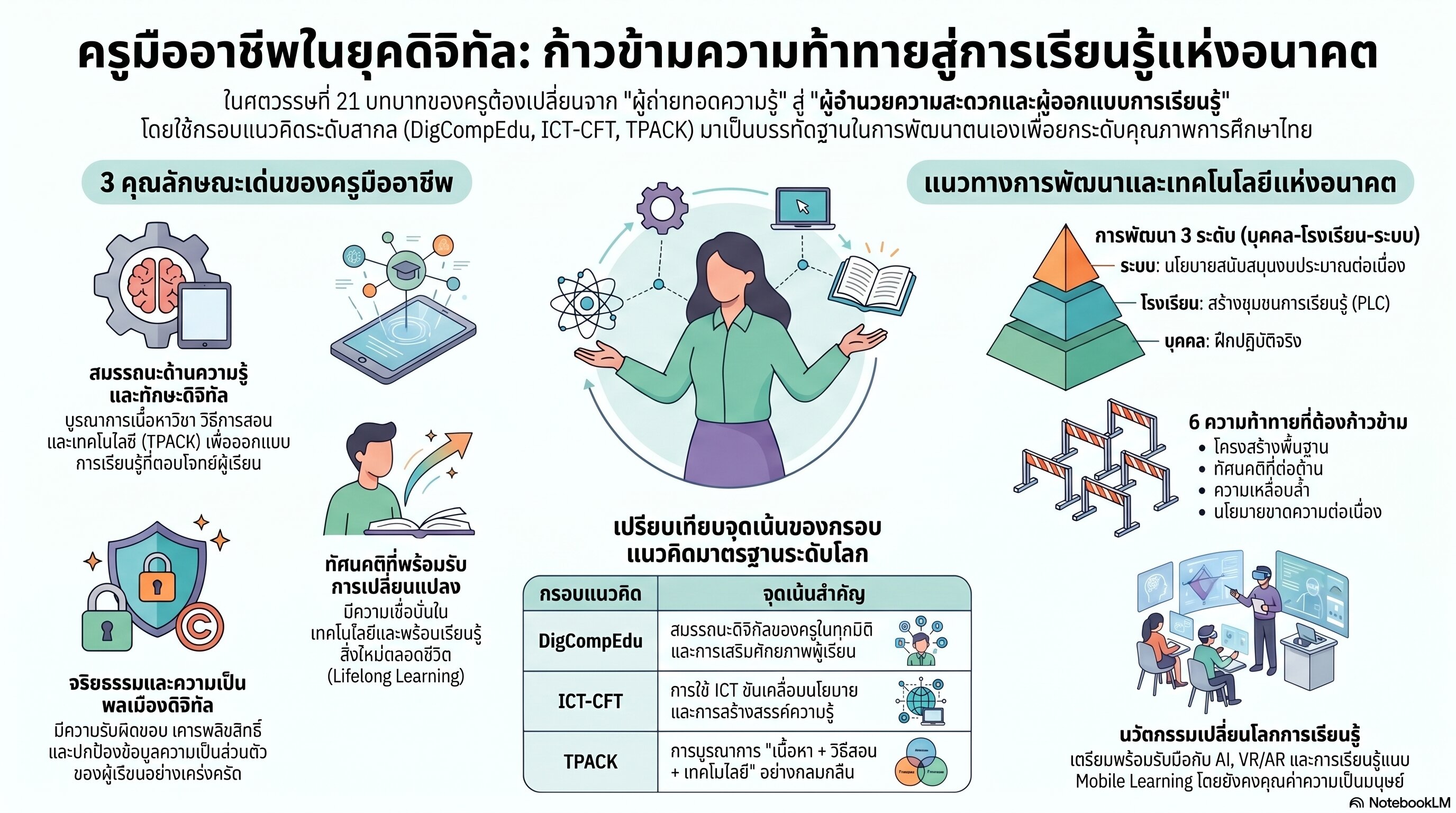
The 21st-century digital revolution has radically altered educational paradigms and the function of teachers. Teachers must transition from just carriers of knowledge to facilitators, learning architects, and sources of inspiration. This article examines the notion of professional educators in the digital age utilizing the frameworks of DigCompEdu (Digital Competence of Educators), ICT-CFT (ICT Competency Framework for Teachers), and TPACK (Technological, Pedagogical, and Content Knowledge), emphasizing that professional teachers must exhibit attributes across 4 dimensions: (1) technological knowledge and skills, digital learning design, and digital assessment; (2) attitudes and beliefs that embrace change; (3) ethics and responsibility as digital citizens; and (4) ongoing self-development. The study identifies 5 principal challenges: inadequate infrastructure, insufficient systematic professional development, resistance in mindset and attitudes toward change, educational inequity, and inconsistent policies. Confronting these challenges necessitates interventions at three tiers: personal advancement via experiential training and continuous education; organizational enhancement through professional learning networks and mentorship frameworks; and systemic improvement through enabling policies and adequate resource distribution. In the future, professional teachers must be equipped to interact with developing technologies like artificial intelligence, virtual reality, and mobile learning while preserving a balance between technological advancement and human values. The findings indicate that fostering professional educators in the digital age requires collaboration among multiple stakeholders, strategic long-term planning, and the establishment of a sustainable learning culture to improve the quality of Thai education in light of the changing digital environment.
References
กระทรวงศึกษาธิการ. (2563). แผนยุทธศาสตร์กระทรวงศึกษาธิการ พ.ศ. 2563–2565. กระทรวงศึกษาธิการ.
สำนักงานสถิติแห่งชาติ. (2564). สรุปข้อมูลสถิติที่สำคัญ พ.ศ. 2564. สำนักงานสถิติแห่งชาติ.
วิจารณ์ พานิช. (2565). หลักสูตรการศึกษาขั้นพื้นฐาน: พัฒนาการเรียนรู้ฐานสมรรถนะทำได้ไม่ยาก. CBE Thailand. CBE Thailand
Adelabu, F., Ngwabe, A., & Alex, J. (2021). Self-directed learning through computer-aided mathematics instruction: First-year teacher education experience. International Journal of Higher Education, 11(3), 79–90. https://doi.org/10.5430/ijhe.v11n3p79
Admiraal, W., Schenke, W., De Jong, L., Emmelot, Y., & Sligte, H. (2019). Schools as professional learning communities: What can schools do to support professional development of their teachers? Professional Development in Education, 47(5), 684–698. https://doi.org/10.1080/19415257.2019.1665573
Ally, M. (2019). Competency profile of the digital and online teacher in future education. The International Review of Research in Open and Distributed Learning, 20(2), 302–318. https://doi.org/10.19173/irrodl.v20i2.4206
Anis, M. (2024). Teacher professional development in the digital age: Addressing the evolving needs post-COVID. International Journal for Multidisciplinary Research, 6(1), 145–157. https://doi.org/10.36948/ijfmr.2024.v06i01.12386
Artacho, E., Martínez, T., Martín, J., Marín, J., & García, G. (2020). Teacher training in lifelong learning: The importance of digital competence in the encouragement of teaching innovation. Sustainability, 12(7), 2852. https://doi.org/10.3390/su12072852
Biswas, S., Benabentos, R., Brewe, E., Potvin, G., Edward, J., Kravec, M., & Kramer, L. (2022). Institutionalizing evidence-based STEM reform through faculty professional development and support structures. International Journal of STEM Education, 9(1), 56. https://doi.org/10.1186/s40594-022-00357-9
Chaipidech, P., Srisawasdi, N., Kajonmanee, T., & Chaipah, K. (2022). A personalized learning system-supported professional training model for teachers' TPACK development. Computers and Education: Artificial Intelligence, 3, 100064. https://doi.org/10.1016/j.caeai.2022.100064
Darling-Hammond, L., Flook, L., Cook-Harvey, C., Barron, B., & Osher, D. (2020). Implications for educational practice of the science of learning and development. Applied Developmental Science, 24(2), 97–140. https://doi.org/10.1080/10888691.2018.1537791
Easterbrook, M., & Hadden, I. (2020). Tackling educational inequalities with social psychology: Identities, contexts, and interventions. Social Issues and Policy Review, 14(1), 180–236. https://doi.org/10.1111/sipr.12070
Ertmer, P. A., & Ottenbreit-Leftwich, A. T. (2010). Teacher technology change: How knowledge, confidence, beliefs, and culture intersect. Journal of Research on Technology in Education, 42(3), 255–284. https://doi.org/10.1080/15391523.2010.10782551
Fernández-Batanero, J., Montenegro-Rueda, M., Fernández-Cerero, J., & García-Martínez, I. (2020). Digital competences for teacher professional development: A systematic review. European Journal of Teacher Education, 45(4), 513–531. https://doi.org/10.1080/02619768.2020.1827389
Fernández-Batanero, J., Román-Graván, P., Reyes-Rebollo, M., & Montenegro-Rueda, M. (2021). Impact of educational technology on teacher stress and anxiety: A literature review. International Journal of Environmental Research and Public Health, 18(2), 548. https://doi.org/10.3390/ijerph18020548
Fullan, M., & Scott, G. (2014). Education plus: New pedagogies for deep learning whitepaper. Collaborative Impact SPC.
Griffiths, V., Thompson, S., & Hryniewicz, L. (2010). Developing a research profile: Mentoring and support for teacher educators. Professional Development in Education, 36(1–2), 245–262. https://doi.org/10.1080/19415250903457166
Heap, T., Thompson, R., & Fein, A. (2020). Designing teacher professional development programs to support a rapid shift to digital. Educational Technology Research and Development, 69(1), 35–38. https://doi.org/10.1007/s11423-020-09863-5
Herlo, D. (2017). Self-directed learning on teacher training studies programs. Journal Plus Education, 18(2), 7–17. https://doi.org/10.24250/JPE/2/2017/DH
McKinsey & Company. (2020). The state of AI in 2020. McKinsey & Company. McKinsey AI Report 2020
Mishra, P., & Koehler, M. J. (2006). Technological pedagogical content knowledge: A framework for teacher knowledge. Teachers College Record, 108(6), 1017–1054. https://doi.org/10.1111/j.1467-9620.2006.00684.x
Nguyễn, L., Kanjug, I., Lowatcharin, G., Manakul, T., Poonpon, K., Sarakorn, W., Somabut, A., Srisawasdi, N., Traiyarach, S., & Tuamsuk, K. (2023). Digital learning ecosystem for classroom teaching in Thailand high schools. SAGE Open, 13(1), 1–15. https://doi.org/10.1177/21582440231158303
OECD. (2021). Education at a glance 2021: OECD indicators. OECD Publishing. https://doi.org/10.1787/b35a14e5-en
Opabola, E., Galasso, C., Rossetto, T., Meilianda, E., Idris, Y., & Nurdin, S. (2023). Investing in disaster preparedness and effective recovery in school physical infrastructures. International Journal of Disaster Risk Reduction, 95, 103623. https://doi.org/10.1016/j.ijdrr.2023.103623
Prokopchuk, M. (2021). Modern trends in teachers’ roles in digital era. In Trends in development of innovative scientific research in the context of global changes (pp. 95–104). https://doi.org/10.30525/978-9934-26-076-6-15
Ramos, J., Cattaneo, A., De Jong, F., & Espadeiro, R. (2021). Pedagogical models for the facilitation of teacher professional development via video-supported collaborative learning: A review of the state of the art. Journal of Research on Technology in Education, 54(5), 695–718. https://doi.org/10.1080/15391523.2021.1911720
Redecker, C., & Punie, Y. (2017). European framework for the digital competence of educators: DigCompEdu. Publications Office of the European Union. https://doi.org/10.2760/178382
Ribble, M. (2015). Digital citizenship in schools: Nine elements all students should know (3rd ed.). International Society for Technology in Education.
Sapohov, M. (2025). Trends in forming digital competence of future teachers in university education. Journal of Modern Educational Research, 2(1), 59–69. https://doi.org/10.31652/3041-1203-2024(2)-59-69
Schwab, K. (2016). The fourth industrial revolution. World Economic Forum.
Shulman, L. S. (1986). Those who understand: Knowledge growth in teaching. Educational Researcher, 15(2), 4–14. https://doi.org/10.3102/0013189X015002004
Starkey, L. (2020). Teacher preparation for the digital age: Is it still an instrumental endeavor? Nordic Journal of Digital Literacy, 15(3), 136–152. https://doi.org/10.18261/ISSN.1891-943X-2020-03-03
Suryawati, E., Syafrinal, S., Harfal, Z., Muhson, A., Dianti, P. R., & Sulaiman, N. A. (2024). Mentor, observe, support, take action (MOST): A model for continuing professional development of teacher leaders. Frontiers in Education, 9, 1352577. https://doi.org/10.3389/feduc.2024.1352577
UNESCO. (2018). UNESCO ICT competency framework for teachers: Version 3. UNESCO. UNESCO ICT Framework for Teachers
UNESCO. (2021). Reimagining our futures together: A new social contract for education. UNESCO Publishing.
World Economic Forum. (2020). The future of jobs report 2020. World Economic Forum.
Zhu, M. (2021). Enhancing MOOC learners’ skills for self-directed learning. Distance Education, 42(4), 441–460. https://doi.org/10.1080/01587919.2021.1956302
Downloads
Published
How to Cite
Issue
Section
Categories
License
Copyright (c) 2026 Journal of Buddhist Education and Research (JBER)

This work is licensed under a Creative Commons Attribution-NonCommercial-NoDerivatives 4.0 International License.