ความเป็นครูมืออาชีพในยุคดิจิทัล
บทคัดย่อ
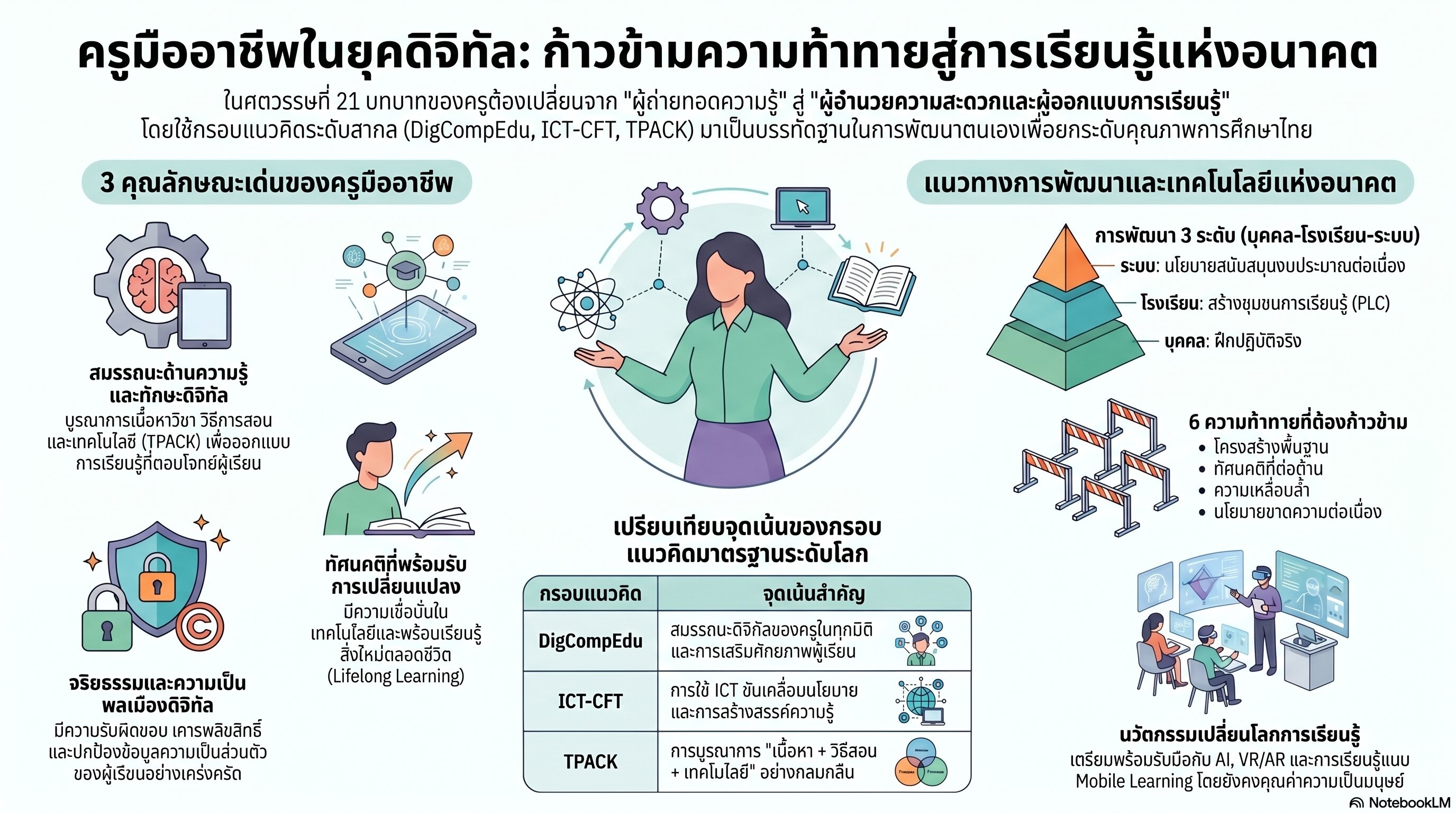
การปฏิวัติดิจิทัลในศตวรรษที่ 21 ได้เปลี่ยนแปลงรูปแบบการเรียนรู้และบทบาทของครูอย่างสิ้นเชิง ครูจึงต้องเปลี่ยนจากผู้ถ่ายทอดความรู้สู่การเป็นผู้อำนวยความสะดวก ผู้ออกแบบการเรียนรู้ และผู้สร้างแรงบันดาลใจ บทความนี้วิเคราะห์ความเป็นครูมืออาชีพในยุคดิจิทัลผ่านกรอบแนวคิด DigCompEdu, ICT-CFT, และ TPACK โดยชี้ให้เห็นว่าครูมืออาชีพต้องมีคุณลักษณะครอบคลุม 4 ด้าน ได้แก่ (1) ความรู้และทักษะด้านเทคโนโลยี การออกแบบการเรียนรู้ดิจิทัล และการประเมินผลแบบดิจิทัล (2) ทัศนคติและความเชื่อที่เปิดกว้างต่อการเปลี่ยนแปลง (3) จริยธรรมและความรับผิดชอบในการเป็นพลเมืองดิจิทัล และ (4) การพัฒนาตนเองอย่างต่อเนื่อง การศึกษาพบความท้าทาย 5 ประการสำคัญ คือ ปัญหาโครงสร้างพื้นฐาน การขาดแคลนการพัฒนาบุคลากรที่เป็นระบบ กระบวนทัศน์และทัศนคติที่ต้านทานการเปลี่ยนแปลง ความเหลื่อมล้ำทางการศึกษา และนโยบายที่ขาดความต่อเนื่อง แนวทางการพัฒนามี 3 ระดับ ได้แก่ การพัฒนาระดับบุคคลผ่านการอบรมเชิงปฏิบัติและการเรียนรู้ตลอดชีวิต การพัฒนาระดับสถานศึกษาด้วยการสร้างชุมชนวิชาชีพและระบบพี่เลี้ยง และการพัฒนาระดับระบบผ่านนโยบายและการจัดสรรทรัพยากรที่เหมาะสม สำหรับอนาคต ครูมืออาชีพต้องเตรียมพร้อมรับมือกับเทคโนโลยีใหม่ เช่น ปัญญาประดิษฐ์ ความเป็นจริงเสมือน และการเรียนรู้แบบเคลื่อนที่ โดยยังคงรักษาสมดุลระหว่างนวัตกรรมดิจิทัลและคุณค่าความเป็นมนุษย์ ผลการศึกษาแสดงให้เห็นว่าการพัฒนาครูมืออาชีพในยุคดิจิทัลต้องอาศัยความร่วมมือจากทุกภาคส่วน มีการวางแผนระยะยาว และมุ่งเน้นการสร้างวัฒนธรรมการเรียนรู้ที่ยั่งยืนเพื่อยกระดับคุณภาพการศึกษาไทยให้ทันต่อการเปลี่ยนแปลงของโลกดิจิทัล
เอกสารอ้างอิง
กระทรวงศึกษาธิการ. (2563). แผนยุทธศาสตร์กระทรวงศึกษาธิการ พ.ศ. 2563–2565. กระทรวงศึกษาธิการ.
สำนักงานสถิติแห่งชาติ. (2564). สรุปข้อมูลสถิติที่สำคัญ พ.ศ. 2564. สำนักงานสถิติแห่งชาติ.
วิจารณ์ พานิช. (2565). หลักสูตรการศึกษาขั้นพื้นฐาน: พัฒนาการเรียนรู้ฐานสมรรถนะทำได้ไม่ยาก. CBE Thailand. CBE Thailand
Adelabu, F., Ngwabe, A., & Alex, J. (2021). Self-directed learning through computer-aided mathematics instruction: First-year teacher education experience. International Journal of Higher Education, 11(3), 79–90. https://doi.org/10.5430/ijhe.v11n3p79
Admiraal, W., Schenke, W., De Jong, L., Emmelot, Y., & Sligte, H. (2019). Schools as professional learning communities: What can schools do to support professional development of their teachers? Professional Development in Education, 47(5), 684–698. https://doi.org/10.1080/19415257.2019.1665573
Ally, M. (2019). Competency profile of the digital and online teacher in future education. The International Review of Research in Open and Distributed Learning, 20(2), 302–318. https://doi.org/10.19173/irrodl.v20i2.4206
Anis, M. (2024). Teacher professional development in the digital age: Addressing the evolving needs post-COVID. International Journal for Multidisciplinary Research, 6(1), 145–157. https://doi.org/10.36948/ijfmr.2024.v06i01.12386
Artacho, E., Martínez, T., Martín, J., Marín, J., & García, G. (2020). Teacher training in lifelong learning: The importance of digital competence in the encouragement of teaching innovation. Sustainability, 12(7), 2852. https://doi.org/10.3390/su12072852
Biswas, S., Benabentos, R., Brewe, E., Potvin, G., Edward, J., Kravec, M., & Kramer, L. (2022). Institutionalizing evidence-based STEM reform through faculty professional development and support structures. International Journal of STEM Education, 9(1), 56. https://doi.org/10.1186/s40594-022-00357-9
Chaipidech, P., Srisawasdi, N., Kajonmanee, T., & Chaipah, K. (2022). A personalized learning system-supported professional training model for teachers' TPACK development. Computers and Education: Artificial Intelligence, 3, 100064. https://doi.org/10.1016/j.caeai.2022.100064
Darling-Hammond, L., Flook, L., Cook-Harvey, C., Barron, B., & Osher, D. (2020). Implications for educational practice of the science of learning and development. Applied Developmental Science, 24(2), 97–140. https://doi.org/10.1080/10888691.2018.1537791
Easterbrook, M., & Hadden, I. (2020). Tackling educational inequalities with social psychology: Identities, contexts, and interventions. Social Issues and Policy Review, 14(1), 180–236. https://doi.org/10.1111/sipr.12070
Ertmer, P. A., & Ottenbreit-Leftwich, A. T. (2010). Teacher technology change: How knowledge, confidence, beliefs, and culture intersect. Journal of Research on Technology in Education, 42(3), 255–284. https://doi.org/10.1080/15391523.2010.10782551
Fernández-Batanero, J., Montenegro-Rueda, M., Fernández-Cerero, J., & García-Martínez, I. (2020). Digital competences for teacher professional development: A systematic review. European Journal of Teacher Education, 45(4), 513–531. https://doi.org/10.1080/02619768.2020.1827389
Fernández-Batanero, J., Román-Graván, P., Reyes-Rebollo, M., & Montenegro-Rueda, M. (2021). Impact of educational technology on teacher stress and anxiety: A literature review. International Journal of Environmental Research and Public Health, 18(2), 548. https://doi.org/10.3390/ijerph18020548
Fullan, M., & Scott, G. (2014). Education plus: New pedagogies for deep learning whitepaper. Collaborative Impact SPC.
Griffiths, V., Thompson, S., & Hryniewicz, L. (2010). Developing a research profile: Mentoring and support for teacher educators. Professional Development in Education, 36(1–2), 245–262. https://doi.org/10.1080/19415250903457166
Heap, T., Thompson, R., & Fein, A. (2020). Designing teacher professional development programs to support a rapid shift to digital. Educational Technology Research and Development, 69(1), 35–38. https://doi.org/10.1007/s11423-020-09863-5
Herlo, D. (2017). Self-directed learning on teacher training studies programs. Journal Plus Education, 18(2), 7–17. https://doi.org/10.24250/JPE/2/2017/DH
McKinsey & Company. (2020). The state of AI in 2020. McKinsey & Company. McKinsey AI Report 2020
Mishra, P., & Koehler, M. J. (2006). Technological pedagogical content knowledge: A framework for teacher knowledge. Teachers College Record, 108(6), 1017–1054. https://doi.org/10.1111/j.1467-9620.2006.00684.x
Nguyễn, L., Kanjug, I., Lowatcharin, G., Manakul, T., Poonpon, K., Sarakorn, W., Somabut, A., Srisawasdi, N., Traiyarach, S., & Tuamsuk, K. (2023). Digital learning ecosystem for classroom teaching in Thailand high schools. SAGE Open, 13(1), 1–15. https://doi.org/10.1177/21582440231158303
OECD. (2021). Education at a glance 2021: OECD indicators. OECD Publishing. https://doi.org/10.1787/b35a14e5-en
Opabola, E., Galasso, C., Rossetto, T., Meilianda, E., Idris, Y., & Nurdin, S. (2023). Investing in disaster preparedness and effective recovery in school physical infrastructures. International Journal of Disaster Risk Reduction, 95, 103623. https://doi.org/10.1016/j.ijdrr.2023.103623
Prokopchuk, M. (2021). Modern trends in teachers’ roles in digital era. In Trends in development of innovative scientific research in the context of global changes (pp. 95–104). https://doi.org/10.30525/978-9934-26-076-6-15
Ramos, J., Cattaneo, A., De Jong, F., & Espadeiro, R. (2021). Pedagogical models for the facilitation of teacher professional development via video-supported collaborative learning: A review of the state of the art. Journal of Research on Technology in Education, 54(5), 695–718. https://doi.org/10.1080/15391523.2021.1911720
Redecker, C., & Punie, Y. (2017). European framework for the digital competence of educators: DigCompEdu. Publications Office of the European Union. https://doi.org/10.2760/178382
Ribble, M. (2015). Digital citizenship in schools: Nine elements all students should know (3rd ed.). International Society for Technology in Education.
Sapohov, M. (2025). Trends in forming digital competence of future teachers in university education. Journal of Modern Educational Research, 2(1), 59–69. https://doi.org/10.31652/3041-1203-2024(2)-59-69
Schwab, K. (2016). The fourth industrial revolution. World Economic Forum.
Shulman, L. S. (1986). Those who understand: Knowledge growth in teaching. Educational Researcher, 15(2), 4–14. https://doi.org/10.3102/0013189X015002004
Starkey, L. (2020). Teacher preparation for the digital age: Is it still an instrumental endeavor? Nordic Journal of Digital Literacy, 15(3), 136–152. https://doi.org/10.18261/ISSN.1891-943X-2020-03-03
Suryawati, E., Syafrinal, S., Harfal, Z., Muhson, A., Dianti, P. R., & Sulaiman, N. A. (2024). Mentor, observe, support, take action (MOST): A model for continuing professional development of teacher leaders. Frontiers in Education, 9, 1352577. https://doi.org/10.3389/feduc.2024.1352577
UNESCO. (2018). UNESCO ICT competency framework for teachers: Version 3. UNESCO. UNESCO ICT Framework for Teachers
UNESCO. (2021). Reimagining our futures together: A new social contract for education. UNESCO Publishing.
World Economic Forum. (2020). The future of jobs report 2020. World Economic Forum.
Zhu, M. (2021). Enhancing MOOC learners’ skills for self-directed learning. Distance Education, 42(4), 441–460. https://doi.org/10.1080/01587919.2021.1956302
ดาวน์โหลด
เผยแพร่แล้ว
รูปแบบการอ้างอิง
ฉบับ
ประเภทบทความ
หมวดหมู่
สัญญาอนุญาต
ลิขสิทธิ์ (c) 2026 Journal of Buddhist Education and Research (JBER)

อนุญาตภายใต้เงื่อนไข Creative Commons Attribution-NonCommercial-NoDerivatives 4.0 International License.