Development of a 21st Century Social Studies Learning Management Model Using the Threefold Training (Tri-Sikkha) to Enhance Social Skills for Students in the Social Studies Teaching Program, Mahamakut Buddhist University, Isan Campus
Keywords:
Development of Social Studies Learning Management Model; Traisikkha Principles; Social SkillsAbstract
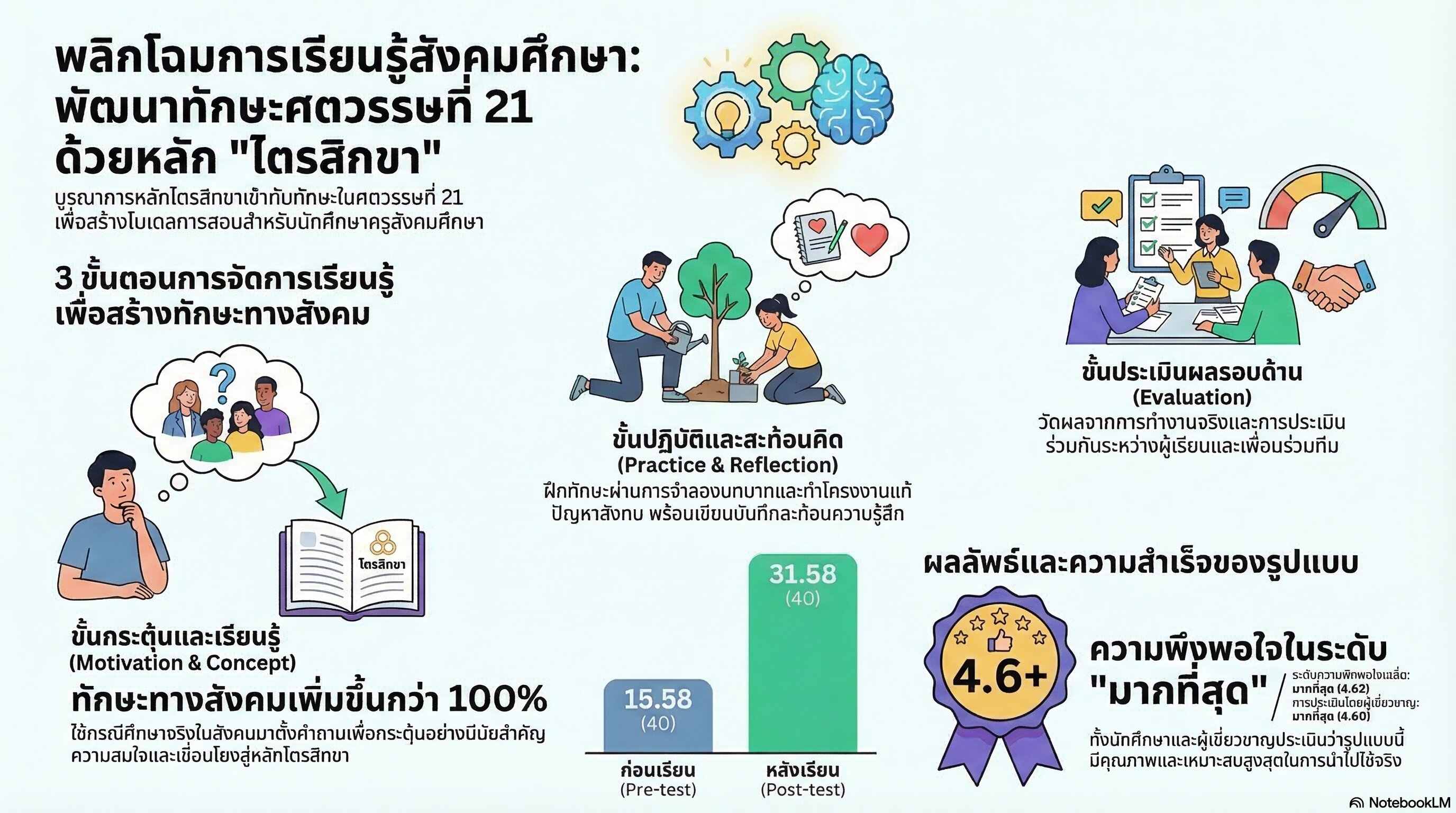
This research aims to: 1) study the current state and needs of learning management; 2) develop a learning management model; 3) implement the learning management model; and 4) evaluate and improve the model. The study focuses on a 21st-century social studies learning management model that applies the Trisikkha (Threefold Training) principles to enhance social skills for students in the Social Studies Education program at Mahamakut Buddhist University, Isan Campus. The target population included 1) 132 undergraduate students in the Social Studies Education program and 2) 39 undergraduate students enrolled in the Introduction to Sociology and Anthropology course. The research utilized a Research and Development (R&D) approach, with an experimental one-group pretest-posttest design. The research instruments were: a learning management model, a user manual, a social skills test, and a satisfaction questionnaire. Data were analyzed using mean, standard deviation, t-test, and content analysis. The research findings revealed the following: 1. The current state and needs of learning management to enhance social skills among students in the Social Studies Education program showed a high level of agreement, with a mean of (x̄) = 4.46 (S.D.) = 0.58. 2. The developed 21st-century social studies learning management model, based on Trisikkha principles, consists of five components: 1) principles of the model, 2) objectives, 3) content, 4) learning process, and 5) measurement and evaluation. The overall quality of the model, verified by experts, was at a high level of consistency, with a mean of (x̄) = 4.30 (S.D.) = 0.60. 3. The implementation of the model showed that the students' average social skills test scores were significantly higher after the intervention than before, at a statistical significance level of .05. The students' overall satisfaction with the model was at the highest level, with a mean of (x̄) = 4.63 (S.D.) = 0.57. 4. The evaluation and improvement of the learning management model, based on expert opinions, showed the overall evaluation was at the highest level, with a mean of (x̄) = 4.60 (S.D.) = 0.33.
References
พระพรหมคุณาภรณ์ (ป. อ. ปยุตฺโต). (2548). พจนานุกรมพุทธศาสตร์ฉบับประมวลธรรม (พิมพ์ครั้งที่ 10). เอส.อาร์.พริ้นติ้งแมสโปรดักส์.
สำนักงานเลขาธิการสภาการศึกษา. (2562). ทักษะที่จำเป็นในศตวรรษที่ 21. กระทรวงศึกษาธิการ.
สุวิทย์ มูลคำ. (2557). การจัดการเรียนรู้เชิงรุกเพื่อพัฒนาทักษะในศตวรรษที่ 21. สำนักพิมพ์แห่งจุฬาลงกรณ์มหาวิทยาลัย.
วิจารณ์ พานิช. (2561). การเรียนรู้เชิงรุกในศตวรรษที่ 21. มูลนิธิสดศรี-สฤษดิ์วงศ์.
Argyle, M. (1967). The psychology of interpersonal behavior. Penguin Books.
Argyle, M. (1994). The psychology of interpersonal behavior (5th ed.). Penguin Books.
Riggio, R. E. (1986). Assessment of basic social skills. Journal of Personality and Social Psychology, 51(3), 649–660. https://doi.org/10.1037/0022-3514.51.3.649
Trilling, B., & Fadel, C. (2009). 21st century skills: Learning for life in our times. Jossey-Bass.
Joyce, B., Weil, M., & Calhoun, E. (2015). Models of teaching (9th ed.). Pearson.
Wulandari, R. (2021). Characteristics and learning models of the 21st century. SHEs: Conference Series, 4(3), 8–16.
Downloads
Published
How to Cite
Issue
Section
Categories
License
Copyright (c) 2026 Journal of Buddhist Education and Research (JBER)

This work is licensed under a Creative Commons Attribution-NonCommercial-NoDerivatives 4.0 International License.