Challenges and Contributing Factors in the Implementation of 7Q Storytelling for Early Childhood Learning Activities
Keywords:
Storytelling, 7Q, early childhood education, obstacles in learning activities, child developmentAbstract
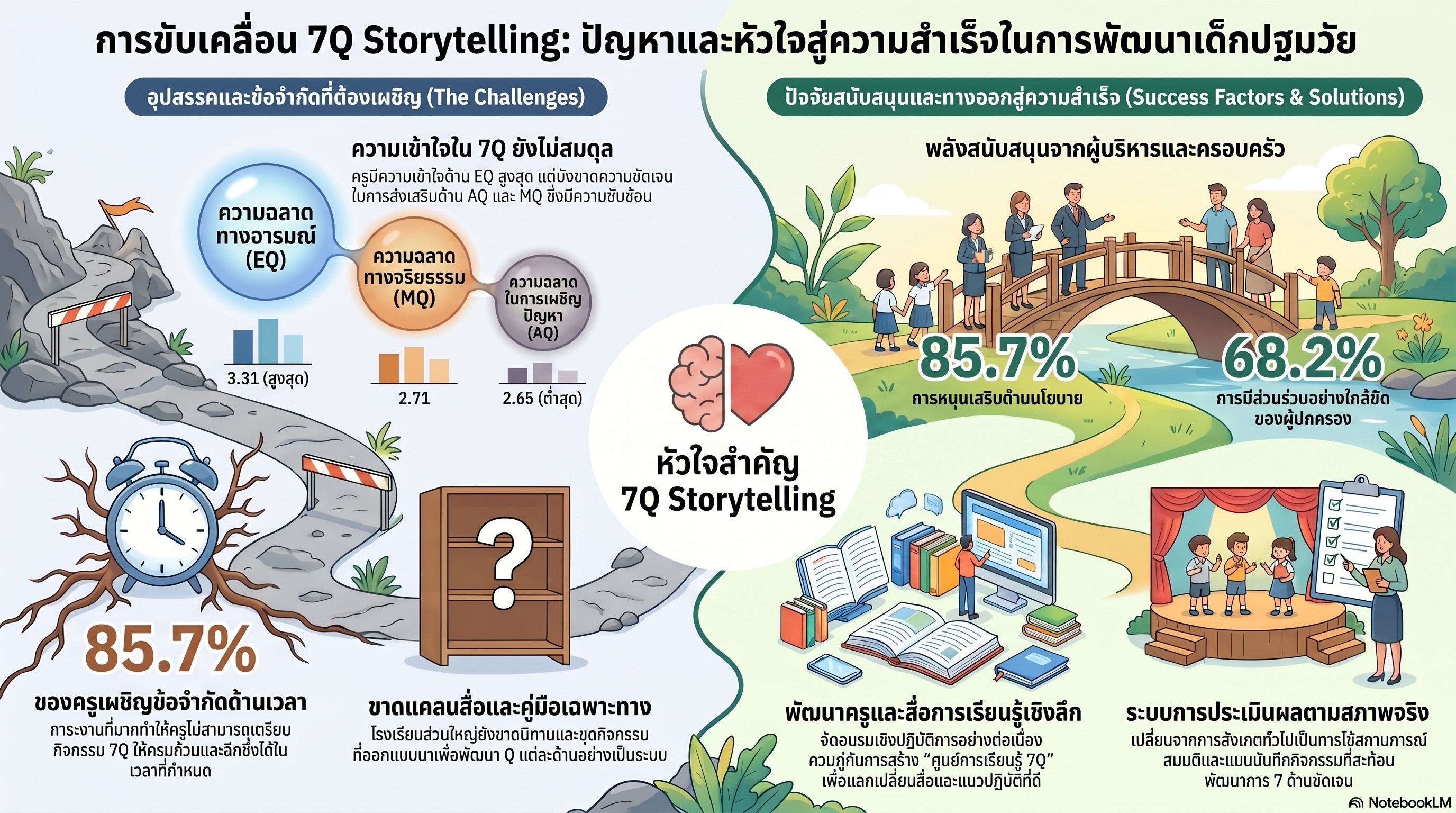
This qualitative study aimed to examine the implementation of the 7Q Storytelling approach in early childhood education, identifying the challenges, constraints, and factors influencing its successful application within Thai school contexts. Data were collected from 18 kindergarten and primary school teachers and 120 students ranging from early childhood to lower primary levels. Research instruments included activity observation records, semi-structured interviews, and open-ended questionnaires. The findings indicated that teachers’ overall understanding of the 7Q framework was at a moderate level (X̄ = 2.94, SD = 0.52), with the highest comprehension in the EQ dimension (X̄ = 3.31) and the lowest in AQ (X̄ = 2.65) and MQ (X̄ = 2.71). Key factors supporting successful implementation included administrative support (85.7%), parental involvement (68.2%), and continuous professional development opportunities for teachers. Major challenges involved limited instructional time, heavy workloads, and insufficient teaching materials or activity guides encompassing all seven Q dimensions. The study suggests several practical strategies for enhancing the effectiveness of 7Q Storytelling implementation. These include providing in-depth professional development to strengthen teachers’ conceptual and practical understanding of the 7Q framework, developing age-appropriate learning materials aligned with each Q component, establishing model learning environments for knowledge sharing among educators, and fostering collaborative partnerships among schools, families, and communities to integrate storytelling into children’s daily experiences. These strategies can serve as a sustainable framework for improving the quality of early childhood education and promoting holistic child development in alignment with 21st-century learning goals.
References
กระทรวงศึกษาธิการ. (2561). หลักสูตรการศึกษาปฐมวัย พุทธศักราช 2560. โรงพิมพ์ชุมนุมสหกรณ์การเกษตรแห่งประเทศไทย.
ศูนย์คุณธรรม (องค์การมหาชน). (2566). รายงานสถานการณ์คุณธรรมสังคมไทย ปี 2566. https://mdc.moralcenter.or.th
Bronfenbrenner, U. (1979). The ecology of human development: Experiments by nature and design. Harvard University Press.
Bruner, J. (1996). The culture of education. Harvard University Press.
Guskey, T. R. (2002). Professional development and teacher change. Teachers and Teaching: Theory and Practice, 8(3), 381–391. https://doi.org/10.1080/135406002100000512
Isbell, R., Sobol, J., Lindauer, L., & Lowrance, A. (2004). The effects of storytelling and story reading on the oral language complexity and story comprehension of young children. Early Childhood Education Journal, 32(3), 157–163. https://doi.org/10.1007/s10643-004-0359-1
Lickona, T. (2004). Character matters: How to help our children develop good judgment, integrity, and other essential virtues. Simon & Schuster.
Miles, M. B., Huberman, A. M., & Saldaña, J. (2014). Qualitative data analysis: A methods sourcebook (3rd ed.). SAGE.
Rahiem, M. D. H. (2021). Storytelling in early childhood education: Time to go digital. International Journal of Child Care and Education Policy, 15(1), Article 4. https://doi.org/10.1186/s40723-021-00081-x
Rovinelli, R. J., & Hambleton, R. K. (1977). On the use of content specialists in the assessment of criterion-referenced test item validity. Dutch Journal of Educational Research, 2(2), 49–60.
Shonkoff, J. P., & Phillips, D. A. (Eds.). (2000). From neurons to neighborhoods: The science of early childhood development. National Academy Press.
Shulman, L. S. (1986). Those who understand: Knowledge growth in teaching. Educational Researcher, 15(2), 4–14. https://doi.org/10.3102/0013189X015002004
Smith, F., & Goldstein, H. (2017). Social-emotional competence and early childhood education: The role of teacher-child relationships. Early Child Development and Care, 187(7–8), 1073–1085. https://doi.org/10.1080/03004430.2016.1223062
Stoltz, P. G. (1997). Adversity quotient: Turning obstacles into opportunities. John Wiley & Sons.
UNESCO. (2020). Education in a post-COVID world: Nine ideas for public action. https://unesdoc.unesco.org/ark:/48223/pf0000373717
UNICEF. (2021). The state of the world's children 2021: On my mind—Promoting, protecting and caring for children's mental health. https://www.unicef.org/reports/state-worlds-children-2021
Zins, J. E., Weissberg, R. P., Wang, M. C., & Walberg, H. J. (Eds.). (2004). Building academic success on social and emotional learning. Teachers College Press.
Downloads
Published
How to Cite
Issue
Section
Categories
License
Copyright (c) 2026 Journal of Buddhist Education and Research (JBER)

This work is licensed under a Creative Commons Attribution-NonCommercial-NoDerivatives 4.0 International License.