ปัญหาและปัจจัยที่ส่งผลต่อการประยุกต์ใช้แนวคิด 7Q Storytelling ในการจัดกิจกรรมการเรียนรู้สำหรับเด็กปฐมวัย
คำสำคัญ:
การเล่านิทาน, 7Q, ปฐมวัย, อุปสรรคในการจัดกิจกรรม, พัฒนาการเด็กบทคัดย่อ
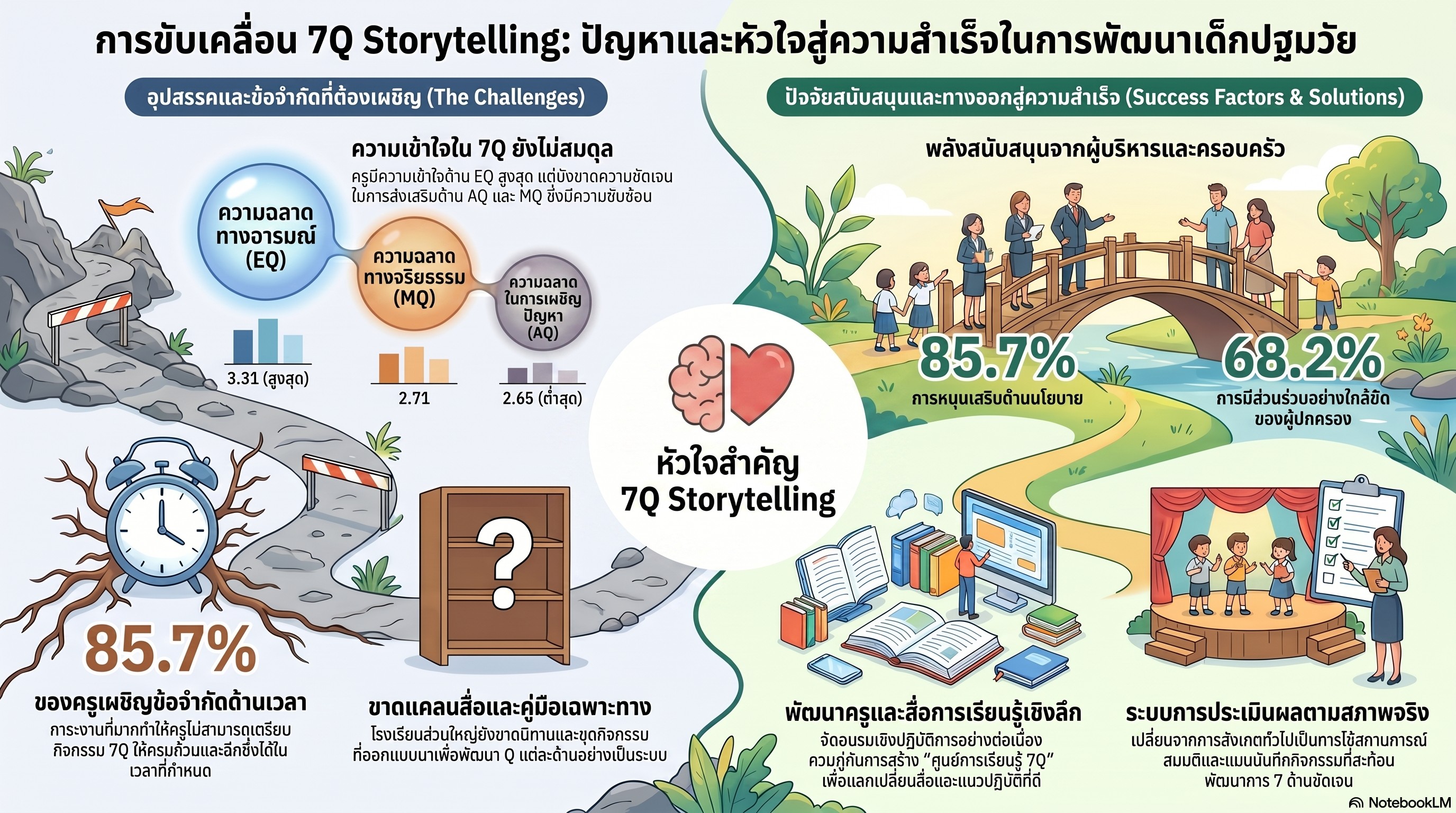
การวิจัยนี้มีวัตถุประสงค์เพื่อวิเคราะห์รูปแบบการประยุกต์ใช้แนวคิด 7Q Storytelling ในการจัดกิจกรรมการเรียนรู้สำหรับเด็กปฐมวัย และเพื่อระบุปัญหาอุปสรรค ตลอดจนปัจจัยที่มีอิทธิพลต่อความสำเร็จหรือข้อจำกัดในการนำแนวคิดดังกล่าวไปใช้ในบริบทของโรงเรียนไทย การวิจัยใช้ระเบียบวิธีเชิงคุณภาพ โดยเก็บข้อมูลจากครูผู้สอนระดับอนุบาลและประถมศึกษา จำนวน 18 คน และนักเรียนระดับปฐมวัยถึงประถมศึกษาตอนต้น จำนวน 120 คน เครื่องมือที่ใช้ประกอบด้วยแบบบันทึกกิจกรรม แบบสัมภาษณ์กึ่งโครงสร้าง และแบบสอบถามปลายเปิด ผลการศึกษาพบว่า ครูผู้สอนมีความเข้าใจในแนวคิด 7Q อยู่ในระดับปานกลาง (X̄ = 2.94, SD = 0.52) โดยเข้าใจสูงสุดด้าน EQ (X̄ = 3.31) และต่ำสุดด้าน AQ (X̄ = 2.65) และ MQ (X̄ = 2.71) ปัจจัยที่ส่งเสริมความสำเร็จ ได้แก่ การสนับสนุนเชิงนโยบายจากผู้บริหาร (ร้อยละ 85.7) การมีส่วนร่วมของผู้ปกครอง (ร้อยละ 68.2) และการพัฒนาวิชาชีพของครูอย่างต่อเนื่อง อุปสรรคสำคัญได้แก่ ข้อจำกัดด้านเวลา ภาระงานที่มาก และการขาดสื่อหรือคู่มือกิจกรรมที่ครอบคลุมทุกองค์ประกอบของ 7Q จากผลการวิจัยยังพบแนวทางการแก้ปัญหาที่เหมาะสม ได้แก่ การจัดอบรมเชิงลึกเพื่อพัฒนาความเข้าใจของครูเกี่ยวกับการประยุกต์ใช้แนวคิด 7Q Storytelling อย่างเป็นระบบ การพัฒนาและจัดสรรสื่อการเรียนรู้ที่สอดคล้องกับแต่ละองค์ประกอบของ 7Q การสร้างแหล่งเรียนรู้ต้นแบบในโรงเรียนเพื่อให้ครูได้แลกเปลี่ยนแนวปฏิบัติที่ดี ตลอดจนการส่งเสริมความร่วมมือระหว่างบ้าน โรงเรียน และชุมชน เพื่อสนับสนุนการเล่านิทานอย่างต่อเนื่องในชีวิตประจำวันของเด็ก ซึ่งแนวทางเหล่านี้สามารถนำไปใช้เพื่อยกระดับคุณภาพการจัดการเรียนรู้และพัฒนาเด็กอย่างรอบด้านและยั่งยืนในอนาคต
เอกสารอ้างอิง
กระทรวงศึกษาธิการ. (2561). หลักสูตรการศึกษาปฐมวัย พุทธศักราช 2560. โรงพิมพ์ชุมนุมสหกรณ์การเกษตรแห่งประเทศไทย.
ศูนย์คุณธรรม (องค์การมหาชน). (2566). รายงานสถานการณ์คุณธรรมสังคมไทย ปี 2566. https://mdc.moralcenter.or.th
Bronfenbrenner, U. (1979). The ecology of human development: Experiments by nature and design. Harvard University Press.
Bruner, J. (1996). The culture of education. Harvard University Press.
Guskey, T. R. (2002). Professional development and teacher change. Teachers and Teaching: Theory and Practice, 8(3), 381–391. https://doi.org/10.1080/135406002100000512
Isbell, R., Sobol, J., Lindauer, L., & Lowrance, A. (2004). The effects of storytelling and story reading on the oral language complexity and story comprehension of young children. Early Childhood Education Journal, 32(3), 157–163. https://doi.org/10.1007/s10643-004-0359-1
Lickona, T. (2004). Character matters: How to help our children develop good judgment, integrity, and other essential virtues. Simon & Schuster.
Miles, M. B., Huberman, A. M., & Saldaña, J. (2014). Qualitative data analysis: A methods sourcebook (3rd ed.). SAGE.
Rahiem, M. D. H. (2021). Storytelling in early childhood education: Time to go digital. International Journal of Child Care and Education Policy, 15(1), Article 4. https://doi.org/10.1186/s40723-021-00081-x
Rovinelli, R. J., & Hambleton, R. K. (1977). On the use of content specialists in the assessment of criterion-referenced test item validity. Dutch Journal of Educational Research, 2(2), 49–60.
Shonkoff, J. P., & Phillips, D. A. (Eds.). (2000). From neurons to neighborhoods: The science of early childhood development. National Academy Press.
Shulman, L. S. (1986). Those who understand: Knowledge growth in teaching. Educational Researcher, 15(2), 4–14. https://doi.org/10.3102/0013189X015002004
Smith, F., & Goldstein, H. (2017). Social-emotional competence and early childhood education: The role of teacher-child relationships. Early Child Development and Care, 187(7–8), 1073–1085. https://doi.org/10.1080/03004430.2016.1223062
Stoltz, P. G. (1997). Adversity quotient: Turning obstacles into opportunities. John Wiley & Sons.
UNESCO. (2020). Education in a post-COVID world: Nine ideas for public action. https://unesdoc.unesco.org/ark:/48223/pf0000373717
UNICEF. (2021). The state of the world's children 2021: On my mind—Promoting, protecting and caring for children's mental health. https://www.unicef.org/reports/state-worlds-children-2021
Zins, J. E., Weissberg, R. P., Wang, M. C., & Walberg, H. J. (Eds.). (2004). Building academic success on social and emotional learning. Teachers College Press.
ดาวน์โหลด
เผยแพร่แล้ว
รูปแบบการอ้างอิง
ฉบับ
ประเภทบทความ
หมวดหมู่
สัญญาอนุญาต
ลิขสิทธิ์ (c) 2026 Journal of Buddhist Education and Research (JBER)

อนุญาตภายใต้เงื่อนไข Creative Commons Attribution-NonCommercial-NoDerivatives 4.0 International License.