Problems and Guidelines for the Development of English Communicative Skills of Undergraduate Chinese Students Studying at Guangxi University of Foreign Languages
Abstract
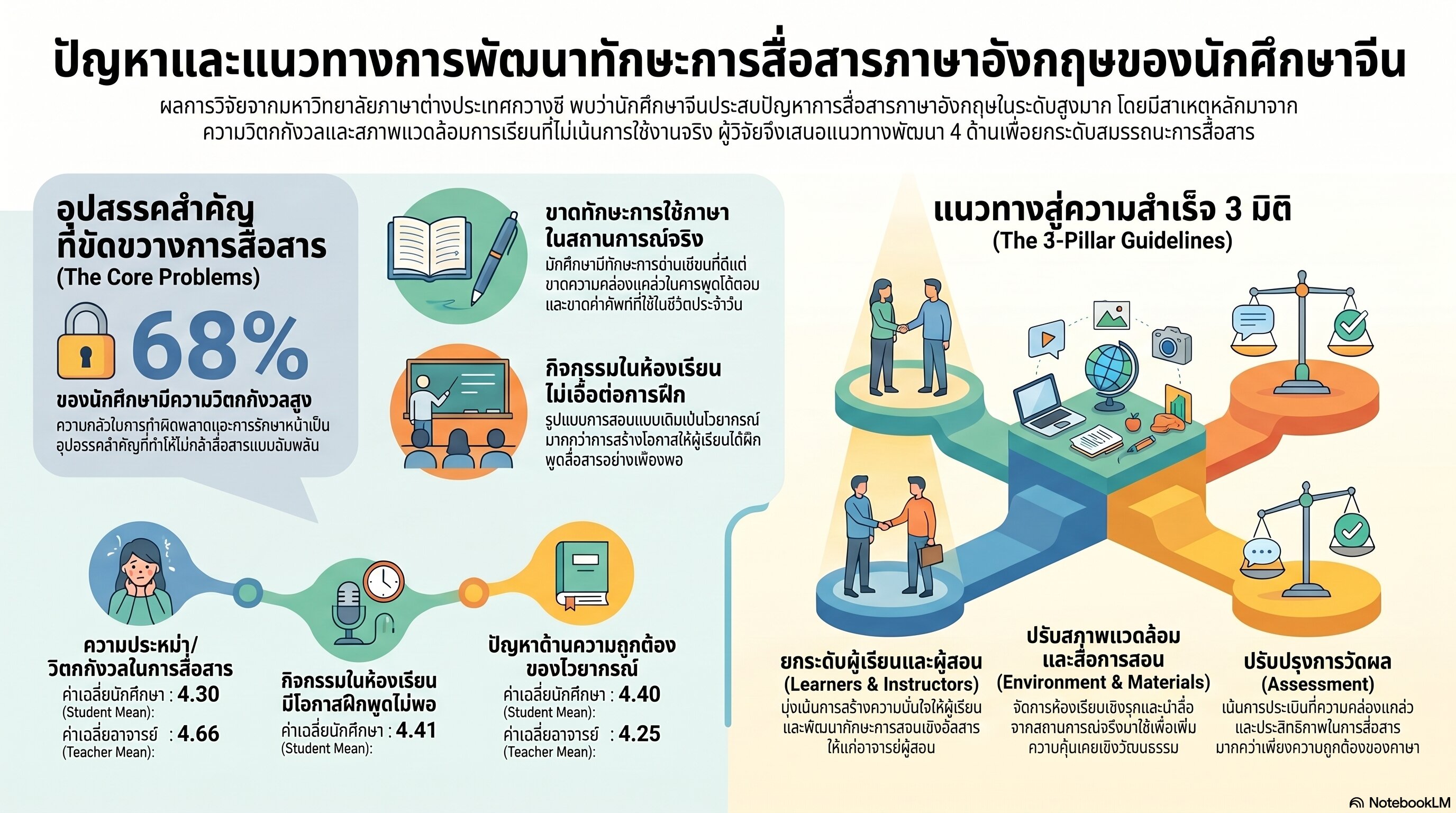
The objectives of this research were to investigate the problems of English communicative skills encountered by undergraduate Chinese students studying at Guangxi University of Foreign Languages and to develop guidelines for the enhancement of English communicative skills of undergraduate Chinese students at Guangxi University of Foreign Languages. This research was considered a mixed-methods research study conducted at Guangxi University of Foreign Languages. The respondents were divided into two groups: undergraduate Chinese students and teachers at Guangxi University of Foreign Languages in the academic year 2025. Two research instruments were employed: 1) a questionnaire for investigating problems of English communicative skills and 2) focus group discussions for evaluating development guidelines. The data collected were analyzed through statistical and content analysis methods and presented in terms of frequency count, percentage, mean, and standard deviation. The results indicated that: 1) The problems of English communicative skills encountered by undergraduate Chinese students were found at the highest level, including difficulties in oral communication fluency, limited vocabulary for spontaneous conversation, anxiety in communicative situations, and insufficient exposure to authentic communicative contexts. 2) The guidelines for the development of English communicative skills were categorized into comprehensive frameworks addressing learner-centered strategies, instructor-mediated approaches, classroom environment optimization, and authentic material integration to enhance overall communicative competence.
References
Chantarath, P. (2021). Interactive strategies for improving EFL oral communication in Thai universities. Asian EFL Journal, 23(2), 77–95.
Huang, L. (2024). Mobile learning applications and English communication confidence among Asian EFL students. Language Learning & Technology, 28(1), 1–20.
Liangpanit, C. (2018). What are the needs and problems of English reading for Thai graduate students? Sripatum Chonburi Academic Journal, 14(3), 50–65.
Lim, K., & Tan, P. (2019). Communicative competence in Singapore’s bilingual education system. Journal of Language Education, 12(4), 210–225.
Liu, J., & Zhang, W. (2020). Strategic behaviors in Chinese university EFL communication. Chinese Journal of Applied Linguistics, 43(2), 175–192.
Rahman, A., & Ng, C. (2020). Supporting Chinese students’ communicative competence in Malaysian universities. Malaysian Journal of ELT Research, 16(1), 99–118.
Seensangworn, P. (2020). Problems and strategies in speaking skills of Chinese students in Thai hospitality programs. Rangsit Journal of Educational Studies, 8(2), 50–65.
Somphong, P., & Yimwilai, S. (2022). Authentic audio and communicative practice in Thai vocational contexts. Journal of Education Studies, 30(1), 45–61.
Thompson, J., Chen, S., & Li, X. (2021). Peer mentoring and communicative development in Thai universities. TESOL Quarterly, 55(3), 765–789.
Tran, H., & Le, T. (2023). From literal to inferential communication in Vietnamese EFL classrooms. Asia-Pacific Education Researcher, 32(2), 211–225.
Downloads
Published
How to Cite
Issue
Section
Categories
License
Copyright (c) 2026 Journal of Buddhist Education and Research (JBER)

This work is licensed under a Creative Commons Attribution-NonCommercial-NoDerivatives 4.0 International License.