Guidelines for Developing Academic Leadership in the Digital Age of School Administrators under Khon Kaen Primary Educational Service Area Office 3
Abstract
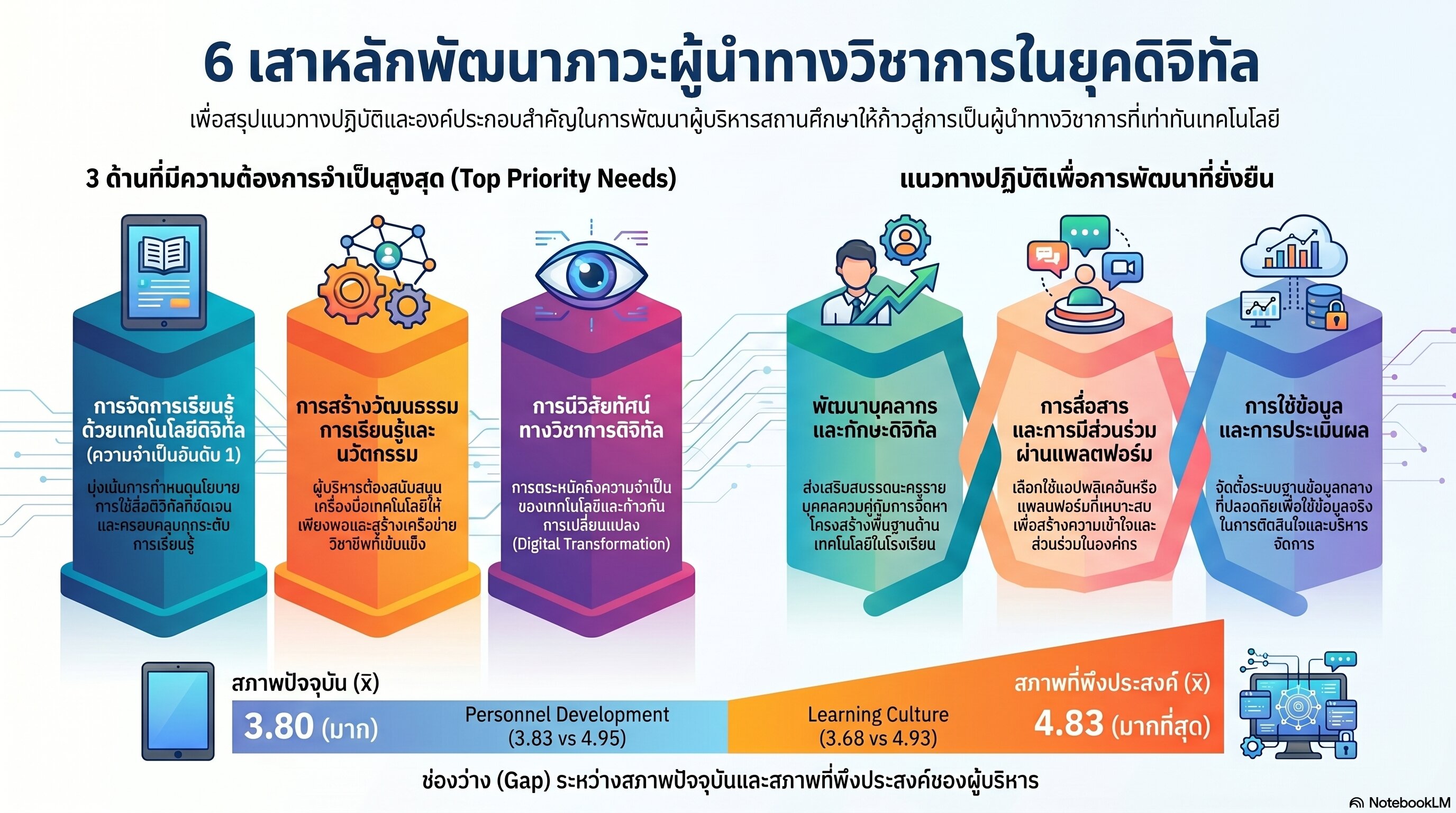
This research aimed to achieve two objectives: 1) to study the current status, desired status, and needs of academic leadership in the digital age of school administrators under the Office of the Basic Education Commission, Khon Kaen Province, Area 3; and 2) to study approaches for developing academic leadership in the digital age of school administrators under the Office of the Basic Education Commission, Khon Kaen Province, Area 3. The sample consisted of 298 school administrators and teachers from schools under the Office of the Basic Education Commission, Khon Kaen Province, Area 3, in the 2025 academic year. The research instruments used were questionnaires, interview forms, and appropriateness and feasibility assessment forms. Data were analyzed by percentages, frequencies, standard deviations, and content analysis. The results revealed that the current status of academic leadership in the digital age of school administrators under the Office of the Basic Education Commission, Khon Kaen Province, Area 3, both overall and in each aspect, was at a high level (x̅ =3.80, SD=0.61). In order of increasing mean values, the highest mean score was found for digital academic vision, followed by digital learning management, data utilization and evaluation with technology, personnel development and digital skills, and the creation of a learning culture and innovation. And communication and participation through technology, respectively. The desired condition found that all aspects were at the highest level (x̅ =4.83, SD=0.29) In order of the average value from highest to lowest, it was found that personnel development and digital skills had the highest average value, followed by creating a culture of learning and innovation, using information and evaluating with technology, communication and participation through technology, having a digital academic vision, and managing learning with digital technology, respectively. In terms of essential needs, in order of highest to lowest, it was found that managing learning with digital technology had the highest need index value, followed by creating a culture of learning and innovation, having a digital academic vision, personnel development and digital skills, and communication and participation through technology, respectively. Guidelines for Developing Academic Leadership in the Digital Age of School Administrators Total of 6 sides 18 Guidelines found that in managing learning with digital technology, a clear vision and policy for digital learning should be established, covering the guidelines for the use of media and technology. In terms of creating a culture of learning and innovation, educational administrators should provide opportunities for teachers to play a leading role in the academic circle and connecting with external professional networks, which will help the organization's learning progress and continuity. In terms of having a digital academic vision, educational administrators should be aware of the need to incorporate digital technology as an important element in educational administration. Keeping up with technological changes. In terms of personnel and digital skills development, school administrators should develop and promote teachers' technological competencies and provide and develop a school technology infrastructure. In terms of communication and participation through technology, school administrators should select appropriate digital applications or platforms specifically for school use. In terms of data use and technology-based assessment, school administrators should establish a central digital database system and promote the use of a secure and reliable student database system. The evaluation of the appropriateness and feasibility of academic leadership development approaches in the digital age found that overall suitability was at the highest level (x̅ =4.89, S.D.=0.24). Overall feasibility was at the highest level (x̅ =4.74, S.D.=0.39).
References
กนกวรรณ จันทรนิมะ. (2565). การศึกษาภาวะผู้นำและแนวทางการพัฒนาภาวะผู้นำเชิงนวัตกรรมของผู้บริหารโรงเรียน สังกัดสำนักงานเขตพื้นที่การศึกษาประถมศึกษาชัยภูมิ เขต 2. วารสารการบริหารการศึกษาและภาวะผู้นำ มหาวิทยาลัยราชภัฏสกลนคร, 10(39), 93–101.
ฉัตรชัย จันทา. (2563). การศึกษาภาวะผู้นำทางวิชาการของผู้บริหารสถานศึกษาขั้นพื้นฐานในจังหวัดนครพนม [วิทยานิพนธ์ครุศาสตรมหาบัณฑิต, มหาวิทยาลัยราชภัฏสกลนคร].
ไชยา ภาวะบุตร. (2565). ภาวะผู้นำทางวิชาการ (Academic leadership) (ฉบับปรับปรุง). มหาวิทยาลัยราชภัฏสกลนคร.
ต้องลักษณ์ บุญธรรม. (2559). การเป็นผู้นำยุคเศรษฐกิจดิจิทัลกับการพัฒนาที่ยั่งยืนขององค์กรทางการศึกษา. วารสารวิชาการครุศาสตร์อุตสาหกรรม พระจอมเกล้าพระนครเหนือ, 7(2), 217–225.
ธนิต รัตนศักดิ์ดา. (2565). ภาวะผู้นำทางวิชาการของผู้บริหารสถานศึกษา สังกัดสำนักงานเขตพื้นที่การศึกษาประถมศึกษาปราจีนบุรี เขต 2 [วิทยานิพนธ์ปริญญามหาบัณฑิต].
ปณิดา สุภารมย์. (2565). แนวทางการพัฒนาภาวะผู้นำดิจิทัลของผู้บริหารสถานศึกษา สังกัดสำนักงานเขตพื้นที่การศึกษาประถมศึกษาขอนแก่น เขต 5 [วิทยานิพนธ์ศึกษาศาสตรมหาบัณฑิต, วิทยาลัยบัณฑิตเอเชีย].
พิชญ์สินี มะโน. (2562). ผลกระทบจากการเปลี่ยนแปลงในยุค digital disruption ต่อการศึกษา. วารสารครุศาสตร์อุตสาหกรรม, 18(1), 1–6.
รุจาภรณ์ ลักษณะดี. (2565). ภาวะผู้นำการดิจิทัลของผู้บริหารสถานศึกษาในสหวิทยาเขตบ้านบึง 1 สังกัดสำนักงานเขตพื้นที่การศึกษาประถมศึกษาชลบุรี เขต 1 [วิทยานิพนธ์ปริญญามหาบัณฑิต, มหาวิทยาลัยเกริก].
รุ่งรัตน์ พลชัย. (2565). ภาวะผู้นำกับการบริหารในยุคดิจิทัล. วารสารมนุษยศาสตร์และสังคมศาสตร์, 1(3), 53–62.
ศิริพงษ์ กลั่นไพฑูรย์. (2564). รูปแบบการพัฒนาภาวะผู้นำทางวิชาการในยุคดิจิทัลของผู้บริหารสถานศึกษาขั้นพื้นฐาน [วิทยานิพนธ์ปรัชญาดุษฎีบัณฑิต, มหาวิทยาลัยนเรศวร].
สาธร ทรัพย์รวงทอง. (2566). รูปแบบภาวะผู้นำเชิงนวัตกรรมของผู้บริหารสถานศึกษา สังกัดสำนักงานคณะกรรมการการศึกษาขั้นพื้นฐาน. วารสารวิจัยวิชาการ, 6(3), 309–324.
สำนักงานเลขาธิการสภาการศึกษา. (2560). การกำหนดแนวทางการพัฒนาการศึกษาไทยกับการเตรียมความพร้อมสู่ศตวรรษที่ 21. สืบค้นเมื่อ 3 มิถุนายน 2568, จาก http://www.onec.go.th/onec_-backoffice/uploads/Book/-file.pdf
สำนักงานเขตพื้นที่การศึกษาประถมศึกษาขอนแก่น เขต 3. (2566). แผนพัฒนาการศึกษาขั้นพื้นฐาน ระยะ 5 ปี พ.ศ. 2566–2570. สำนักงานเขตพื้นที่การศึกษาประถมศึกษาขอนแก่น เขต 3.
เอกรัตน์ เชื้อวังคำ, และวัลลภา อารีรัตน์. (2564). องค์ประกอบของภาวะผู้นำดิจิทัลของผู้บริหารสถานศึกษา สังกัดสำนักงานเขตพื้นที่การศึกษาประถมศึกษาอุดรธานี เขต 4. วารสารศึกษาศาสตร์ มหาวิทยาลัยขอนแก่น.
Sheninger, E. (2019). Digital leadership: Changing paradigms for changing times (2nd ed.). Corwin Press.
Downloads
Published
How to Cite
Issue
Section
Categories
License
Copyright (c) 2026 Journal of Buddhist Education and Research (JBER)

This work is licensed under a Creative Commons Attribution-NonCommercial-NoDerivatives 4.0 International License.