The Impact of National Karaoke Software on the Academic Performance of Students Majoring in Popular Vocal Singing
Abstract
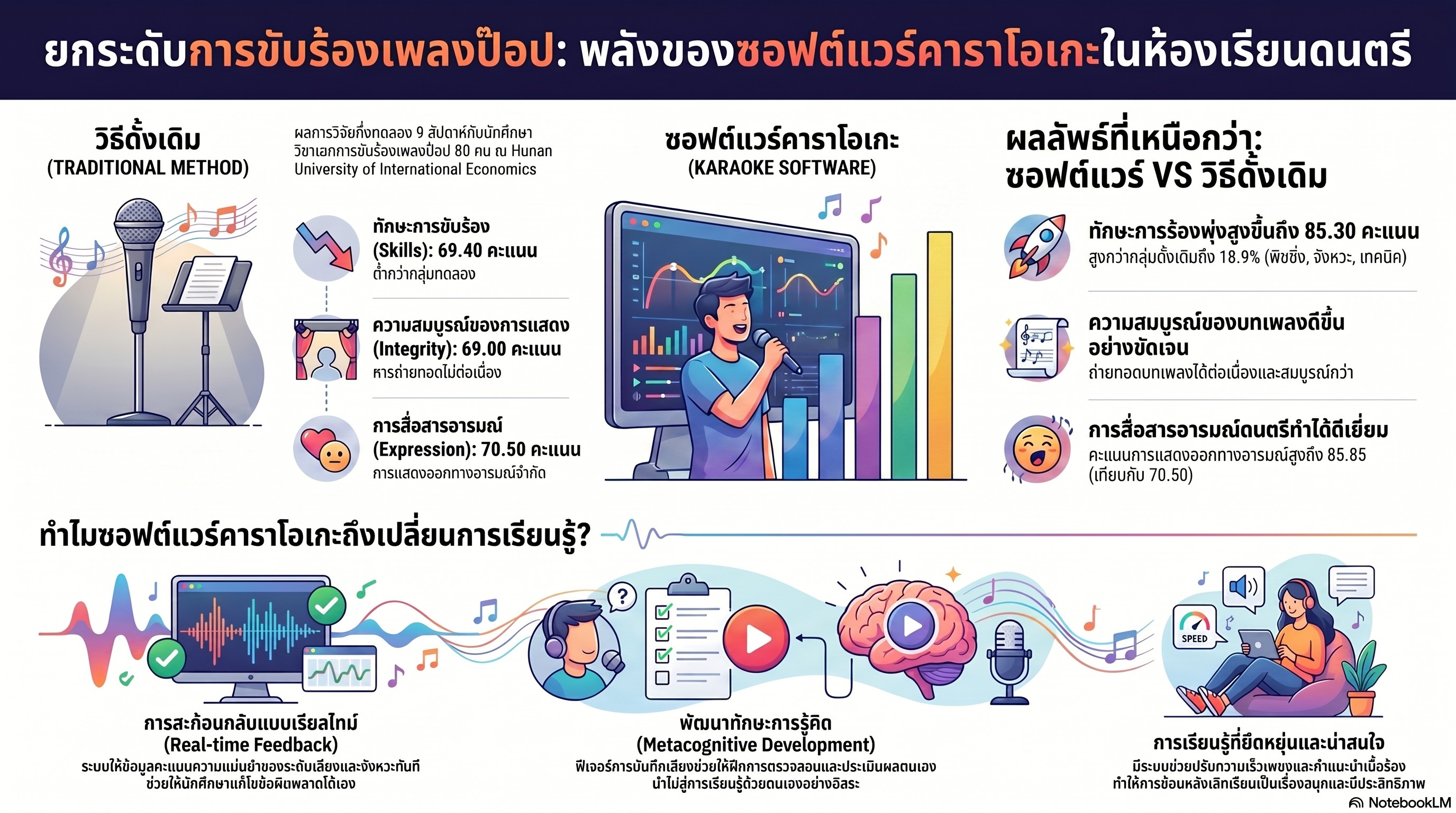
This dissertation explores the impact of the National Karaoke Software on the academic performance of college students majoring in popular vocal singing at Hunan University of International Economics. Adopting a quasi-experimental research design, 80 students were systematically divided into an experimental group and a control group. Due to the fact that the popular music singing course at Hunan University of International Economics usually adopts group teaching, this study used purposive sampling techniques to ensure the credibility and accuracy of the research. The total sample size of this study is 132 people. In the group of students majoring in pop music singing, purposefully select a class of 40 as the control group and another 40 as the experimental group. The experimental group utilized the National Karaoke Software as a learning aid for nine weeks, while the control group followed traditional teaching methods. Pre- and post-tests were conducted to assess students' the completeness of students' pop music singing, academic performance, and performance in singing popular music. The results reveal that students in the experimental group demonstrated significant improvements in their popular music singing skills, including pitch accuracy, rhythm control, and vocal techniques. In terms of Pop Music Singing Skills, the control group and experimental group showed a significant difference of 0.01 level in the posterior analysis (t=-11.562, p=0.000). The specific comparison difference can be seen that the average value of the control group was 69.400, significantly lower than the average level of the experimental group (85.300), with an average difference of 18.900. The experimental group achieved better results.In terms of Pop Music Singing Performance Integrity, the control group and the experimental group showed a significance level of 0.01 in the posterior analysis (t=-12.471, p=0.000). The specific comparison difference can be seen that the average value of the control group was 69.000, significantly lower than the average level of the experimental group (83.620), with an average difference of 14.620.In terms of Pop Music Singing Expression, the control group and experimental group showed significant significance at the 0.01 level in the posterior analysis (t=12.923, p=0.000). The specific comparison difference can be seen that the average value of the control group was 70.500, significantly lower than the average level of the experimental group (85.850), with an average difference of 15.350. The experimental group achieved better results. Furthermore, the experimental group exhibited enhanced performance integrity, characterized by more coherent and expressive renditions of songs. Notably, the National Karaoke Software's real-time feedback and interactive features facilitated self-monitoring and evaluation, contributing to students' metacognitive development and independent learning abilities. The study underscores the potential of digital tools like the National Karaoke Software in revolutionizing music education by providing personalized, engaging, and effective learning experiences. It offers valuable insights for educators and curriculum developers on integrating technology into traditional music teaching methodologies to enhance students' overall musical development.
References
Bakó, M. (2011). Learning support of the basic concepts of mathematical logic by using e-learning materials in the teaching of expert systems. International Journal of Mathematics and Systems Science, 6(3), 27–34.
Choi, S., Kim, J., & Kim, S. (2024). Effects of exposure in computer-assisted virtual environments on vocalists’ performance anxiety: A quasi-experimental study. Journal of Rational-Emotive & Cognitive-Behavior Therapy, 42(3), 523–543.
Dong, Q. (2020). Vocal music teaching in the era of new media. Basic & Clinical Pharmacology & Toxicology, 126(2), 57–58.
Dylan, J. (2024). A very personal memoir, all change at the Evening Standard, and Sunak's karaoke song. Music Education Research, 25(5), 485–495.
Faustino, K. A. K. D. S., Moreti, F., & Behlau, M. (2024). Self-perception of voice and knowledge of vocal health and hygiene in Candomblé religious leaders in Brazil. Art and Performance Letters, 5(1), 55–62.
Hu, J., Phongsatha, T., & Achwarin, N. (2022). Effectiveness of the Pro Tools software to enhance vocal music students’ singing performance of a polytechnic institution in middle China. ABAC ODI Journal Vision. Action. Outcome, 9(2), 106–122.
Huralna, S., Demianko, N., Sulaieva, N., Irkliienko, V., & Horokhivska, T. (2022). Multimedia technologies for teaching musical art under present-day conditions. International Journal of Education and Information Technologies, 16, 128–135.
Jia, Y. (2024). Analyzing the health and cognitive benefits of bel canto singing technique in music performance through biocognitive science. Journal of Commercial Biotechnology, 29(1).
Kim, J. O. (2021). BTS as method: A counter-hegemonic culture in the network society. Media, Culture & Society, 43(6), 1061–1077.
Kim, Y., & Park, H. Y. (2024). Effects of virtual reality training on clinical skill performance in nursing students: A systematic review, meta-analysis and meta-regression. International Journal of Nursing Practice, 30(6), e13284. https://doi.org/10.1111/ijn.13284
Krumme, C., Cebrian, M., Pickard, G., & Pentland, A. (2012). Quantifying social influence in an online cultural market. PLOS ONE, 7(5), e33785. https://doi.org/10.1371/journal.pone.0033785
Leski, A., Szmidt, M., & Synaszko, P. (2017). Localization of sound sources during full-scale fatigue test of the vertical stabilizer with the acoustic holography technique. Fatigue of Aircraft Structures, 9, 17–25.
Li, J. (2024). A study of the effect of Sichuan opera singing on the vocal skills of music students. Journal of Contemporary Educational Research, 8(6), 161–165.
Li, J., & Li, S. (2021). Design of multimedia assisted teaching system for basketball theory course. Journal of Physics: Conference Series, 1992(3), Article 032081. https://doi.org/10.1088/1742-6596/1992/3/032081
Li, M. (2024). Integration of traditional cultural elements into civics teaching practice in colleges and universities based on internet distance education. International Journal of Web-Based Learning and Teaching Technologies, 19(1), 1–11.
Li, R., Zhao, Z., Zhou, X., Ding, G., Chen, Y., Wang, Z., & Zhang, H. (2017). Intelligent 5G: When cellular networks meet artificial intelligence. IEEE Wireless Communications, 24(5), 175–183. https://doi.org/10.1109/MWC.2017.1600304WC
Liu, Y. (2024). Exploration of the integration of ethnic music elements into modern piano art creation. Journal of Contemporary Educational Research, 8(6), 216–220.
Long, Z., Yap, J. H., & Koning, S. I. (2024). Harmonising tradition and technology: A review of multimedia integration in Guizhou's vocal music. Asian Pendidikan, 4(1), 14–22.
Loukas, S., Filippa, M., De Almeida, J. S., Boehringer, A. S., Tolsa, C. B., Barcos-Munoz, F., Grandjean, D. M., Van De Ville, D., & Hüppi, P. S. (2024). Newborn’s neural representation of instrumental and vocal music as revealed by fMRI: A dynamic effective brain connectivity study. Human Brain Mapping, 45(10).
Macedo-Lima, M., Hamlette, L. S., & Caras, M. L. (2024). Orbitofrontal cortex modulates auditory cortical sensitivity and sound perception in Mongolian gerbils. Current Biology, 34(15), 3354–3366.
Madkour, M., & Alaskar, H. (2024). Exploring cognitive teaching approaches for inclusive translation online classes: A case study during the COVID-19 pandemic. Theory and Practice in Language Studies, 14(4), 1219–1230.
Manavi, S., Fattahi, E., & Becker, T. (2024). A parameterized physics-informed machine learning approach for solving heat and mass transfer equations in the drying process. International Communications in Heat and Mass Transfer, 158, 107897.
Mei, Z., Li, X., Lyu, Y., Lin, Y., Yang, H., Cheng, X., & Yang, J. (2024). Broadening sound absorption bandwidth via multi-order resonances. International Journal of Mechanical Sciences, 280, 109493.
Merezhko, Y. V., Lievit, D. A., Petrykova, O. P., Gmyrina, S. V., & Kasianchuk, M. S. (2020). Experimental and research verification of the methodology of forming the high school students’ artistic taste for the vocal heritage (late XIX–early XX century). International Journal of Learning, Teaching and Educational Research, 19(4), 309–321.
Missfelder, J. F. (2023). From choir to chamber: Negotiating vocal music in the Zurich Reformation. Journal of Early Modern Christianity, 10(2), 187–214.
Miyazaki, A., & Mori, H. (2020). Frequent karaoke training improves frontal executive cognitive skills, tongue pressure, and respiratory function in elderly people: Pilot study from a randomized controlled trial. International Journal of Environmental Research and Public Health, 17(4), 1459. https://doi.org/10.3390/ijerph17041459
Nichols, B. E., Piña, K., & Atchison, S. (2024). Voice load in a music student teacher: A quantitative case study in voice dosimetry. Voice and Speech Review, 18(1), 34–43.
Pan, T. (2021). Application of artificial intelligence system in music education. In Lecture Notes on Data Engineering and Communications Technologies (pp. 1115–1121). Springer.
Patel, R. R., Lulich, S. M., & Francisco, P. (2023). Laryngeal, respiratory, and acoustic characteristics of vocal trillo with simultaneous high-speed videoendoscopy, inductive plethysmography, and acoustic recordings. Journal of Voice, 37(3), 447–453.
Petrovic, S. (2023). From karaoke to lip-syncing: Performance communities and TikTok use in Japan. Media International Australia, 186(1), 11–28.
Rai, N., & Thapa, B. (2015). A study on purposive sampling method in research. Kathmandu School of Law Review, 5(1), 8–15.
Rengifo, A. R. (2009). Improving pronunciation through the use of karaoke in an adult English class. PROFILE Issues in Teachers’ Professional Development, 11(1), 91–106.
Shin, C., & Lim, Y. (2023). Design and implementation of impromptu mobile social karaoke for digital cultural spaces in the new normal era. Applied Sciences, 13(22), 12319. https://doi.org/10.3390/app132212319
Tada, W. (2022). Preparing student teachers to use songs in English language classrooms. The Language Teacher, 46(4), 11–16.
Wexler, D., Yip, J., Lee, K. P., Li, X., & Wong, Y. H. (2024). A touch on musical innovation: Exploring wearables and their impact on new interfaces for musical expression. Sensors, 24(1), 250. https://doi.org/10.3390/s24010250
Yuge, M., Hori, S., Ushida, K., & Momosaki, R. (2022). Karaoke as a feasible alternative therapy to pulmonary rehabilitation for COPD. European Respiratory Journal, 59(6). https://doi.org/10.1183/13993003.02810-2021
Zhao, X. (2024). An exploration of senior high school English teaching based on Rogers’ humanistic learning theory. Education Reform and Development, 6(7), 119–125.
Downloads
Published
How to Cite
Issue
Section
Categories
License
Copyright (c) 2026 Journal of Buddhist Education and Research (JBER)

This work is licensed under a Creative Commons Attribution-NonCommercial-NoDerivatives 4.0 International License.