Diverse Paths to Virtuous Citizens: A Comparative Analysis of Moral and Ethical Education in Thailand, Japan, the Philippines, Indonesia, and Singapore
Keywords:
moral and ethical education, comparative education, education policy, moral curriculumAbstract
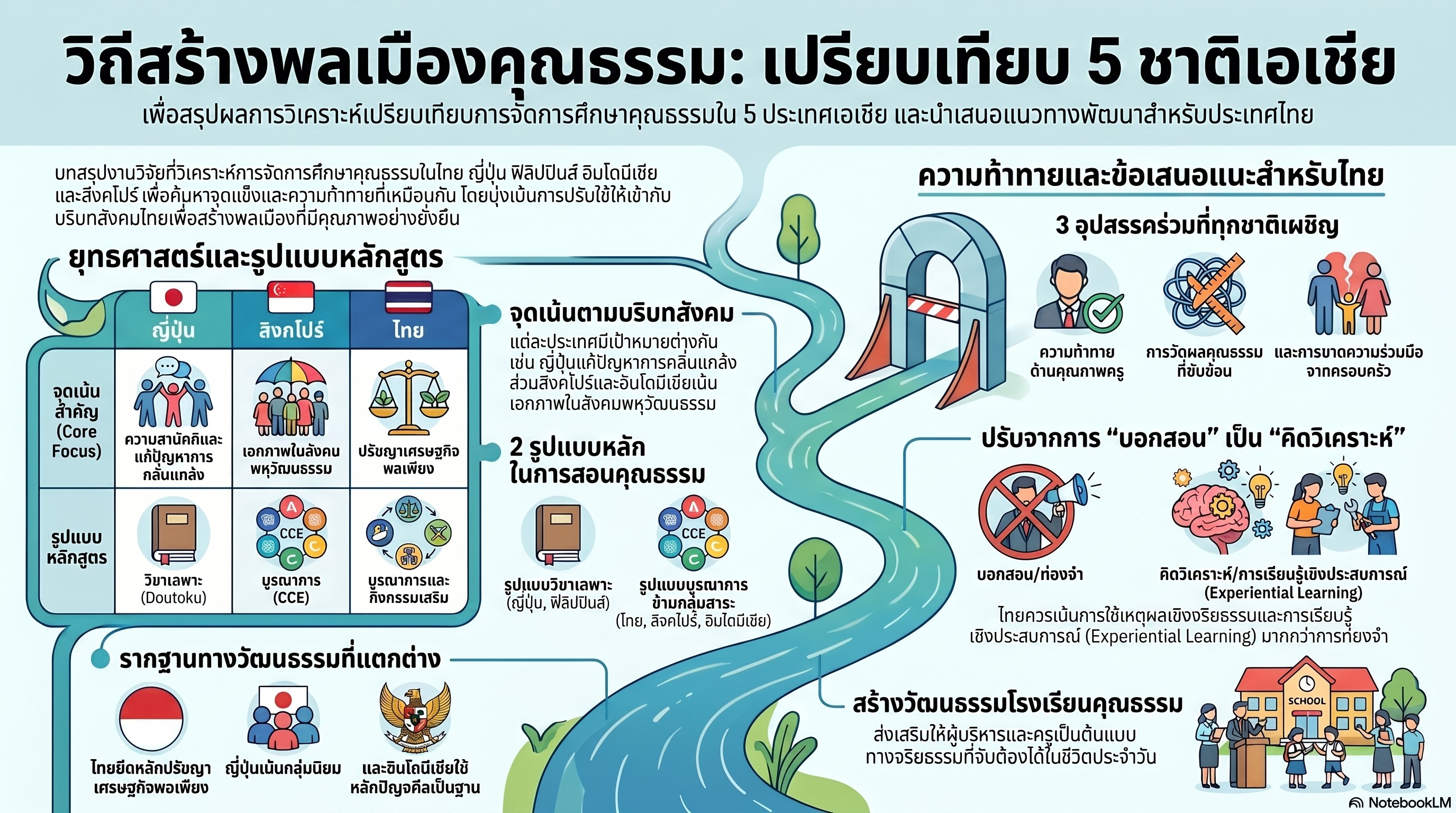
This research aims to analyze and compare moral and ethics education management in Thailand, Japan, the Philippines, Indonesia, and Singapore across five dimensions: contextual factors, national policies, development approaches and principles, curriculum frameworks and learning management, and implementation and outcomes. The study seeks to propose guidelines for moral and ethics education in Thailand by drawing lessons from other countries that are aligned with the Thai social context. The findings indicate that although all countries share the common goal of cultivating quality citizens, their approaches differ according to their historical, social, and cultural contexts. In terms of policy, Singapore and Indonesia emphasize social cohesion in multicultural societies; Japan focuses on addressing social problems; the Philippines integrates religious principles with universal values; while Thailand emphasizes the integration of national strategies with the Sufficiency Economy Philosophy. Regarding curriculum, two main approaches are identified: specific subjects (e.g., Japan and the Philippines) and integration across subjects and student development activities (e.g., Thailand, Singapore, and Indonesia). These approaches reflect each country’s core values and distinctive cultural identity. However, all countries face common challenges, including teacher quality, assessment and evaluation, and collaboration with families and communities. The study highlights the need to establish concrete mechanisms for moral and ethics education alongside systematic teacher development in order to sustainably cultivate high-quality citizens.
References
กระทรวงศึกษาธิการ. (2560). โรงเรียนคุณธรรม สพฐ. สืบค้นจาก https://www.moe.go.th/โรงเรียนคุณธรรม-สพฐ/
กระทรวงศึกษาธิการ. (2565). การปลูกฝังคุณธรรมในสถานศึกษาของเรา. สืบค้นจาก https://www.moe.go.th/การปลูกฝังคุณธรรมในสถา/
ไพจิตร์ จิตต์โสภณ. (2561). รายงานการประเมินโครงการส่งเสริมคุณธรรม จริยธรรมนักเรียน ตามแนวการดำเนินงานโรงเรียนคุณธรรม โรงเรียนวัดเจริญราษฎร์. สืบค้นจาก https://research.otepc.go.th/files/_________________________________%20(1)_g8voox1b.pdf
ศูนย์ปฏิบัติการต่อต้านการทุจริต. (2564). หลักสูตรต้านทุจริตศึกษา (Anti-Corruption Education). กระทรวงมหาดไทย. สืบค้นจาก https://multi.dopa.go.th/acoc/news/cate2/view34
สำนักงานคณะกรรมการการศึกษาขั้นพื้นฐาน. (2559). โครงการโรงเรียนสุจริต. สำนักพัฒนานวัตกรรมการจัดการศึกษา. สืบค้นจาก https://www.uprightschool.net
สำนักงานเลขาธิการสภาการศึกษา. (2560). แผนการศึกษาแห่งชาติ พ.ศ. 2560-2579. กระทรวงศึกษาธิการ.
อรทัย ทองฤกษ์ฤทธิ์, เบญจมาศ ฉลาดการณ์, ชรินทร์ จันทดี, และสุเชน เลิศวีระสวัสดิ์. (2561). คุณธรรม จริยธรรม และความเป็นพลเมืองของผู้เรียนทุกช่วงชั้น ภายใต้การกำกับดูแลของกระทรวงศึกษาธิการ. วารสารครุศาสตร์ มหาวิทยาลัยราชภัฏบ้านสมเด็จเจ้าพระยา, 17(2), 259–272.
Adhikari, A., Saha, B., & Sen, S. (2023). Nel Noddings’ theory of care and its ethical components. IRJEdT (International Research Journal of Educational Trends), 05(08), 198–206.
Bo, F. (2019). A study on the education of common values of Singapore from the perspective of legalization. International Workshop on Education, Development and Social Sciences (IWEDSS 2019).
Bray, M., Adamson, B., & Mason, M. (Eds.). (2014). Comparative education research: Approaches and methods (2nd ed.). Springer. https://doi.org/10.1007/978-3-319-05594-7
Capadosa, R. N., Muega, M. A., & Acido-Muega, M. (2025). Moral reasoning courseware for problem-solving in values Education: Grade 8 students' performances. Education Review, 13(1), 1-22.
Fitch, R. M. (1990). Moral education in Indonesia: A preliminary study. Educación y Ciencia, 1(1), 45-50.
Guiab, M. R., Andaya, O. J. F., Sario, M. L. P., Ganal, N. N., Palting, J. D., & Reyes, V. F., Jr. (2015). Moral intelligence of faculty and prospective teacher graduates of PNU North Luzon: Basis for the development of a framework for a values training program for pre-service teachers. The Normal Lights, 9(1), 93-118.
Human Rights Watch. (2013). In religion’s name: Abuses against religious minorities in Indonesia. Retrieved from https://www.refworld.org/docid/513085c22.html
Kerr, J. (2011). Habituation: A method for cultivating starting points in the ethical life. Journal of Philosophy of Education, 45(4), 643–655.
Kohlberg, L. (1984). The psychology of moral development: The nature and validity of moral stages Vol. 2. Harpercollins College Div.
Kusanagi, Y. (2019). Moral education in Japan: Values, curriculum, and pedagogy. National Institute for Educational Policy Research (NIER).
Lincoln, Y. S., & Guba, E. G. (1985). Naturalistic inquiry. Sage.
Ministry of Education Singapore. (2021). Secondary character and citizenship education syllabus. Retrieved from https://www.moe.gov.sg/docs/default-source/document/education/syllabuses/character-and-citizenship-education/files/2021-cce-secondary-syllabus.pdf
Ministry of Education, Culture, Sports, Science and Technology (MEXT). (2002). Japanese government policies in education, culture, sports, science and technology 2002. Retrieved from https://www.mext.go.jp/b_menu/hakusho/html/hpac200201/hpac200201_2_027.html
Mista, M. A. J. T., Padios, A., Ramirez, J. M. M., & Murillo, N. (2024). Challenges of values education teachers in teaching Edukasyon sa Pagpapakatao (ESP) in the secondary. International Journal of Social Science and Human Research, 7(6), 3678-3687.
Muega, M. A. G. (2010). Values/moral education: Current conceptions and practices in Philippines schools. Alipato: A Journal of Basic Education, 4, 83-96.
Nicmanis, M. (2024). Reflexive content analysis: An approach to qualitative data analysis, reduction, and description. International Journal of Qualitative Methods, 23, Article 16094069241236603.
Qoyyima, U. (2015). Theories of moral education and implementation in Indonesia: Reenergizing cultural identity and addressing future challenges [Paper presentation]. The International Conference on Education Research and Development: Trend and Challenges toward Asian Economic community, Surabaya, Indonesia.
Ramadhani, T., Widiyanta, D., Sumayana, Y., Santoso, R. Y., Agustin, P. D., & Al-Amin. (2024). The role of character education in forming ethical and responsible students. IJGIE (International Journal of Graduate of Islamic Education), 5(2), 110–124.
Sasaki, T. (2017). Character and moral education in Japan: From tradition to modernization. Asia-Pacific Journal of Education, 37(4), 561–574.
Tai, W. T., & Lee, C. C. (2004). Moral and citizenship education as statecraft in Singapore: A curriculum critique. Journal of Moral Education, 33(4), 597–606.
UNESCO. (2015). Global citizenship education: Topics and learning objectives. UNESCO Publishing.
Waterworth, P. G. (2022). Towards a moral community: Moral education strategies in Indonesian schools. In Proceedings of the International Conference on Learning Innovation and Research in Basic Education (pp. 166–185). KnE Life Sciences. https://doi.org/10.18502/kss.v8i8.13294
Yoshida, M. (2020). Implementation of moral education as a special subject in Japanese schools. Journal of Educational Studies, 68(2), 45–58.
Downloads
Published
How to Cite
Issue
Section
Categories
License
Copyright (c) 2026 Journal of Buddhist Education and Research (JBER)

This work is licensed under a Creative Commons Attribution-NonCommercial-NoDerivatives 4.0 International License.