A Hotel Management Model for Supporting Buddhist Tourism and Sustainable Tourism Development in Chaiyaphum Province, Thailand
Abstract
This study aimed to 1) examine the potential and limitations of hotels in Chaiyaphum Province in accommodating Buddhist tourism, 2) analyze the influence of niche service design on Buddhist tourists’satisfaction, and 3) develop a hotel management model to support Buddhist tourism and sustainable tourism development. A mixed methods research design was employed. Quantitative data were collected from 400 Buddhist tourists staying in hotels in Chaiyaphum Province using a structured questionnaire and analyzed using descriptive statistics, confirmatory factor analysis, and structural equation modeling. In addition, qualitative data were gathered from 15 key informants, including hotel operators, temple representatives, and tourism-related agencies, through in-depth interviews and analyzed using content analysis. The findings revealed that hotels in Chaiyaphum Province possess a relatively high potential to support Buddhist tourism, particularly in terms of location, tranquil environment, and basic facilities. However, significant limitations were identified in the design of specialized services tailored to Buddhist tourists, especially the lack of systematically integrated spiritual service offerings. The structural model analysis indicated that niche service design, including meditation spaces, healthy or vegetarian food services, and integrated tourism packages combining relaxation with spiritual practices, had a statistically significant positive influence on tourists’ satisfaction. Based on the findings, a hotel management model for Buddhist tourism was developed, consisting of three key components: 1) spiritual-oriented service design tailored to specific tourist needs, 2) integration and collaboration among hotels, temples, and local communities, and 3) implementation based on sustainable tourism principles encompassing economic, social, and environmental dimensions. The proposed model provides both policy and practical implications for enhancing the capacity and competitiveness of Buddhist tourism at the local level.
References
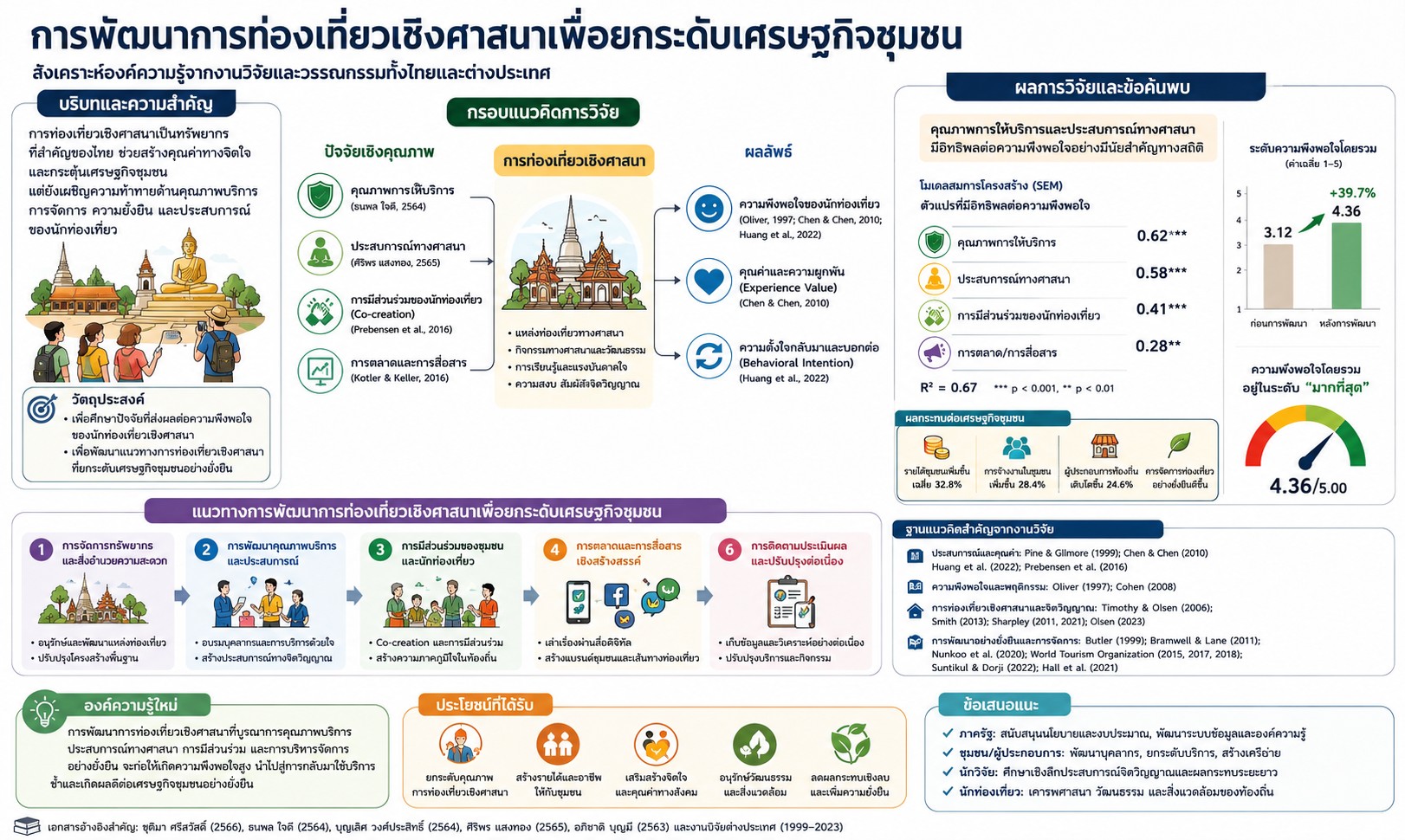
ชุติมา ศรีสวัสดิ์. (2566). การพัฒนาการท่องเที่ยวเชิงศาสนาเพื่อยกระดับเศรษฐกิจชุมชน. วารสารพัฒนาท้องถิ่น, 12(1), 78–95.
ธนพล ใจดี. (2564). คุณภาพการให้บริการที่ส่งผลต่อความพึงพอใจของนักท่องเที่ยว. วารสารการท่องเที่ยวไทย, 15(2), 45–60.
บุญเลิศ วงศ์ประสิทธิ์. (2564). แนวทางการบูรณาการการท่องเที่ยวเชิงพุทธในระดับชุมชน. วารสารสังคมศาสตร์และมนุษยศาสตร์, 18(2), 55–72.
ศิริพร แสงทอง. (2565). ประสบการณ์ทางศาสนาที่ส่งผลต่อความพึงพอใจของนักท่องเที่ยวเชิงพุทธ [วิทยานิพนธ์มหาบัณฑิต, มหาวิทยาลัยขอนแก่น].
อภิชาติ บุญมี. (2563). การจัดการการท่องเที่ยวอย่างยั่งยืนในประเทศไทย. วารสารการจัดการภาครัฐ, 10(3), 101–120.
Pine, B. J., II, & Gilmore, J. H. (1999). The experience economy: Work is theatre and every business a stage. Harvard Business School Press.
Bramwell, B., & Lane, B. (2011). Critical research on the governance of tourism and sustainability. Journal of Sustainable Tourism, 19(4–5), 411–421. https://doi.org/10.1080/09669582.2011.580586
Butler, R. W. (1999). Sustainable tourism: A state-of-the-art review. Tourism Geographies, 1(1), 7–25. https://doi.org/10.1080/14616689908721291
Chen, C. F., & Chen, F. S. (2010). Experience quality, perceived value, satisfaction, and behavioral intentions for heritage tourists. Tourism Management, 31(1), 29–35. https://doi.org/10.1016/j.tourman.2009.02.008
Cohen, E. (2008). The changing faces of contemporary tourism. Society, 45(4), 330–333. https://doi.org/10.1007/s12115-008-9096-8
Timothy, D. J., & Olsen, D. H. (2006). Tourism, religion and spiritual journeys. Routledge.
Hall, C. M., Scott, D., & Gössling, S. (2021). Pandemics, transformations and tourism: Be careful what you wish for. Tourism Geographies, 23(3), 577–598. https://doi.org/10.1080/14616688.2020.1759131
Huang, S., Hsu, C. H. C., & Chan, A. (2022). Tourist experience, satisfaction, and behavioral intention in spiritual tourism. Journal of Travel & Tourism Marketing, 39(4), 435–448. https://doi.org/10.1080/10548408.2022.2048288
Nunkoo, R., Sharma, A., Rana, N. P., & Dwivedi, Y. K. (2020). Advancing sustainable tourism: The role of smart technologies and institutional frameworks. Journal of Sustainable Tourism, 28(12), 2033–2053. https://doi.org/10.1080/09669582.2020.1744126
Oliver, R. L. (1997). Satisfaction: A behavioral perspective on the consumer. McGraw-Hill.
Olsen, D. H. (2023). The future of religious tourism and pilgrimage. Tourism Recreation Research, 48(2), 260–272.
Kotler, P., & Keller, K. L. (2016). Marketing management (15th ed.). Pearson.
Prebensen, N. K., Kim, H., & Uysal, M. (2016). Co-creation as moderator between the experience value and satisfaction relationship. Journal of Travel Research, 55(7), 934–945. https://doi.org/10.1177/0047287513520441
Sharpley, R., & Jepson, D. (2011). Rural tourism: A spiritual experience? Annals of Tourism Research, 38(1), 52–71. https://doi.org/10.1016/j.annals.2010.05.002
Sharpley, R. (2021). Tourism and spiritual transformation. Annals of Tourism Research, 87, Article 103160. https://doi.org/10.1016/j.annals.2021.103160
Smith, M. K. (2013). The Routledge handbook of tourism and spirituality. Routledge.
Suntikul, W., & Dorji, U. (2022). Tourism, spirituality and sustainable community development. Sustainability, 14(9), Article 5432. https://doi.org/10.3390/su14095432
Timothy, D. J., & Olsen, D. H. (2006). Tourism, religion and spiritual journeys. Routledge.
World Tourism Organization. (2015). Sustainable development of tourism. UNWTO.
World Tourism Organization. (2017). Tourism and culture synergies. UNWTO.
World Tourism Organization. (2018). Tourism for development: Volume I—Key areas for action. UNWTO. https://doi.org/10.18111/9789284419728
Downloads
Published
How to Cite
License
Copyright (c) 2026 Journal of Buddhist Education and Research (JBER)

This work is licensed under a Creative Commons Attribution-NonCommercial-NoDerivatives 4.0 International License.