More Than Football: Intercultural Learning and Social Awareness through The Beautiful Game in the EFL Classroom
Keywords:
EFL classroom, intercultural communicative competence, film-based activityAbstract
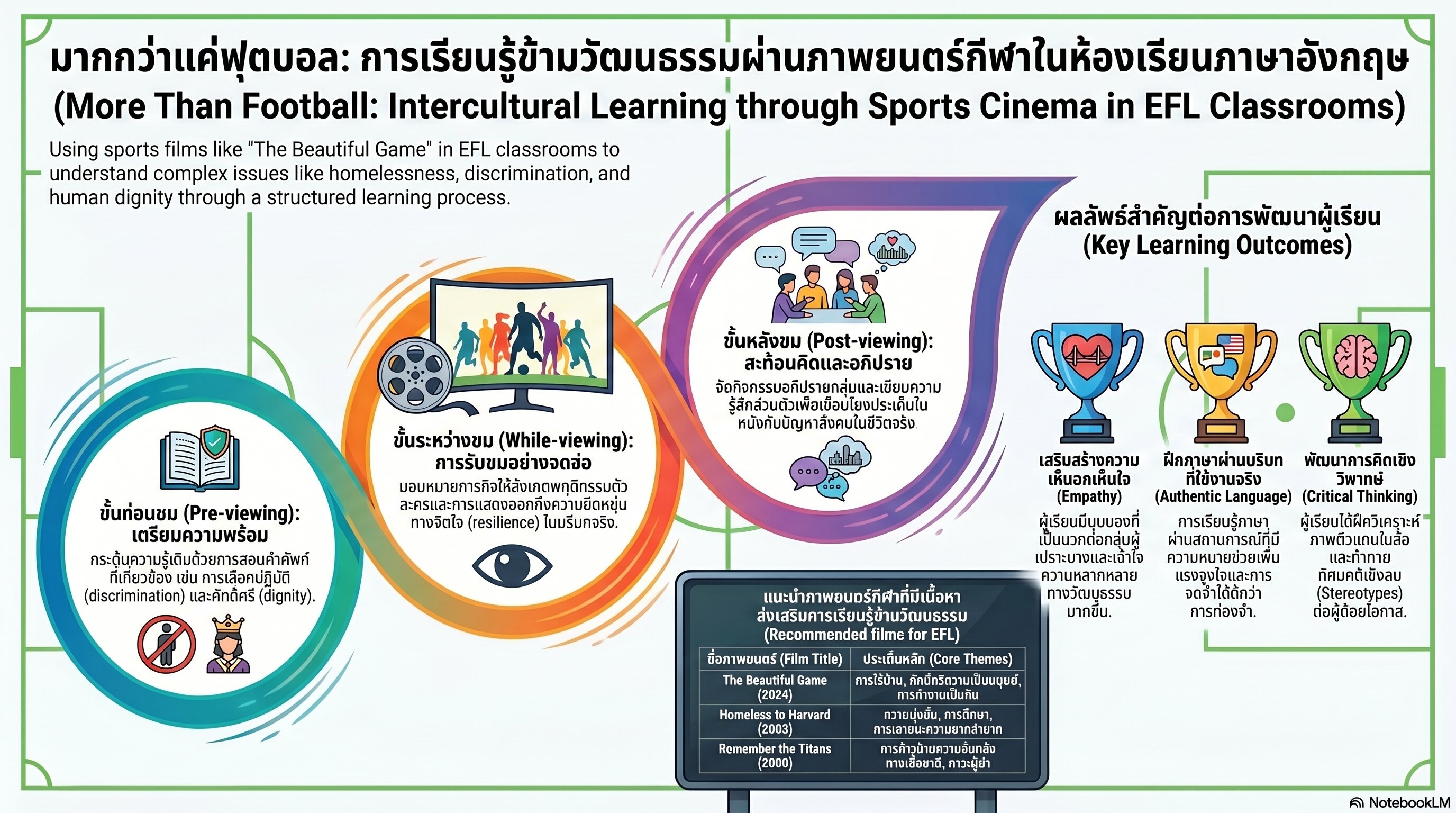
This paper discusses the pedagogical potential of film as a tool for fostering intercultural awareness in English as a Foreign Language (EFL) classroom through the sports drama The Beautiful Game. Drawing on Byram’s framework of Intercultural Communicative Competence and perspectives from critical pedagogy, the paper explores how themes of dignity, marginalization, and social inclusion portrayed in the film can encourage meaningful cultural reflection among language learners. In particular, the narrative surrounding homelessness and participation in the Homeless World Cup provides a platform for discussing issues of discrimination, resilience, and social identity. The paper outlines several pedagogical strategies that teachers may employ when integrating film into language instruction, including pre-viewing activities that activate students’ background knowledge, guided viewing tasks that support comprehension, and post-viewing discussions that encourage critical reflection. These activities allow students to engage with authentic language while also examining the broader social themes presented in the film. By connecting language learning with socially relevant topics, film-based instruction can promote empathy, intercultural understanding, and critical thinking in the classroom. The discussion suggests that sports cinema can function as a valuable multimodal resource in EFL education, supporting culturally responsive teaching practices and contributing to the broader goal of developing globally aware learners.
References
Brown, A., & Fraser, M. (2004). Celebrity identification in sports films and its influence on audience attitudes. Journal of Sport and Social Issues, 28(1), 1–17.
Coakley, J. (2017). Sports in society: Issues and controversies (12th ed.). McGraw-Hill Education.
Collins, M., & Haudenhuyse, R. (2015). Social exclusion and austerity policies in England: The role of sports in a new area of social polarisation and inequality. Social Inclusion, 3(3), 5–18. Retrieved from https://doi.org/10.17645/si.v3i3.54
Haudenhuyse, R., Theeboom, M., & Coalter, F. (2012). The potential of sports-based social interventions for vulnerable youth: Implications for sport coaches and youth workers. Journal of Youth Studies, 15(4), 437–454. Retrieved from https://doi.org/10.1080/13676261.2012.663895
Homeless World Cup Foundation. (2024). About the Homeless World Cup. Retrieved from https://www.homelessworldcup.org
Jarvie, G., & Ahrens, S. (2019). Sport, homelessness and capability: Voices from the street. Quest, 71(2), 239–251. Retrieved from https://doi.org/10.1080/00336297.2018.1552160
Magee, J., & Jeanes, R. (2013). Football’s coming home: A critical evaluation of the Homeless World Cup as an intervention to combat social exclusion. International Review for the Sociology of Sport, 48(1), 3–19.
Nelson, H., Spurr, S., Bally, J. M., Foulds, H., & de Padua, A. (2025). Finding belonging through sport for children from low-income households: A grounded theory. Sport in Society. Retrieved from https://doi.org/10.1080/14927713.2025.2551513
O’Rourke, J. J., Bundon, A., Faulkner, G., Cruwys, T., & Beauchamp, M. R. (2024). Street soccer and homelessness: Exploring social identities, health, and well-being. Psychology of Sport and Exercise, 70, 102529. Retrieved from https://doi.org/10.1016/j.psychsport.2023.102529
Sherry, E. (2010). (Re)engaging marginalized groups through sport: The Homeless World Cup. International Review for the Sociology of Sport, 45(1), 59–71.
Sherry, E., & Rowe, K. (2015). Developing sport for social inclusion: A study of community sport programs. Sport Management Review, 18(1), 126–136.
Sherry, E., & Strybosch, V. (2012). A kickstart to life: The Homeless World Cup and the role of sport in addressing homelessness. International Review for the Sociology of Sport, 47(4), 421–436.
Spaaij, R. (2012). Beyond the playing field: Experiences of sport, social capital, and integration among migrants and refugees. Routledge.
United Nations. (2003). Sport for development and peace: Towards achieving the Millennium Development Goals. United Nations.
Young, M. (2010). The Homeless World Cup: A personal account of a global social movement. Luath Press.
Downloads
Published
How to Cite
Issue
Section
Categories
License
Copyright (c) 2026 Journal of Buddhist Education and Research (JBER)

This work is licensed under a Creative Commons Attribution-NonCommercial-NoDerivatives 4.0 International License.