Development of Media-Based Learning Activities to Enhance Understanding of Government Fiscal Policy among Grade 11 Students
Abstract
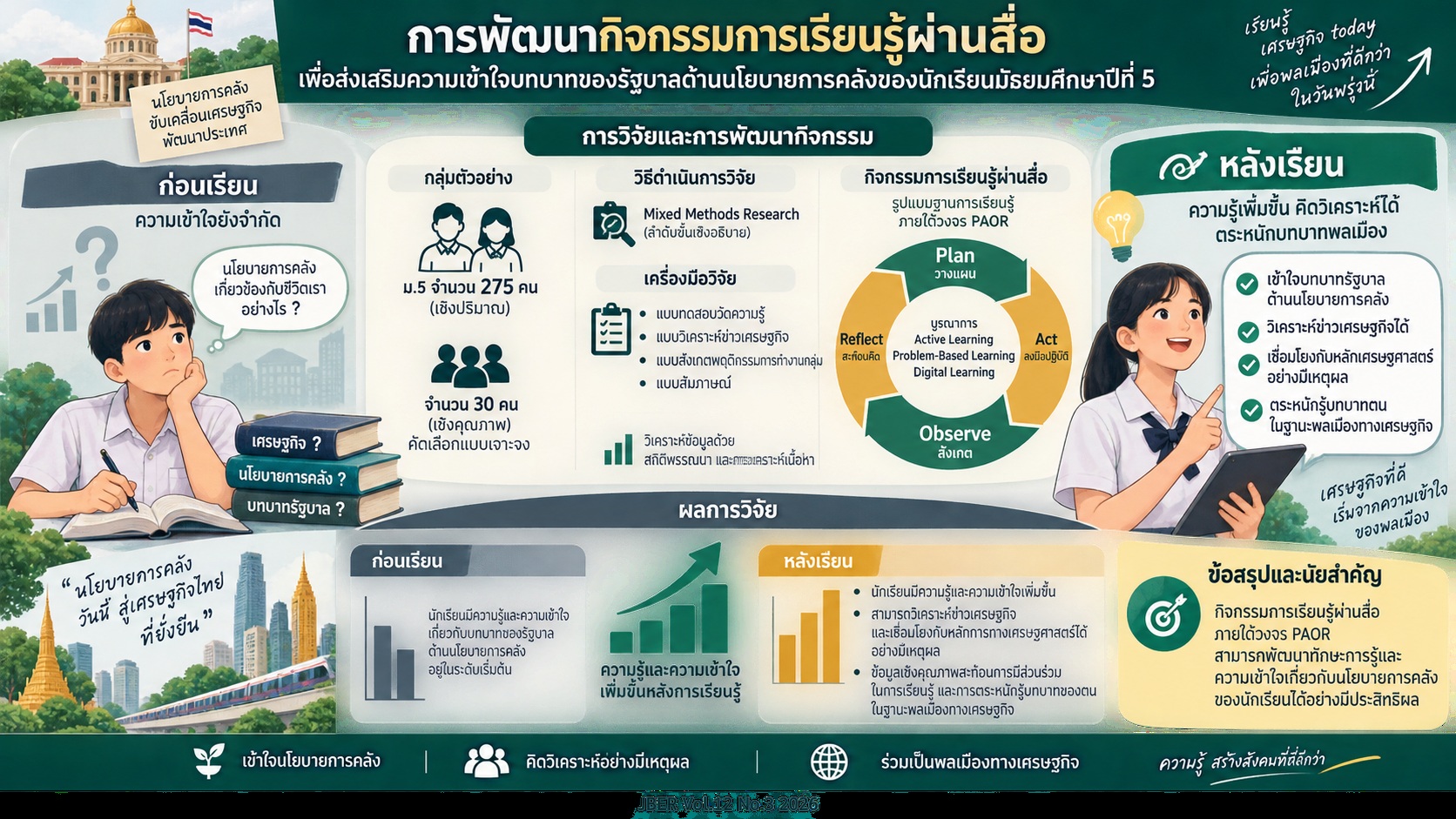
This research aimed to (1) develop students’ literacy and understanding of the government’s role in fiscal policy for Thailand’s economic development and (2) develop media-based learning activities on monetary and fiscal policy to enhance such understanding. The study employed a mixed methods research design using an explanatory sequential approach. Quantitative data were collected first, followed by qualitative data to further explain the results. The learning activities were designed as station-based learning under the PAOR cycle (Plan–Act–Observe–Reflect) and integrated the concepts of Active Learning, Problem-Based Learning, and Digital Learning.
The sample consisted of 30 Grade 11 students from Chumsaengchanutid School. The research instruments included a knowledge test, an economic news analysis form, a group observation form, and interviews. Data were analyzed using descriptive statistics and content analysis.
The results revealed that students demonstrated improved knowledge and understanding of the government’s role in fiscal policy. They were able to analyze economic news and logically connect it with economic principles. Qualitative findings supported the quantitative results, reflecting students’ active participation in learning and increased awareness of their roles as economic citizens. In conclusion, the media-based learning activities under the PAOR cycle effectively enhanced students’ literacy and understanding of fiscal policy.
Keyword: fiscal policy, media-based learning, PAOR cycle, critical thinking
References
เอกสารอ้างอิง
Aufderheide, P. (1993). Media literacy: A report of the National Leadership Conference on Media Literacy. Aspen Institute.
Barrows, H. S. (1996).Problem-based learning in medicine and beyond: A brief overview.New Directions for Teaching and Learning, 1996(68), 3–14.
Barrows, H. S., & Tamblyn, R. M. (1980). Problem-based learning: An approach to medical education. Springer Publishing Company.
Bates, A. W. (2015). Teaching in a digital age: Guidelines for designing teaching and learning. Tony Bates Associates.
Becker, W. E. (2004). Economics for a higher education: New approaches to teaching and learning. Southern Economic Journal, 70(4), 763–774.
Bonwell, C. C., & Eison, J. A. (1991). Active learning: Creating excitement in the classroom. ASHE-ERIC Higher Education Report No. 1.
Braun, V., & Clarke, V. (2006). Using thematic analysis in psychology. Qualitative Research in Psychology, 3(2), 77–101.
Cohen, L., Manion, L., & Morrison, K. (2018). Research methods in education (8th ed.). Routledge.
Creswell, J. W. (2014). Research design: Qualitative, quantitative, and mixed methods approaches (4th ed.). Sage.
Creswell, J. W., & Plano Clark, V. L. (2011). Designing and conducting mixed methods research (2nd ed.). Sage.
Denzin, N. K. (1978). The research act: A theoretical introduction to sociological methods (2nd ed.). McGraw-Hill.
Ennis, R. H. (1985). A logical basis for measuring critical thinking skills. Educational Leadership, 43(2), 44–48.
Kolb, D. A. (1984). Experiential learning: Experience as the source of learning and development. Prentice-Hall.
Lincoln, Y. S., & Guba, E. G. (1985). Naturalistic inquiry. Sage.
Miles, M. B., Huberman, A. M., & Saldaña, J. (2014). Qualitative data analysis: A methods sourcebook (3rd ed.). Sage.
Paul, R., & Elder, L. (2008). The miniature guide to critical thinking: Concepts and tools (5th ed.). Foundation for Critical Thinking.
Prince, M. (2004). Does active learning work? A review of the research. Journal of Engineering Education, 93(3), 223–231.
UNESCO. (2015). Global citizenship education: Topics and learning objectives. UNESCO.
กระทรวงศึกษาธิการ. (2551). หลักสูตรแกนกลางการศึกษาขั้นพื้นฐาน พุทธศักราช 2551 (ฉบับปรับปรุง พ.ศ. 2560). กระทรวงศึกษาธิการ.
กมลชนก สกนธวัฒน์, & ชาริณี ตรีวรัญญู. (2562). การพัฒนาชุดกิจกรรมการเรียนรู้ทางเศรษฐศาสตร์โดยใช้แนวคิดการเรียนรู้แบบฉากทัศน์เป็นฐานเพื่อส่งเสริมความฉลาดรู้การเงินของนักเรียนมัธยมศึกษาตอนต้น. โรงเรียนสาธิตจุฬาลงกรณ์มหาวิทยาลัย.
เกียรติภูมิ สังข์เงิน. (2565). การวิเคราะห์ข้อมูลการวิจัยเชิงคุณภาพแบบการวิเคราะห์แก่นสาร: แนวทางปฏิบัติสำหรับนักวิจัยใหม่. วารสารการปกครองท้องถิ่น, 15(2), 117–138.
ชนกนันท์ ช่วยประคอง. (2565). การพัฒนาทักษะในการแก้ปัญหาโดยการใช้เกมเป็นฐาน เรื่องนโยบายการเงินและการคลังของนักเรียนชั้นมัธยมศึกษาปีที่ 6 โรงเรียนดงตาลวิทยา [วิทยานิพนธ์ปริญญามหาบัณฑิต].
ฉัตรทราวดี บุญถนอม. (2567). การจัดการเรียนรู้โดยใช้ปัญหาเป็นฐาน problem-based learning.
ธวัชชัย สันติสุข. (2564). เศรษฐศาสตร์เบื้องต้น. สำนักพิมพ์มหาวิทยาลัยธรรมศาสตร์.
ทิศนา แขมมณี. (2556). ศาสตร์การสอน: องค์ความรู้เพื่อการจัดกระบวนการเรียนรู้ที่มีประสิทธิภาพ (พิมพ์ครั้งที่ 17). โรงพิมพ์แห่งจุฬาลงกรณ์มหาวิทยาลัย.
ประไพพิมพ์ สุธีวสินนนท์, & ประสพชัย พสุนนท์. (2559). กลยุทธ์การเลือกตัวอย่างสำหรับการวิจัยเชิงคุณภาพ. วารสารปาริชาต, 29(2), 31–48.
พิมพันธ์ เดชะคุปต์. (2560). การจัดการเรียนรู้ในศตวรรษที่ 21. โรงพิมพ์แห่งจุฬาลงกรณ์มหาวิทยาลัย.
รังสรรค์ ธนะพรพันธุ์. (2559). นโยบายการคลัง: หลักการและประยุกต์. สำนักพิมพ์จุฬาลงกรณ์มหาวิทยาลัย.
สายฝน แสนใจพรม. (2564). การพัฒนาครูโดยใช้กระบวนการวิจัยเชิงปฏิบัติการ (PAOR) ในการจัดการเรียนรู้เพื่อส่งเสริมทักษะการคิดวิเคราะห์ของนักเรียน. วารสารวิจัยราชภัฏเชียงใหม่.
สุกัญญา อมรเลิศชัย. (2563). การตรวจสอบสามเส้าในการวิจัยทางสังคมศาสตร์. วารสารการสื่อสารมวลชน, 8(1), 59–78.
สุวิมล ว่องวาณิช. (2562). การวิจัยและพัฒนาการจัดการเรียนรู้ในยุคดิจิทัล. สำนักพิมพ์แห่งจุฬาลงกรณ์มหาวิทยาลัย.
สำนักงานคณะกรรมการการอุดมศึกษา. (2555). แนวทางการจัดการเรียนรู้แบบ problem-based learning. สำนักงานคณะกรรมการการอุดมศึกษา.
สำนักงานเลขาธิการสภาการศึกษา. (2560). ทักษะแห่งศตวรรษที่ 21 สำหรับเด็กไทย. พริกหวานกราฟฟิค.
Downloads
Published
How to Cite
Issue
Section
Categories
License
Copyright (c) 2026 Journal of Buddhist Education and Research (JBER)

This work is licensed under a Creative Commons Attribution-NonCommercial-NoDerivatives 4.0 International License.