The Development of Learners' English Listening and Pronunciation Skills through English Phonetics Using Songs
Abstract
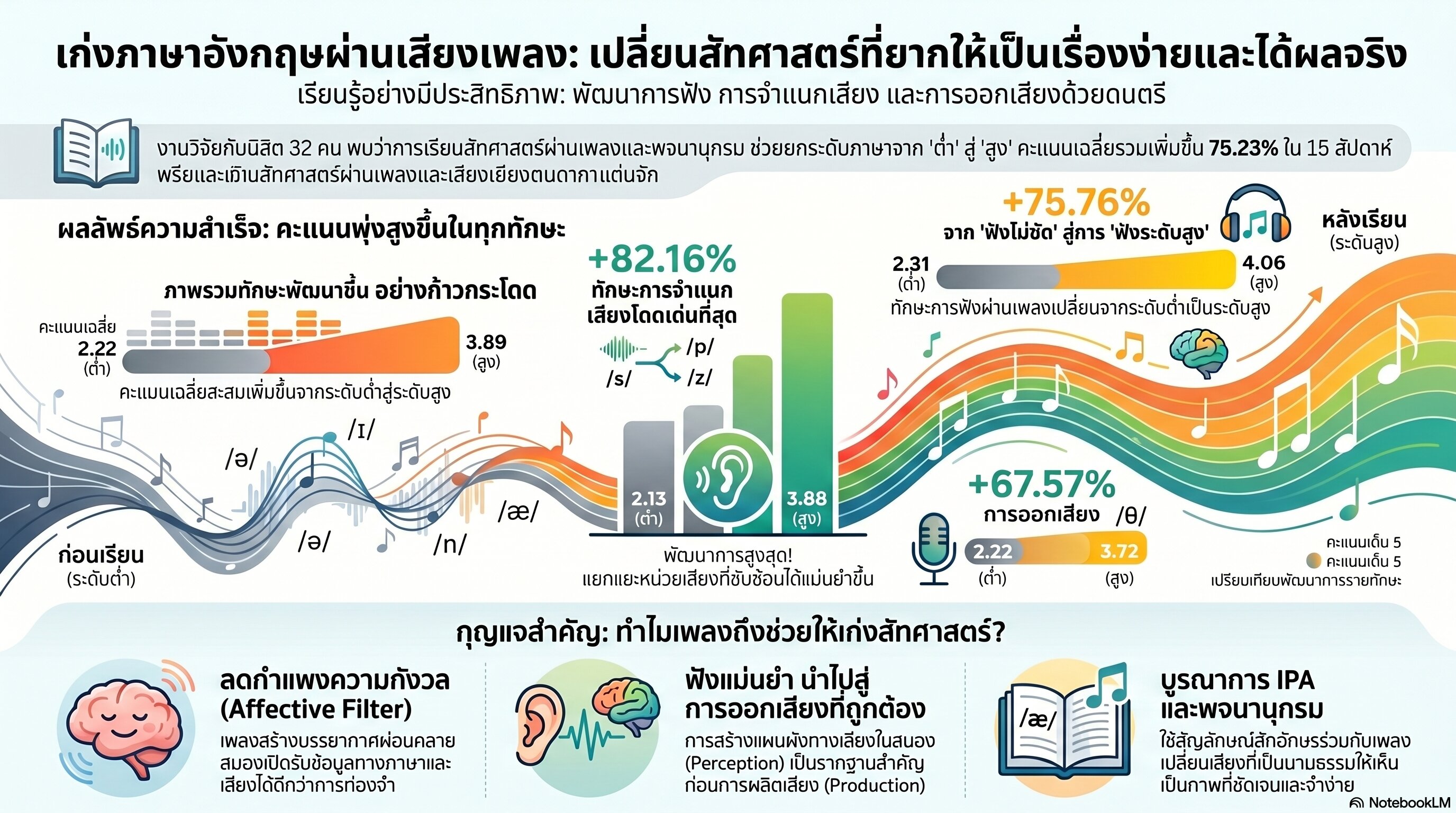
This quasi-experimental study aimed to compare learners' abilities in three skills: listening, sound discrimination, and English pronunciation before and after learning English phonetics through songs. The sample, selected through purposive sampling, consisted of 32 English major undergraduates. The research instrument was a pre-test and post-test to evaluate the learners' abilities. The data were analyzed using descriptive statistics (mean, standard deviation, and percentage) and inferential statistics (Paired-Samples t-test) for hypothesis testing. The results revealed that after learning English phonetics through songs, the learners' abilities in all skills were significantly higher than before the instruction at the .05 level of statistical significance. The mean score for listening skills increased from a low level (M = 2.31, SD = 0.47) to a high level (M = 4.06, SD = 0.62). The mean score for sound discrimination skills rose from a low level (M = 2.13, SD = 0.42) to a high level (M = 3.88, SD = 0.75). Similarly, the mean score for pronunciation skills improved from a low level (M = 2.22, SD = 0.55) to a high level (M = 3.72, SD = 0.73). Overall, the learners' average proficiency score increased from 2.22 to 3.89, representing a 75.23% improvement. The skill with the highest development was sound discrimination (82.16% increase), followed by listening (75.76% increase) and pronunciation (67.57% increase), respectively. This research suggests that learning English phonetics through songs is an effective teaching method for developing learners' listening, sound discrimination, and pronunciation skills concretely. The findings can be applied as a guideline for promoting the teaching and learning of the English language in the future.
References
ฉลวย บุญประเสริฐ. (2553). ภาษาศาสตร์พื้นฐาน (ฉบับแก้ไขเพิ่มเติม, พิมพ์ครั้งที่ 2). มหาวิทยาลัยราชภัฏธนบุรี.
เทียนมณี บุญจุน. (2548). สัทศาสตร์: ระบบเสียงในภาษาอังกฤษและภาษาไทย. โอเดียนสโตร์.
ปรารถนา ผดุงพจน์. (2567). ประสิทธิภาพของชุดการฝึกปฏิบัติด้วยตนเองการออกเสียงภาษาอังกฤษเรื่องการลงเสียงหนัก-เบาในภาษาอังกฤษสำหรับนักศึกษาสาขาภาษาอังกฤษ. วารสารศึกษาศาสตร์ มหาวิทยาลัยสงขลานครินทร์ วิทยาเขตปัตตานี, 35(1), 81–94.
พิณทิพย์ ทวยเจริญ. (2544). การพูดภาษาอังกฤษตามหลักภาษาศาสตร์ (พิมพ์ครั้งที่ 3). มหาวิทยาลัยธรรมศาสตร์.
Avdiu, T. A. (2021). Non-native English teachers' views on the use of music and songs in teaching English as a foreign language to primary school learners. Rast Musicology Journal, 9(3), 3105–3120.
Cambridge advanced learner's dictionary (4th ed.). (2013). Cambridge University Press.
Celce-Murcia, M., Brinton, D. M., & Goodwin, J. M. (2010). Teaching pronunciation: A course book and reference guide (2nd ed.). Cambridge University Press.
Engh, D. (2013). Why use music in English language learning? A survey of the literature. English Language Teaching, 6(2), 113–127.
Flege, J. E. (2018, July). The speech learning model (SLM) account of how Japanese speakers learn English /r/ and /l/ [Conference presentation]. Sophia University, Tokyo, Japan.
Hewings, M. (2004). Pronunciation practice activities book and audio CD pack (Vol. 2). Cambridge University Press.
Krashen, S. D. (1982). Principles and practice in second language acquisition. Pergamon Press.
Medina, S. L. (1993). The effect of music on second language acquisition (ED358337). ERIC. Retrieved from https://scispace.com/pdf/the-effects-of-music-upon-second-language-vocabulary-531viv1ndp.pdf
Patel, A. D. (2011). Why would musical training benefit the neural encoding of speech? The OPERA hypothesis. Frontiers in Psychology, 2, 142. Retrieved from https://doi.org/10.3389/fpsyg.2011.00142
Schön, D., Boyer, M., Moreno, S., Besson, M., Peretz, I., & Kolinsky, R. (2008). Songs as an aid for language acquisition. Cognition, 106(2), 975–983.
Shen, C. (2009). Using English songs: An enjoyable and effective approach to ELT. English Language Teaching, 2(1), 88–94. Retrieved from https://doi.org/10.5539/elt.v2n1p88
Ward, S. (2009, October 26). Stand by me [Video]. YouTube. Retrieved from https://www.youtube.com/watch?v=40H9mpkkaz0
Downloads
Published
How to Cite
Issue
Section
Categories
License
Copyright (c) 2026 Journal of Buddhist Education and Research (JBER)

This work is licensed under a Creative Commons Attribution-NonCommercial-NoDerivatives 4.0 International License.