Model Based on Good Governance Principles for Small-Size Educational Institutions under the Bangkok Metropolitan Administration
Abstract
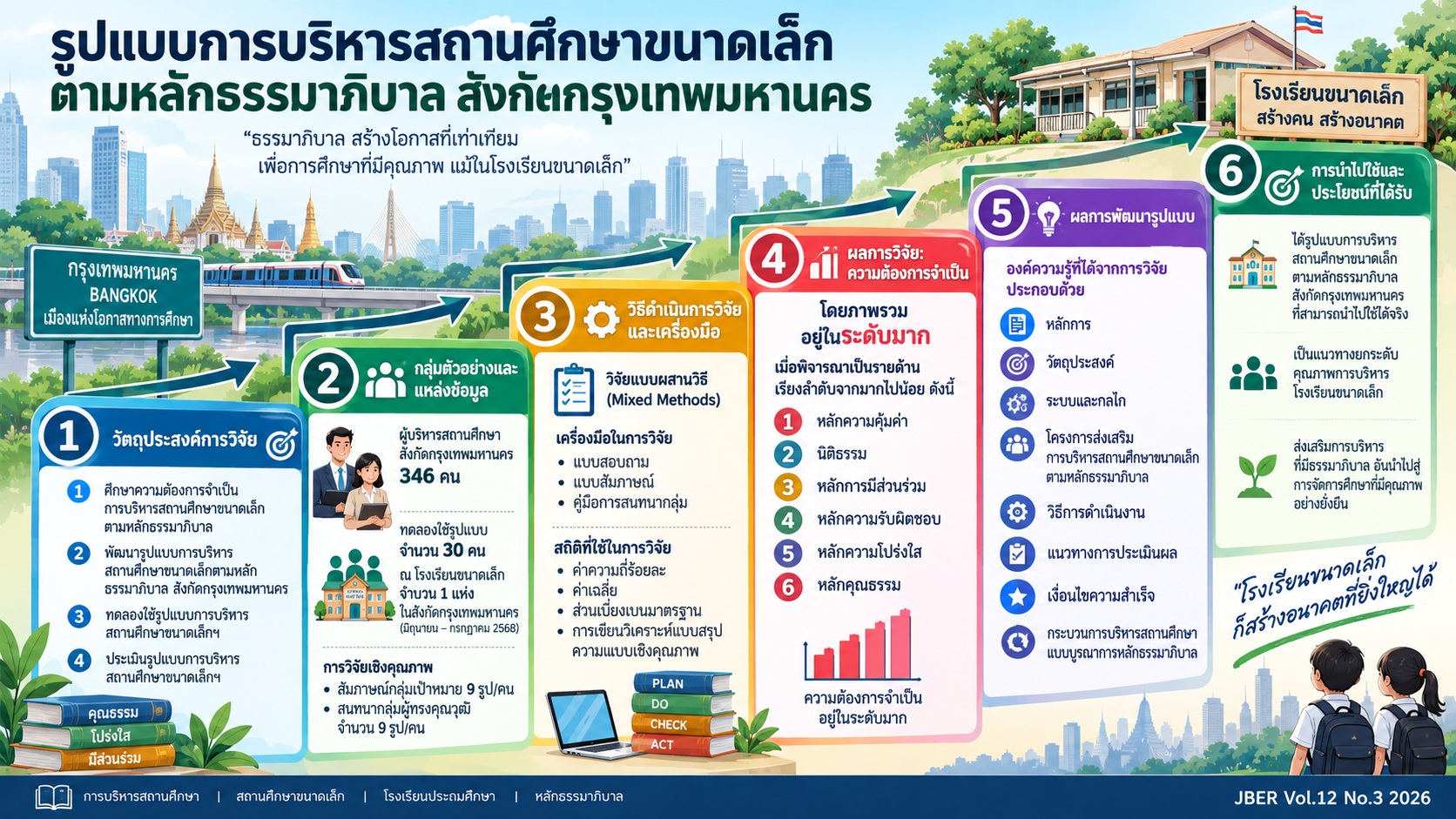
This research aims to 1) study the needs for managing small schools according to good governance principles; and 2) develop a model for managing small schools under the Bangkok Metropolitan Administration (BMA) based on good governance principles. This research employs a mixed-methods approach, combining quantitative and qualitative research. Quantitative research involved a sample of 346 school administrators from the BMA and a pilot test of the model for managing small schools based on good governance principles with 30 participants at one small BMA school during June-July 2025. Qualitative research included interviews with 9 administrators and focus group discussions with 9 experts. Research instruments included questionnaires, interview guides, and focus group discussion manuals. Statistical analysis included frequency, percentage, mean, standard deviation, and qualitative summary analysis. The results showed that: 1) The overall needs for managing small schools under the BMA based on good governance principles were high. When considering each aspect individually, the needs were ranked from most to least needed as follows: cost-effectiveness, rule of law, participation, accountability, and transparency. And regarding the moral aspect, 2) The results of developing a model for managing small schools based on good governance principles in Bangkok found that the knowledge gained from the research includes principles, objectives, systems and mechanisms, as well as projects to promote the management of small schools based on good governance principles, methods of operation, guidelines for evaluating success conditions, and the integrated school management process based on good governance principles.
References
พระสกล ฐานธมฺโม (อินทร์คล้าย). (2556). การบริหารสถานศึกษาตามหลักธรรมาภิบาลของผู้บริหาร
สถานศึกษาในจังหวัดนครสวรรค์. พระนครศรีอยุธยา: มหาวิทยาลัยมหาจุฬาลงกรณราช
วิทยาลัย.
พระอุทิศ สมมาภาณี (แท่งทอง). (2564). หลักธรรมาภิบาลกับการบริหารการศึกษา. นครสวรรค์: วิทยาลัย
สงฆ์นครสวรรค์ มหาวิทยาลัยมหาจุฬาลงกรณราชวิทยาลัย.
โรงเรียนสังกัดกรุงเทพมหานคร. (2567). ระบบสารสนเทศ Big Data ข้อมูลจำนวนบุคลากร. เรียกใช้เมื่อ 9 กรกฎาคม 2567. https://webportal.bangkok.go.th/
วรวิทย์ มีเดช. (2562). การศึกษาผลของการจัดการเรียนรู้ต่อผลสัมฤทธิ์ของผู้เรียน. วารสารวิชาการศึกษา.
สมชาย เหล็กเพชร. (2561). วิเคราะห์งานของพระสงฆ์ในฐานะที่เป็นผู้นำพัฒนาชุมชน. บัณฑิตวิทยาลัย
มหาวิทยาลัยเชียงใหม่.
สุวิมล ว่องวาณิช. (2558). การวิจัยประเมินความต้องการจำเป็น. (พิมพ์ครั้งที่ 3). กรุงเทพมหานคร: สำนักพิมพ์แห่งจุฬาลงกรณ์มหาวิทยาลัย.
สำนักงานเลขาธิการสภาการศึกษา. (2562). แผนการศึกษาแห่งชาติ พ.ศ. ๒๕๖๐-๒๕๗๙. กรุงเทพฯ: พริก
หวานกราฟฟิค.
Best, J. W. (1977). Research in education. (3rd ed.). Englewood Cliffs, NJ: Prentice-Hall.
Cronbach, L. J. (1971). Essentials of psychological testing. (4th ed.). New York: Harper & Row.
Keeves. (1988). Educational research methodology, and measurement: An international
handbook. Oxford, England: Pergamon Press
Krejcie, R. V. & Morgan, D. W. (1970). Determining sample size for research activities. Educational and Psychological Measurement, 30(3), 607-610.
Likert, R. (1967). The method of constructing an attitude scale. In M. Fishbein, Reading in attitude theory and measurement. New York: Wiley & Sons.
Downloads
Published
How to Cite
Issue
Section
Categories
License
Copyright (c) 2026 Journal of Buddhist Education and Research (JBER)

This work is licensed under a Creative Commons Attribution-NonCommercial-NoDerivatives 4.0 International License.