The Development of Reading Skills Through Gamification-Based Learning Combined with Citta Bhāvanā for Prathom Suksa 2 Students at Anuban Nakhon Champasri School, Maha Sarakham Province
Abstract
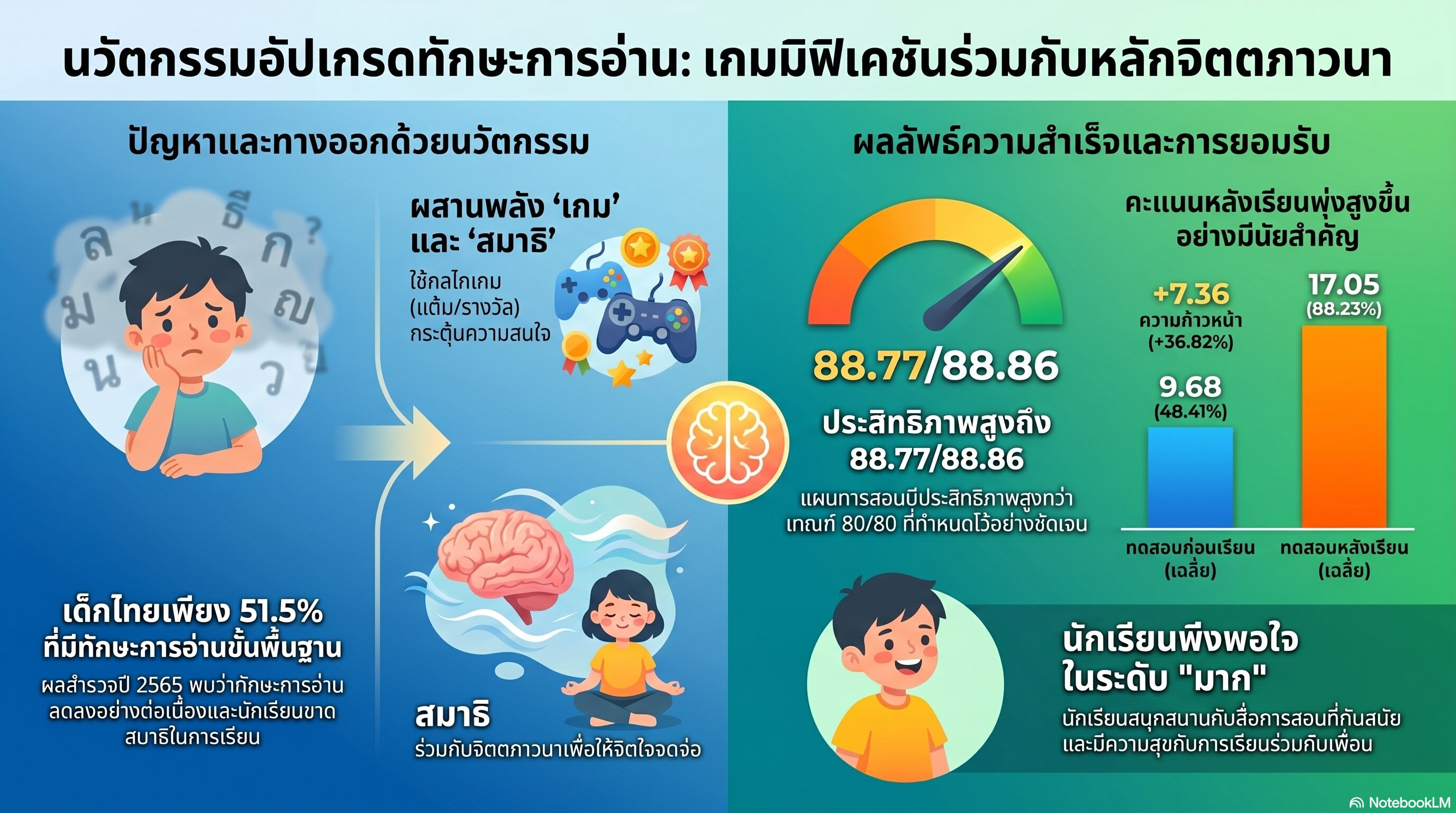
This research aimed to: (1) develop a Thai reading skill development lesson plan using gamification-based learning integrated with Citta Bhāvanā, targeting the efficiency criteria of 80/80, (2) compare learning achievements in Thai reading skills before and after implementing the gamification and Citta Bhāvanā-based instruction, and (3) examine students’ satisfaction toward the learning approach. The target group consisted of 22 Prathom Suksa 2/2 students from Anuban Nakhon Champasri School, Maha Sarakham Province. The research instruments included: (1) the Thai reading skill development lesson plans based on gamification and Citta Bhāvanā, (2) a learning achievement test, and (3) a satisfaction questionnaire. Data were analyzed using basic statistics: mean, standard deviation (S.D.), and the dependent t-test. The research results were as follows: 1) The Thai reading skill development lesson plan, using gamification-based learning combined with Citta Bhāvanā for Prathom Suksa 2/2 students, achieved an efficiency of 88.77/88.86, which is higher than the specified criterion of 80/80. 2) Students’ learning achievement in Thai reading through gamification-based learning integrated with Citta Bhāvanā showed that the mean pre-test and post-test scores were 9.68 and 17.05, respectively. A comparison of the scores revealed that the post-test mean was significantly higher than the pre-test mean at the .05 level of statistical significance. 3) Students expressed a high level of satisfaction with the Thai reading lesson plan using gamification-based learning combined with Citta Bhāvanā, with an overall average score of 2.67, interpreted as a high level of satisfaction.
References
กระทรวงศึกษาธิการ. (2553). หลักสูตรแกนกลางการศึกษาขั้นพื้นฐาน พุทธศักราช 2551 (พิมพ์ครั้งที่ 3). โรงพิมพ์ชุมนุมสหกรณ์การเกษตรแห่งประเทศไทย จำกัด.
กิตติชัย สิธาสุโนบล. (2555). การพัฒนารูปแบบการจัดการเรียนการสอนแบบบูรณาการตามแนวพุทธเพื่อสะท้อนแนวคิดปรัชญาเศรษฐกิจพอเพียงในบริบทแห่งสังคมไทยยุคปัจจุบัน [รายงานการวิจัย]. คณะศึกษาศาสตร์ มหาวิทยาลัยศรีนครินทรวิโรฒ.
ขนิษฐา โลหะประเสริฐ, และคณะ. (2566). การพัฒนาชุดฝึกทักษะการอ่านร่วมกับเทคนิคเกมิฟิเคชัน (Gamification) เพื่อส่งเสริมความสามารถการอ่านคำภาษาไทยของนักเรียนชั้นประถมศึกษาปีที่ 2 สังกัดสำนักงานการศึกษาเอกชนจังหวัดสงขลา. วารสารพิกุล, 21(2), 233–252.
ชนัตถ์ พูนเดช, & ธนิตา เลิศพรกุลรัตน์. (2559). แนวทางการจัดการเรียนรู้ด้วยแนวคิดเกมมิฟิเคชัน. วารสารศึกษาศาสตร์ มหาวิทยาลัยนเรศวร, 18(3), 331–339.
เบญจพร พลไกร. (2565). การพัฒนาความสามารถด้านการอ่านสะกดคำภาษาไทย โดยใช้การจัดการเรียนรู้เชิงรุก (Active Learning) ร่วมกับแนวคิดเกมิฟิเคชัน (Gamification) สำหรับนักเรียนที่มีภาวะถดถอยทางการเรียนรู้ (Learning Loss) ในสถานการณ์การโควิด-19 ชั้นประถมศึกษาปีที่ ... [การค้นคว้าอิสระปริญญาการศึกษามหาบัณฑิต]. มหาวิทยาลัยนเรศวร.
ยูนิเซฟแห่งประเทศไทย. (2566). รายงานผลการดำเนินงานประจำปี 2566. สืบค้นจาก https://www.unicef.org/thailand/th/reports/รายงานผลการดำเนินงานประจำปี-2566
สำนักงานคณะกรรมการการศึกษาขั้นพื้นฐาน. (2566). รายงานผลการประเมินคุณภาพผู้เรียน (NT) ชั้นประถมศึกษาปีที่ 3 ปีการศึกษา 2566. สืบค้นจาก http://180.180.244.42/NT/ExamWeb/FrLogin.aspx?ReturnUrl=%2fNT%2fExamWeb%2f
สุภัทรา สดเอี่ยม. (2565). การพัฒนาทักษะการอ่านและแรงจูงใจในการอ่านของนักเรียนชั้นประถมศึกษาตอนปลายด้วยวิธีการสอนแบบแจกลูกสะกดคำร่วมกับเกมมิฟิเคชัน [วิทยานิพนธ์ครุศาสตรมหาบัณฑิต สาขาวิชาหลักสูตรและการสอน]. มหาวิทยาลัยธุรกิจบัณฑิตย์.
อาจหาญ นิมิตหมื่นไวย. (2550). การประยุกต์ใช้หลักธรรมะเรื่องจิตตภาวนาเพื่อพัฒนาความฉลาดทางอารมณ์ของบุคลากร [สารนิพนธ์วิทยาศาสตรมหาบัณฑิต สาขาวิชาการพัฒนาทรัพยากรมนุษย์และองค์การ]. สถาบันบัณฑิตพัฒนบริหารศาสตร์.
โอม สุขสมยศ. (2560). การพัฒนาช่วงความสนใจและสมาธิของนักเรียนระดับชั้นประถมศึกษาปีที่ 1 โดยใช้กิจกรรมการเล่น [วิทยานิพนธ์วิทยาศาสตรมหาบัณฑิต สาขาวิชาสุขภาพจิต]. จุฬาลงกรณ์มหาวิทยาลัย.
Al-Dosakee, K., & Ozdamli, F. (2021). Gamification in teaching and learning languages: A systematic literature review. Revista Romaneasca pentru Educatie Multidimensionala, 13(2), 559–577.
Jenni Majuri, Jonna Koivisto, & Juho Hamari. (2018). Gamification of education and learning: A review of empirical literature. In GamiFIN Conference 2018 (pp. 11–19). Pori, Finland.
Downloads
Published
How to Cite
Issue
Section
License
Copyright (c) 2026 Authors

This work is licensed under a Creative Commons Attribution-NonCommercial-NoDerivatives 4.0 International License.