Modern Buddhist Training Process
Abstract
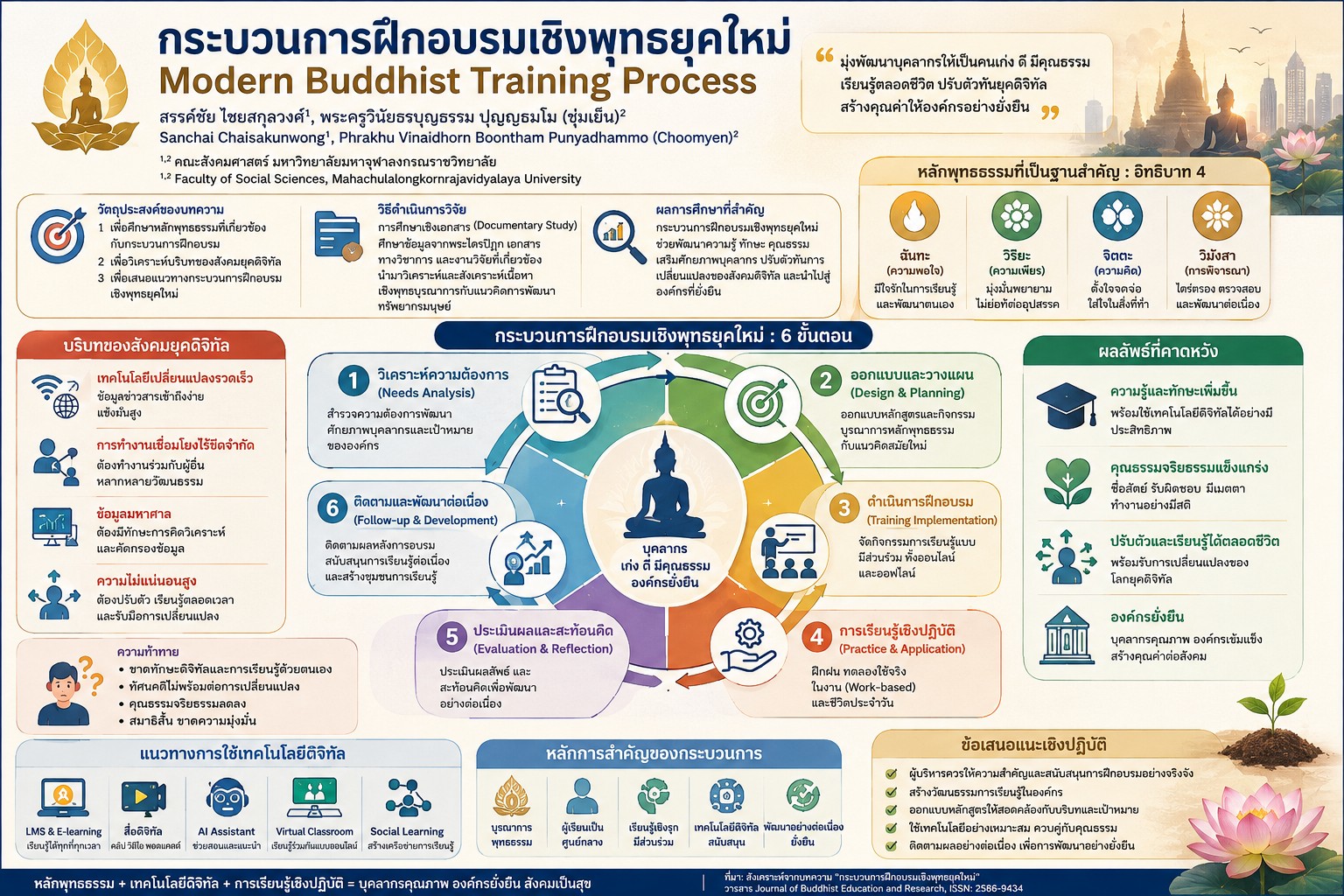
This academic article aims to 1) study Buddhist principles related to the training process, 2) analyze the context of the digital age, and 3) propose a modern Buddhist training process that can be applied to develop the potential of personnel in organizations. This article is a documentary study, examining information from the Tripitaka, academic documents, and related research. The content is then analyzed and synthesized, integrating Buddhist principles with human resource development concepts. The findings indicate that: 1) Modern Buddhist training processes should emphasize the development of knowledge, skills, and virtues, based on the Four Bases of Success (Iddhipada 4); 2) Learning through digital technology enhances the potential of personnel by equipping them with knowledge, skills, and moral character; and 3) enables effective adaptation to the changes in the digital age, leading to long-term organizational sustainability.
References
ชูชัย สมิทธิไกร. (2548). การฝึกอบรมบุคลากรในองค์การ (พิมพ์ครั้งที่ 4). สำนักพิมพ์แห่งจุฬาลงกรณ์มหาวิทยาลัย.
ถนอมพร เลาหจรัสแสง. (2545). Designing e-Learning: หลักการออกแบบและการสร้างเว็บเพื่อการเรียนการสอน. อรุณการพิมพ์.
พระไตรปิฎกภาษาไทย. (2539). พระสุตตันตปิฎก ทีฆนิกาย ปาฏิกวรรค (เล่ม 11, ข้อ 306, หน้า 277). โรงพิมพ์มหาจุฬาลงกรณราชวิทยาลัย.
พระธรรมปิฎก (ป. อ. ปยุตฺโต). (2540). พุทธศาสนาพัฒนาคนและสังคม. มูลนิธิพุทธธรรม.
พิไร สุพัตร. (2560). การพัฒนาการฝึกอบรมออนไลน์ด้วยระบบการจัดการเรียนรู้ระบบเปิดสำหรับมหาชน เรื่อง การออกแบบสื่ออินโฟกราฟิก [วิทยานิพนธ์ปริญญามหาบัณฑิต, มหาวิทยาลัยศิลปากร].
เยาวลักษณ์ ศรีกล่ำ. (2547). การศึกษาผลการเรียนแบบร่วมมือโดยกระบวนการแก้ปัญหาที่เป็นพลวัตรที่มีต่อความสามารถในการแก้ปัญหาทางคณิตศาสตร์ของนักเรียนชั้นประถมศึกษาปีที่ 4 [วิทยานิพนธ์ปริญญามหาบัณฑิต, มหาวิทยาลัยศรีนครินทรวิโรฒ].
เรวดี จุลรอด. (2556). กระบวนการฝึกอบรมและการบริหารงานฝึกอบรม. https://www.gotoknow.org/posts/189628
วรัญญา เฮงเจริญ. (2557). การเรียนรู้ผ่านระบบการฝึกอบรมออนไลน์ (E-Training). http://mochinoc.blogspot.com/2014/04/e-training.html
วรวุฒิ มั่นสุขผล. (2557). การพัฒนารูปแบบการฝึกอบรมออนไลน์โดยการเรียนรู้แบบร่วมกันเพื่อพัฒนาสมรรถนะการออกแบบอีเลิร์นนิงเพื่อการเรียนการสอนของอาจารย์ระดับอุดมศึกษา [วิทยานิพนธ์ปริญญาดุษฎีบัณฑิต, มหาวิทยาลัยศิลปากร].
สามารถ สิงห์มา. (2562). การพัฒนากลยุทธ์การฝึกอบรมออนไลน์เพื่อส่งเสริมสมรรถนะการพัฒนาคอร์สแวร์ของอาจารย์ในสถาบันอุดมศึกษา: กรณีมหาวิทยาลัยขอนแก่น [วิทยานิพนธ์ปริญญามหาบัณฑิต, มหาวิทยาลัยมหาสารคาม].
สมคิด บางโม. (2545). เทคนิคการฝึกอบรมและการประชุม. วิทยาพัฒน์.
สถาบันบัณฑิตพัฒนบริหารศาสตร์. (2523). นิด้า 23. โรงพิมพ์มหาวิทยาลัยธรรมศาสตร์.
เสนาะ ติเยาว์. (2546). หลักการบริหาร. โรงพิมพ์มหาวิทยาลัยธรรมศาสตร์.
Clark, G. (1996). Glossary of CBT/WBT terms. http://www.clark.net/pub/nractive/alt5.htm
Hannum, W. (1998). Web based instruction lessons. http://www.soe.unc.edu/edci111/8-98/index_wbi2.htm
Hirumi, A., & Bermúdez, A. (1996). Interactivity, distance education, and instructional systems design converge on the information superhighway. Journal of Research on Computing in Education, 29, 1–16.
Downloads
Published
How to Cite
Issue
Section
Categories
License
Copyright (c) 2026 Journal of Buddhist Education and Research (JBER)

This work is licensed under a Creative Commons Attribution-NonCommercial-NoDerivatives 4.0 International License.