A Study of Patterns and Strategic Logics of Community Development Initiatives by Private Business Organizations in Thailand
Keywords:
Community development, Private business organizations, Strategic logics, Corporate social responsibility, SustainabilityAbstract
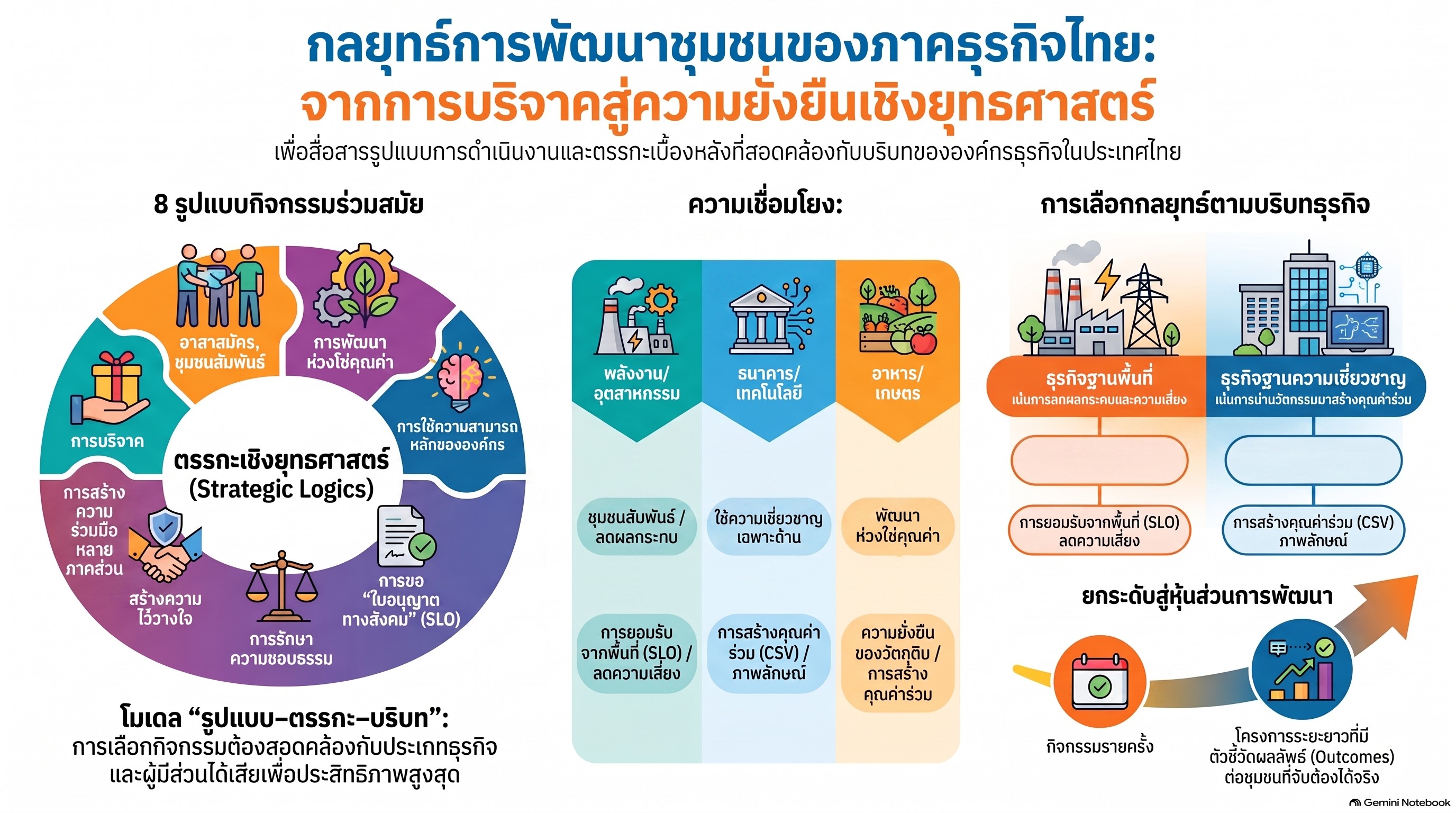
This study aimed to 1) examine the context and contemporary characteristics of community development initiatives undertaken by private business organizations in Thailand, 2) analyze the patterns of these initiatives, and 3) synthesize the strategic logics underlying those patterns. A qualitative documentary approach was employed. Fifty documents published between 2018 and 2026 were purposively selected, comprising 15 Thai academic and research articles, 10 international academic and research articles, 20 corporate reports, and 5 standards or guideline documents. Document quality was appraised in terms of source credibility, transparency of data generation, traceability, and risk of producer bias. Evidence levels were also classified to distinguish corporate self-reports from outcomes supported by independent evidence. Data were analyzed through qualitative content analysis, coding, and thematic synthesis. The findings showed that community development initiatives appeared as overlapping contemporary patterns rather than a linear historical progression. Eight patterns were identified: philanthropy and charitable support, employee volunteering, community relations, impact mitigation and risk management, livelihood and local economic development, value chain development, the use of core organizational competencies, and development partnerships. These patterns were associated with eight strategic logics: corporate image, trust, legitimacy, social license to operate, risk reduction, shared value creation, sustainability and disclosure, and the use of core organizational competencies. The study proposes the Pattern–Logic–Context Model, linking business context, activity patterns, and strategic logics while considering evidence quality. However, the study was limited to documents from the specified period, included corporate reports containing selectively disclosed information, and did not collect field data from communities. The findings therefore describe patterns evident in the selected documents and do not directly verify community impacts in every case.
References
เจณิสตา มะละกา, จิรัฐติกาล วุฒิพันธุ์, เดชอนันต์ บังกิโล, และ ธนภณ วิมูลอาจ. (2567). ความสัมพันธ์ระหว่างระดับความรับผิดชอบด้านสิ่งแวดล้อม สังคมและบรรษัทภิบาล (ESG) กับผลการดำเนินงานของบริษัทจดทะเบียนในตลาดหลักทรัพย์แห่งประเทศไทยในช่วงสถานการณ์การระบาดของโควิด-19. วารสารการบัญชีและการจัดการ, 16(2), 46–63. https://so02.tci-thaijo.org/index.php/mbs/article/view/263037
ทัศไนย์ ขอนสี และ นพวรรณ วิเศษสินธุ์. (2567). แนวทางการส่งเสริมการจัดกิจกรรมความรับผิดชอบต่อสังคมของบริษัทในนิคมอุตสาหกรรมบางปู โดยมีวัดศรีจันทร์ประดิษฐ์เป็นศูนย์กลาง. วารสารการจัดการและการพัฒนา มหาวิทยาลัยราชภัฏอุบลราชธานี, 11(2), 161–178. https://so06.tci-thaijo.org/index.php/JMDUBRU/article/view/280448
พงศ์ปณต ใจยา และ นุจรี ภาคาสัตย์. (2564). แนวทางในการสร้างคุณค่าร่วมกับสังคมขององค์กร (CSV) ที่มีอิทธิพลต่อภาพลักษณ์ ชื่อเสียง และการยอมรับของชุมชนในเขตพื้นที่มาบตาพุด จังหวัดระยอง. วารสารดุษฎีบัณฑิตทางสังคมศาสตร์, 11(2), 469–479. https://doi.org/10.14456/phdssj.2021.35
อุไรรัตน์ อภิวัฒนกุล และ จินตวีร์ เกษมศุข. (2565). รูปแบบกิจกรรมความรับผิดชอบสังคมกับความยั่งยืนของธุรกิจ กรณีศึกษา บมจ. ทรู คอร์ปอเรชั่น. วารสารปัญญาภิวัฒน์, 14(3), 293–306. https://so05.tci-thaijo.org/index.php/pimjournal/article/view/260829
Attanasio, G., Preghenella, N., De Toni, A. F., & Battistella, C. (2022). Stakeholder engagement in business models for sustainability: The stakeholder value flow model for sustainable development. Business Strategy and the Environment, 31(3), 860–874. https://doi.org/10.1002/bse.2922
Fallah Shayan, N., Mohabbati-Kalejahi, N., Alavi, S., & Zahed, M. A. (2022). Sustainable Development Goals (SDGs) as a framework for corporate social responsibility (CSR). Sustainability, 14(3), Article 1222. https://doi.org/10.3390/su14031222
Latapí Agudelo, M. A., Jóhannsdóttir, L., & Davídsdóttir, B. (2019). A literature review of the history and evolution of corporate social responsibility. International Journal of Corporate Social Responsibility, 4, Article 1. https://doi.org/10.1186/s40991-018-0039-y
Lindman, Å., Ranängen, H., & Kauppila, O. (2020). Guiding corporate social responsibility practice for social license to operate: A Nordic mining perspective. The Extractive Industries and Society, 7(3), 892–907. https://doi.org/10.1016/j.exis.2020.07.013
Pakdeepinit, P., Limpanitgul, T., Lertthaitrakul, W., & Promchan, S. (2026). Dynamics of corporate social responsibility (CSR) amongst local communities in Thailand: Between 2019 and 2023. Thammasat Review, 29(1), 21–39. https://doi.org/10.70730/tureview.v29i1.241432
Taghipour, A., Khazaei, M., Azar, A., Rajabzadeh Ghatari, A., Hajiaghaei-Keshteli, M., & Ramezani, M. (2022). Creating shared value and strategic corporate social responsibility through outsourcing within supply chain management. Sustainability, 14(4), Article 1940. https://doi.org/10.3390/su14041940
Vishwanathan, P., van Oosterhout, H., Heugens, P. P. M. A. R., Duran, P., & van Essen, M. (2020). Strategic CSR: A concept building meta-analysis. Journal of Management Studies, 57(2), 314–350. https://doi.org/10.1111/joms.12514
Wong, W.-K., Teh, B.-H., & Tan, S.-H. (2023). The influence of external stakeholders on environmental, social, and governance (ESG) reporting: Toward a conceptual framework for ESG disclosure. Foresight and STI Governance, 17(2), 9–20. https://doi.org/10.17323/2500-2597.2023.2.9.20
Downloads
Published
How to Cite
Issue
Section
Categories
License
Copyright (c) 2026 Journal of Buddhist Education and Research (JBER)

This work is licensed under a Creative Commons Attribution-NonCommercial-NoDerivatives 4.0 International License.