Emotional Intelligence of Generation Z in the Digital Era: A Dual-Impact Analysis on Learning and Work Performance in the 21st Century
Keywords:
Emotional Intelligence, Generation Z, Digital Technology, Mental Health, LearningtionAbstract
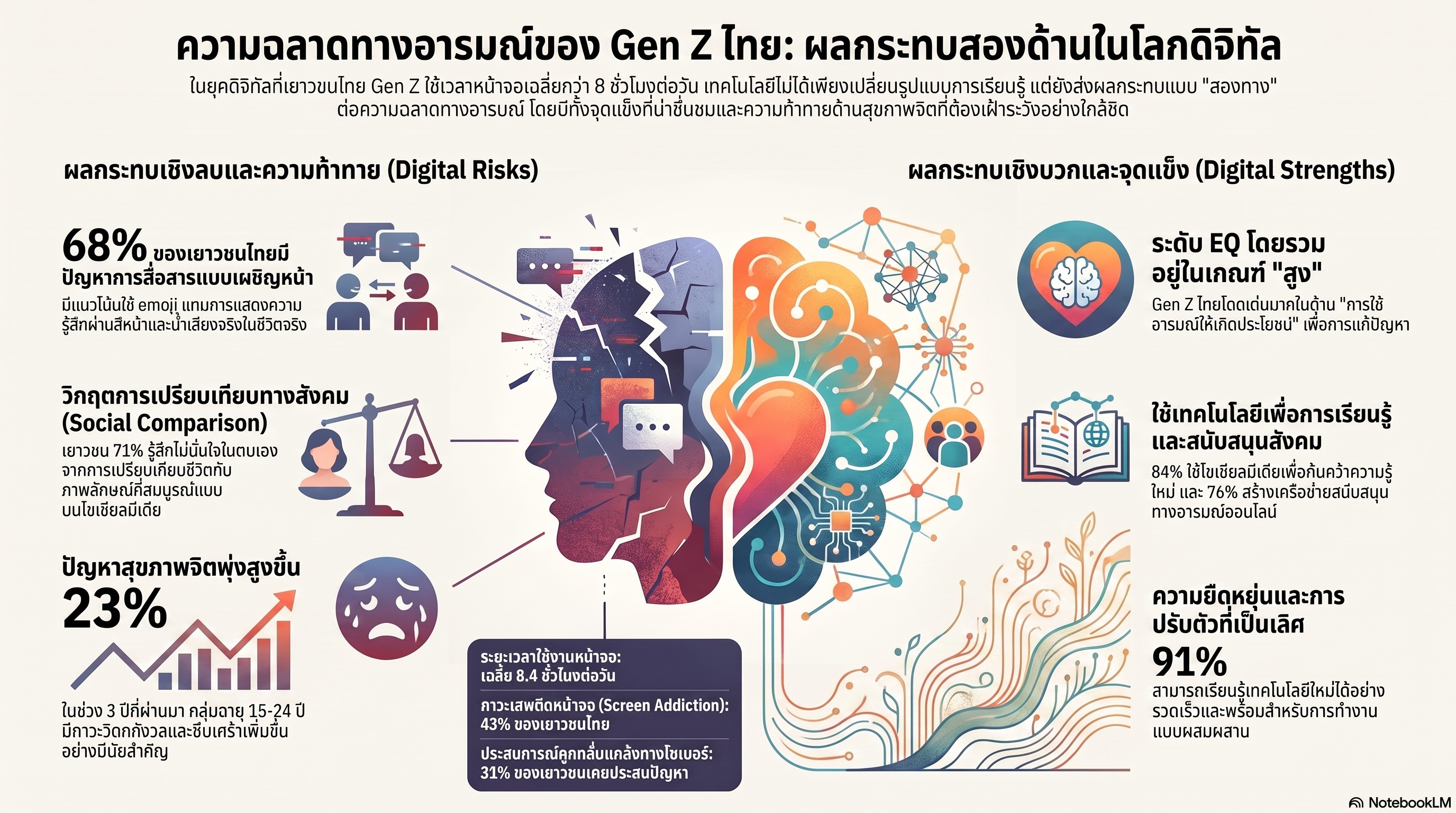
This study aimed to analyze the impact of the digital era on the emotional intelligence of Thai Generation Z and examine its relationship with learning and working behaviors in the twenty-first century. The study employed a literature review by synthesizing and analyzing relevant Thai and international research. The findings indicated that the digital era has both positive and negative impacts on the emotional intelligence of Thai Generation Z. On the negative side, the digital environment contributes to reduced face-to-face communication skills, increased social comparison through social media, excessive screen time, and a rising trend of mental health problems. Conversely, Thai Generation Z demonstrates a high overall level of emotional intelligence, particularly in the effective use of emotions for constructive purposes. They also exhibit strong capabilities in utilizing digital technology for learning, establishing supportive social networks, and adapting effectively to emerging technologies. Furthermore, family, educational institutions, and community environments play significant roles in fostering emotional intelligence and social competence. Emotional support from families, the appropriate integration of technology into educational practices, and opportunities for real-life social interaction contribute to the development of balanced emotional and social skills. The study recommends the implementation of integrated policies, including curriculum reform that incorporates Social-Emotional Learning (SEL), capacity building for teachers and parents in digital parenting, strengthening cybersecurity standards, enhancing mental health support systems, and promoting collaboration among relevant agencies. In addition, future research should focus on longitudinal studies, the development of emotional intelligence assessment tools suitable for digital contexts, and culturally appropriate intervention programs for Thai society. Achieving an appropriate balance between the effective use of digital technology and the development of emotional and social competencies is essential for promoting sustainable human resource development in Thailand in the twenty-first century.
References
กรมสุขภาพจิต. (2564). รายงานสถานการณ์ความฉลาดทางอารมณ์เด็กไทย. กรมสุขภาพจิต กระทรวงสาธารณสุข.
กรมสุขภาพจิต. (2566). รายงานการสำรวจสุขภาพจิตคนไทย ปี 2566. กรมสุขภาพจิต กระทรวงสาธารณสุข.
ชุมผล, ว. (2565). ความสัมพันธ์ระหว่างการเผชิญปัญหาและความฉลาดทางอารมณ์ของนักเรียน Gen Z. วารสารศึกษาศาสตร์ มหาวิทยาลัยเชียงใหม่, 7(1), 1–15.
ชนแดง, ก. (2567). ปัจจัยที่มีอิทธิพลต่อการปรับตัวของนักศึกษาเจนเนอเรชั่นซี (Generation Z) มหาวิทยาลัยอุบลราชธานี. วารสารสุขภาพจิตแห่งประเทศไทย, 32(2), 87–102.
ณิชกุล เสนาวงษ์. (2564). การศึกษาพฤติกรรมการใช้สื่อสังคมออนไลน์ของคนเจนเนอเรชั่นแซดในยุค New Normal ในกรุงเทพมหานคร. วารสารนิเทศศาสตร์และนวัตกรรม, 9(2), 45–62.
บุญทิวา สมพงษ์, และคณะ. (2565). ผลกระทบของโซเชียลมีเดียต่อการสร้างตัวตนของวัยรุ่นไทย. วารสารสังคมศาสตร์และมนุษยศาสตร์, 49(2), 15–34.
สมาคมจิตแพทย์แห่งประเทศไทย. (2565). ความฉลาดทางอารมณ์ของนักศึกษาแพทย์และปัจจัยที่เกี่ยวข้อง. วารสารจิตแพทย์, 67(3), 178–195.
Happy Home Clinic. (2023). สถานการณ์การกลั่นแกล้งทางไซเบอร์ในเด็กและเยาวชนไทย. https://happyhomeclinic.com/cyberbullying-report-2023
The Potential. (2023). โซเชียลมีเดียกับสมองวัยรุ่น: ผลกระทบต่อพัฒนาการและพฤติกรรม. https://thepotential.org/social-media-teen-brain-2023
Bar-On, R. (1997). The emotional quotient inventory (EQ-i): Technical manual. Multi-Health Systems.
Best, P., Manktelow, R., & Taylor, B. (2014). Online communication, social media and adolescent wellbeing: A systematic narrative review. Children and Youth Services Review, 41, 27–36. https://doi.org/10.1016/j.childyouth.2014.03.001
Goleman, D. (1995). Emotional intelligence: Why it can matter more than IQ. Bantam Books.
Nesi, J., & Prinstein, M. J. (2015). Using social media for social comparison and feedback-seeking: Gender and popularity moderate associations with depressive symptoms. Journal of Abnormal Child Psychology, 43(8), 1427–1438. https://doi.org/10.1007/s10802-015-0020-0
Salovey, P., & Mayer, J. D. (1990). Emotional intelligence. Imagination, Cognition and Personality, 9(3), 185–211. https://doi.org/10.2190/DUGG-P24E-52WK-6CDG
Uhls, Y. T., Michikyan, M., Morris, J., Garcia, D., Small, G. W., Zgourou, E., & Greenfield, P. M. (2014). Five days at outdoor education camp without screens improves preteen skills with nonverbal emotion cues. Computers in Human Behavior, 39, 387–392. https://doi.org/10.1016/j.chb.2014.05.036
Downloads
Published
How to Cite
Issue
Section
License
Copyright (c) 2026 Author(s)

This work is licensed under a Creative Commons Attribution-NonCommercial-NoDerivatives 4.0 International License.