The Application of Positive Psychology in Building Team Motivation and Performance Enhancement
Keywords:
positive psychology, inspiration, team performance, Thai organizations, PERMA ModelAbstract
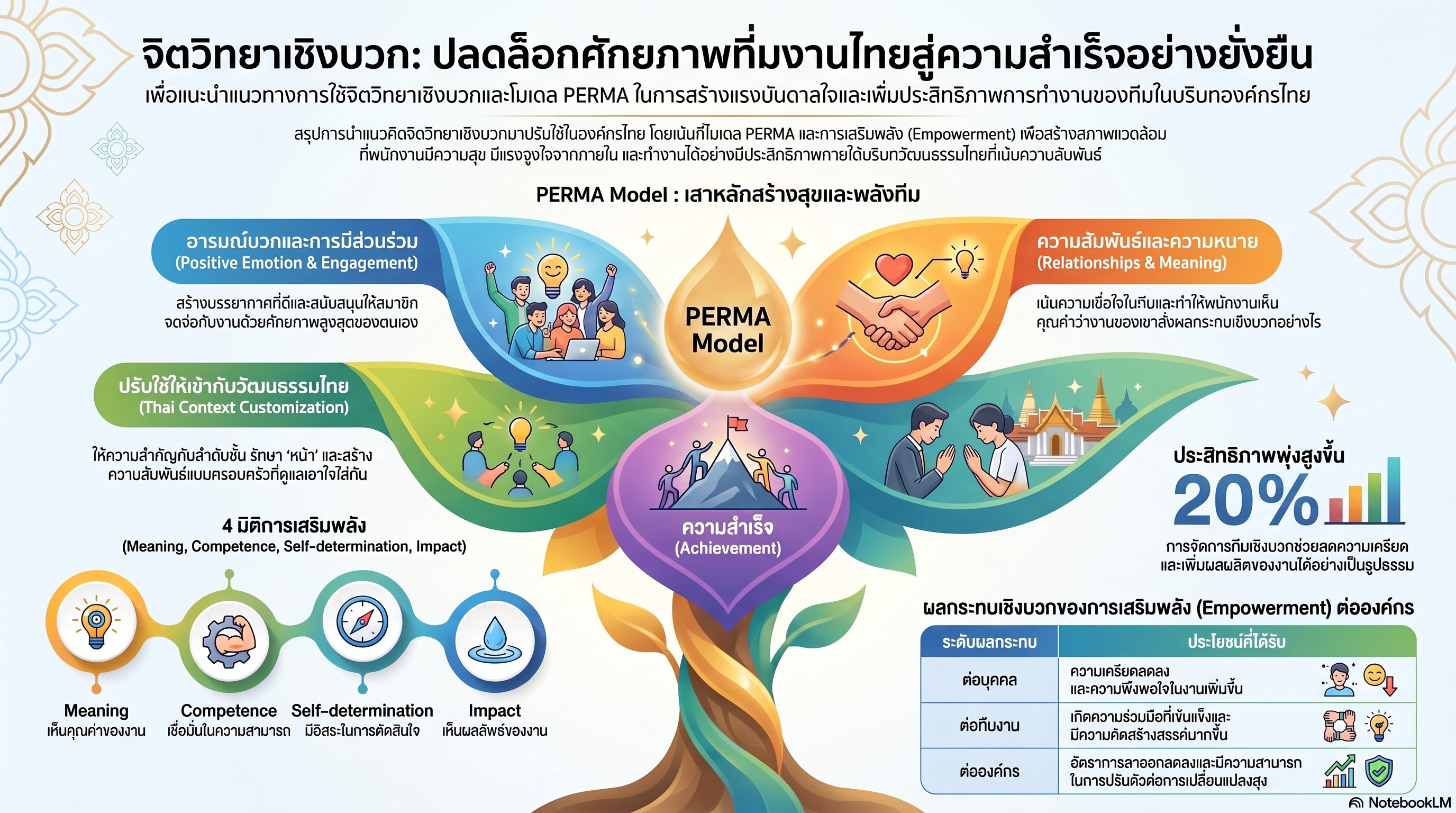
This academic article presents the application of positive psychology in fostering inspiration and enhancing team performance within Thai organizations. The study emphasizes the theories and concepts of positive psychology, particularly Seligman's PERMA Model (2011), which comprises key elements such as positive emotions, engagement, relationships, meaning, and achievement. Findings reveal that the integration of positive psychology principles with team management significantly promotes intrinsic motivation, cultivates a happy working environment, and leads to sustainable improvements in team effectiveness. Furthermore, practical techniques such as positive reinforcement and empowerment strengthen team members’ confidence and resilience. The results from Thai organizational contexts indicate that a positive-oriented approach reduces workplace stress, fosters relationships, and develops individual potential based on a well-rounded understanding of human nature. Organizations that adopt this approach are advised to prioritize the development of a supportive culture that continually encourages happiness and internal growth among team members.
References
จุฬาลักษณ์ พินิจพงษ์. (2563). การพัฒนาทีมงานและการเสริมสร้างความสัมพันธ์ในองค์กรไทยตามแนวคิดจิตวิทยาเชิงบวก. วารสารการพัฒนาทรัพยากรมนุษย์, 10(2), 59–75.
ณัทรพร พรไพศาล, & เศรษฐวัฒน์ เลิศถาวร. (2563). จิตวิทยาเชิงบวกและการสร้างแรงบันดาลใจในองค์กรไทย. วารสารจิตวิทยาไทย, 27(2), 45–62.
รัญชา ประเสริฐสุข. (2564). จิตวิทยาเพื่อการประยุกต์ใช้ในงานบริหารบุคคล. สำนักพิมพ์แห่งจุฬาลงกรณ์มหาวิทยาลัย.
Avey, J. B., Luthans, F., & Jensen, S. M. (2009). Psychological capital: A positive resource for combating employee stress and turnover. Human Resource Management, 48(5), 677–693.
Cameron, K. S., Dutton, J. E., & Quinn, R. E. (Eds.). (2003). Positive organizational scholarship: Foundations of a new discipline. Berrett-Koehler.
Cameron, K. S., & Pierce, W. D. (1994). Reinforcement, reward, and intrinsic motivation: A meta-analysis. Review of Educational Research, 64(3), 363–423.
Cameron, K. S., & Spreitzer, G. M. (Eds.). (2012). The Oxford handbook of positive organizational scholarship. Oxford University Press.
Dutton, J. E., & Heaphy, E. D. (2003). The power of high-quality connections. In K. S. Cameron, J. E. Dutton, & R. E. Quinn (Eds.), Positive organizational scholarship: Foundations of a new discipline (pp. 263–278). Berrett-Koehler.
Dutton, J. E., & Ragins, B. R. (Eds.). (2007). Exploring positive relationships at work: Building a theoretical and research foundation. Lawrence Erlbaum Associates.
Fredrickson, B. L. (2001). The role of positive emotions in positive psychology: The broaden-and-build theory of positive emotions. American Psychologist, 56(3), 218–226.
Hackman, J. R., & Wageman, R. (2005). A theory of team coaching. Academy of Management Review, 30(2), 269–287.
Kern, M. L., Waters, L. E., Adler, A., & White, M. (2015). Assessing employee wellbeing in schools using a multifaceted approach: Associations with depression, resilience, and work-related outcomes. Psychology of Well-Being, 5(5), 1–19.
Lencioni, P. (2002). The five dysfunctions of a team: A leadership fable. Jossey-Bass.
Luthans, F., & Youssef, C. M. (2007). Emerging positive organizational behavior. Journal of Management, 33(3), 321–349.
Luthans, F., Youssef, C. M., & Avolio, B. J. (2007). Psychological capital: Developing the human competitive edge. Oxford University Press.
Meyers, M. C., van Woerkom, M., & Bakker, A. B. (2013). The added value of the positive: A literature review of positive psychology interventions in organizations. European Journal of Work and Organizational Psychology, 22(5), 618–632.
Patarapornpaisan, W., & Lertthavorn, S. (2020). Positive psychology and team motivation in Thai organizations. Thai Journal of Psychology, 27(2), 45–62.
Ryan, R. M., & Deci, E. L. (2000). Self-determination theory and the facilitation of intrinsic motivation, social development, and well-being. American Psychologist, 55(1), 68–78.
Seligman, M. E. P. (2002). Authentic happiness: Using the new positive psychology to realize your potential for lasting fulfillment. Free Press.
Seligman, M. E. P. (2011). Flourish: A visionary new understanding of happiness and well-being. Free Press.
Seligman, M. E. P., & Csikszentmihalyi, M. (2000). Positive psychology: An introduction. American Psychologist, 55(1), 5–14.
Skinner, B. F. (1953). Science and human behavior. Macmillan.
Spreitzer, G. M. (1995). Psychological empowerment in the workplace: Dimensions, measurement, and validation. Academy of Management Journal, 38(5), 1442–1465.
Spreitzer, G. M. (2008). Taking stock: A review of more than twenty years of research on empowerment at work. In J. Barling & C. L. Cooper (Eds.), The SAGE handbook of organizational behavior (Vol. 1, pp. 54–72). SAGE.
Thomas, K. W., & Velthouse, B. A. (1990). Cognitive elements of empowerment: An "interpretive" model of intrinsic task motivation. Academy of Management Review, 15(4), 666–681.
Van Knippenberg, D., & Schippers, M. C. (2007). Work group diversity. Annual Review of Psychology, 58, 515–541.
Downloads
Published
How to Cite
Issue
Section
License
Copyright (c) 2026 Authors

This work is licensed under a Creative Commons Attribution-NonCommercial-NoDerivatives 4.0 International License.