The effects of Learning Activity Management Based on Constructivist Theory with SQRQCQ Strategy on Mathematical Concepts and Problem Solving Ability of Mathayomsuksa 1 Students
Keywords:
Learning Management Based On Constructivist Theory, SQRQCQ Strategy, Mathematical Concepts, Problem Solving AbilityAbstract
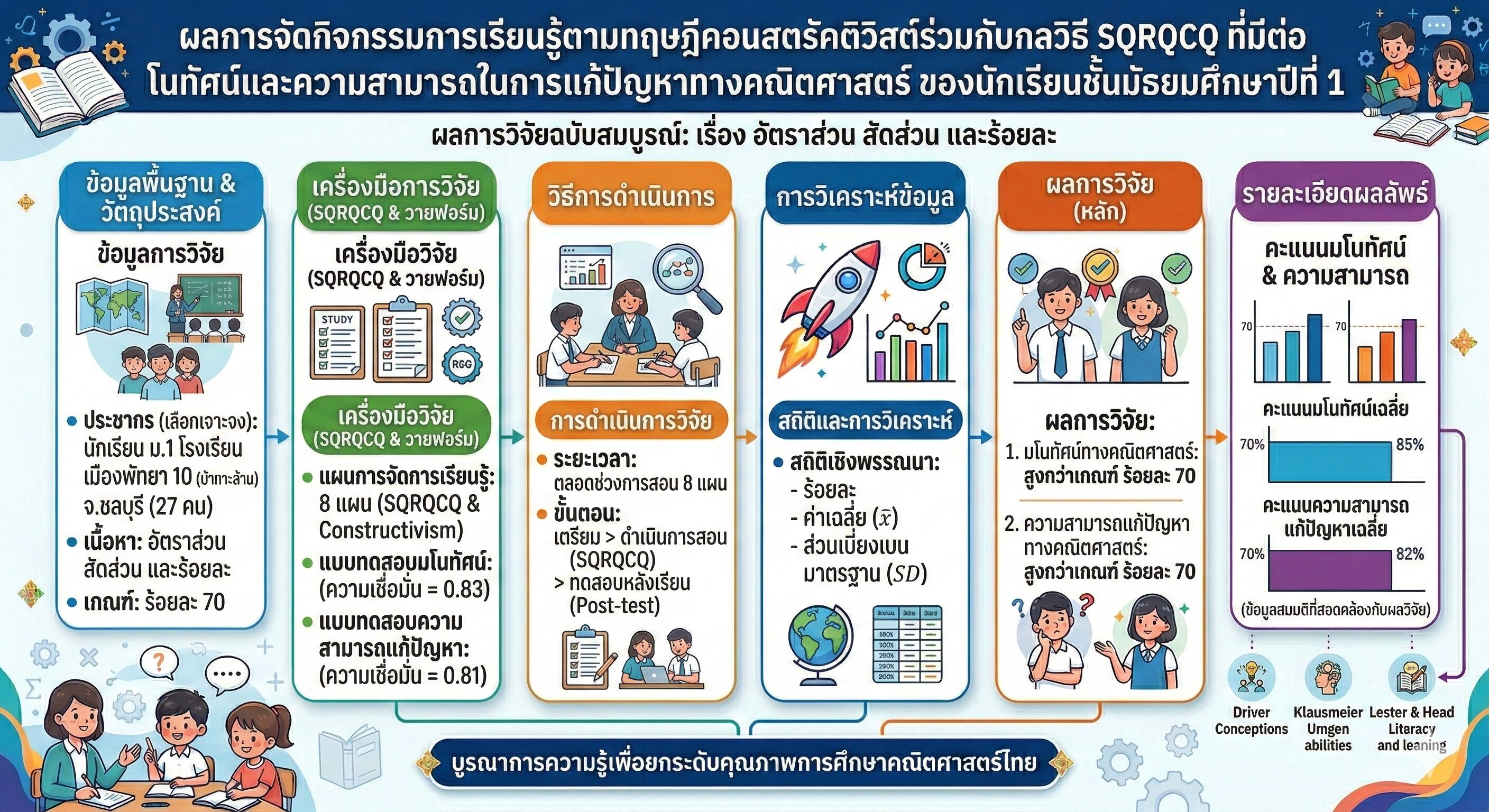
The purposes of this research were to compare the mathematical concepts and problem solving ability on the topic of ratio, proportion and percentage after they had participated in learning activity management based on a constructivist theory with SQRQCQ strategy with the criterion at 70 percent. The research population were selected by purposive sampling. The population for this research consisted of 27 Mathayomsuksa 1 students at Muang Pattaya 10 School (Ban Koh Lan) Chonburi. The research instruments consisted of eight lesson plans of learning management based on constructivist theory with SQRQCQ strategy. a mathematical concepts test with a reliability coefficient of 0.83 and a problem solving ability test with a reliability coefficient of 0.81. The data were analyzed by percentage, mean, and standard deviation. The result indicated that: 1.The Mathayomsuksa 1 students after learning activity management based on constructivist theory with SQRQCQ strategy achieved scores on mathematical concepts was higher than the 70 percent. 2. The Mathayomsuksa 1 students after learning activity management based on constructivist theory with SQRQCQ strategy achieved scores on mathematical problem solving ability was higher than the 70 percent.
References
กระทรวงศึกษาธิการ. (2552). หลักสูตรแกนกลางการศึกษาขั้นพื้นฐาน พุทธศักราช 2551 (ฉบับปรับปรุง พ.ศ. 2560). คุรุสภาลาดพร้าว.
ปรีชา เนาว์เย็นผล. (2537). การพัฒนาทักษะการคิดคำนวณของนักเรียนระดับประถมศึกษา. จุฬาลงกรณ์มหาวิทยาลัย.
ปรีชา เนาว์เย็นผล. (2544). การพัฒนาความสามารถในการแก้ปัญหาทางคณิตศาสตร์. วารสารคณิตศาสตร์, 38(434–435), 62–74.
ปรีชา เนาว์เย็นผล. (2556). หน่วยที่ 9 การแก้ปัญหาคณิตศาสตร์. ใน ประมวลสาระชุดวิชาสารัตถะและวิทยวิธีทางคณิตศาสตร์. มหาวิทยาลัยสุโขทัยธรรมาธิราช.
วิชัย วงษ์ใหญ่. (2543). กระบวนทัศนใหม่ในการพัฒนาหลักสูตร. มหาวิทยาลัยสุโขทัยธรรมาธิราช.
วีณา ประชากูล, & ประสาท เนืองเฉลิม. (2554). รูปแบบการเรียนการสอน. มหาวิทยาลัยมหาสารคาม.
ล้วน สายยศ, & อังคณา สายยศ. (2543). เทคนิคการวิจัยทางการศึกษา (พิมพ์ครั้งที่ 3). สุวีริยาสาส์น.
เวชฤทธิ์ อังกนะภัทรขจร. (2546). การสังเคราะห์งานวิจัยที่เกี่ยวข้องกับมโนทัศน์ที่คลาดเคลื่อนในวิชาคณิตศาสตร์ [วิทยานิพนธ์ครุศาสตรมหาบัณฑิต, จุฬาลงกรณ์มหาวิทยาลัย]. Digital Research Information Center. https://cuir.car.chula.ac.th/handle/123456789/65750
เวชฤทธิ์ อังกนะภัทรขจร. (2555). ครบเครื่องเรื่องควรรู้สำหรับครูคณิตศาสตร์: หลักสูตร การสอน และการวิจัย. จรัลสนิทวงศ์การพิมพ์.
สิรภพ สินธุประเสริฐ. (2558). ผลของการจัดกิจกรรมการเรียนรู้โดยใช้กลวิธีเอสคิวอาร์คิวซีคิวร่วมกับคำถามระดับสูงที่มีต่อความสามารถในการแก้ปัญหาและผลสัมฤทธิ์ทางการเรียนคณิตศาสตร์ เรื่องสถิติ ของนักเรียนชั้นมัธยมศึกษาปีที่ 5 [วิทยานิพนธ์ศึกษาศาสตรมหาบัณฑิต, มหาวิทยาลัยบูรพา]. Digital Research Information Center. https://ojs.lib.buu.ac.th/index.php/ejes/article/view/8989
สถาบันส่งเสริมการสอนวิทยาศาสตร์และเทคโนโลยี. (2556). ทักษะและกระบวนการทางคณิตศาสตร์. 3 คิว มีเดีย.
สถาบันส่งเสริมการสอนวิทยาศาสตร์และเทคโนโลยี. (2563, 7 ธันวาคม). รายงานผลการทดสอบ PISA 2015. https://pisathailand.ipst.ac.th/pisa2015-cps-fullreport/
สถาบันส่งเสริมการสอนวิทยาศาสตร์และเทคโนโลยี. (2564, 25 มีนาคม). รายงานผลการทดสอบ PISA 2018. https://pisathailand.ipst.ac.th/pisa2018-fullreport/
สถาบันส่งเสริมการสอนวิทยาศาสตร์และเทคโนโลยี. (2568, 6 ธันวาคม). รายงานผลการทดสอบ PISA 2022. https://pisathailand.ipst.ac.th/pisa2022-fullreport/
สิริพร ทิพย์คง. (2545). หลักสูตรและการสอนคณิตศาสตร์. พัฒนาคุณภาพวิชาการ.
สิริพร ทิพย์คง. (2558). มโนทัศน์ที่คลาดเคลื่อน ความรู้คณิตศาสตร์ที่ถูกต้อง. พัฒนาคุณภาพวิชาการ.
อัมพร ม้าคนอง. (2546). คณิตศาสตร์: การสอนและการเรียนรู้. จุฬาลงกรณ์มหาวิทยาลัย.
อัมพร ม้าคนอง. (2552). การพัฒนามโนทัศน์ทางคณิตศาสตร์โดยใช้โมเดลการได้มาซึ่งมโนทัศน์และคำถามระดับสูง. จุฬาลงกรณ์มหาวิทยาลัย.
อัมพร ม้าคนอง. (2553). ทักษะและกระบวนการทางคณิตศาสตร์: การพัฒนาเพื่อพัฒนาการ. จุฬาลงกรณ์มหาวิทยาลัย.
อัมพร ม้าคนอง. (2557). คณิตศาสตร์สำหรับครูมัธยม. จุฬาลงกรณ์มหาวิทยาลัย.
Driver, R. (1989). Students’ conceptions and the learning of science. International Journal of Science Education, 11(5), 481–490.
Klausmeier, H. J., & Ripple, R. E. (1971). Learning and human abilities: Educational psychology (3rd ed.). Harper & Row.
Lester, H., & Head, M. H. (1999). Literacy & learning: Reading in the content areas. Allyn & Bacon.
Downloads
Published
How to Cite
Issue
Section
Categories
License
Copyright (c) 2026 Journal of Buddhist Education and Research (JBER)

This work is licensed under a Creative Commons Attribution-NonCommercial-NoDerivatives 4.0 International License.