Developing Learning Activities Based on the Model-Eliciting Activities Concept to Promote Mathematical Literacy for 7th Grade
Abstract
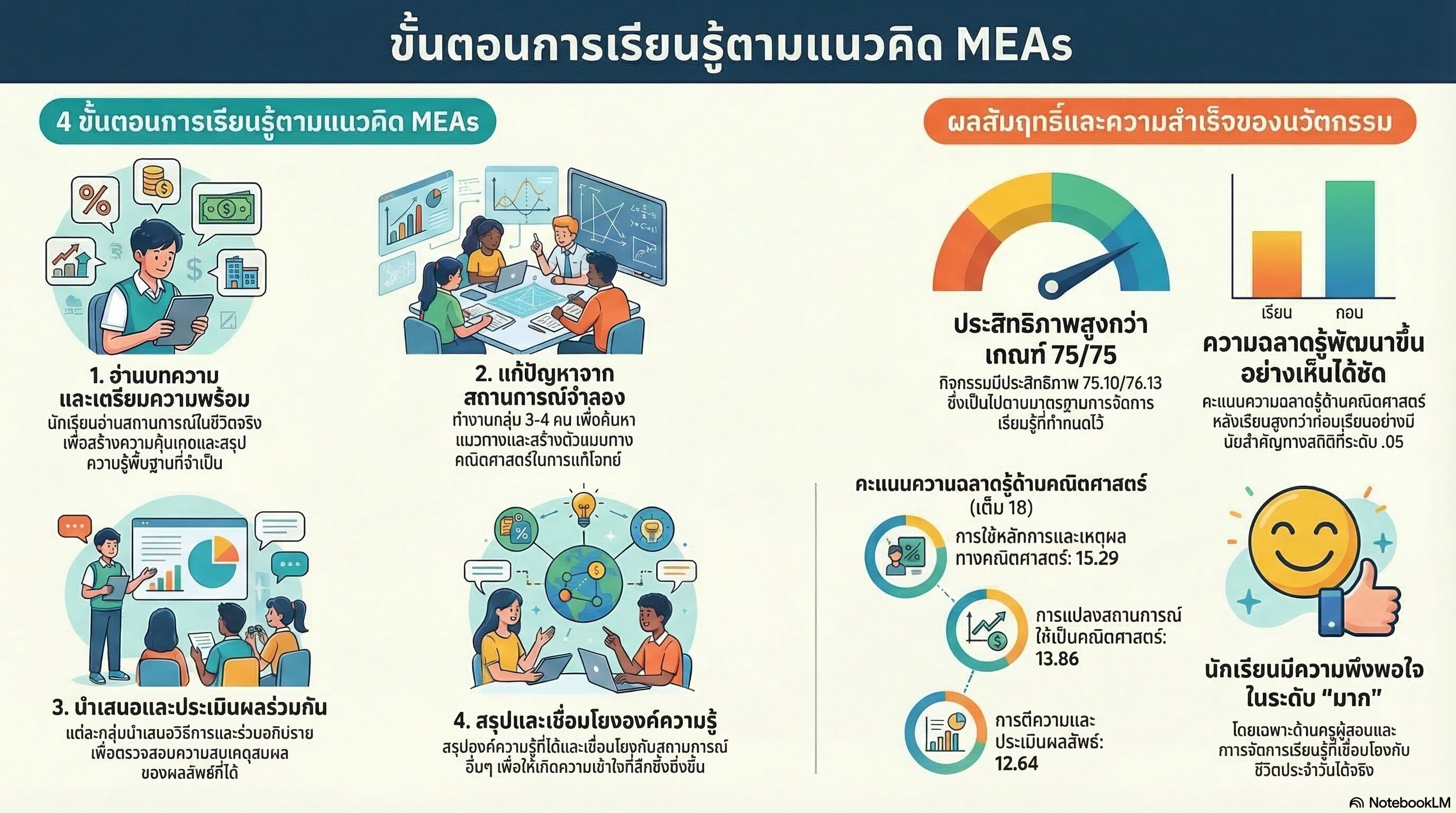
The objectives of this research were: 1) develop and evaluate the effectiveness of learning activities based on the Model Eliciting Activities approach to enhance mathematical literacy for Mathayomsuksa 1 Grade 7 students, using the 75/75 efficiency criterion; 2) investigate the outcomes of implementing Model Eliciting Activities based learning activities in promoting students’ mathematical literacy as follows: 2.1) a comparison of students’ mathematical literacy before and after participating in the activities, and 2.2) a comparison of students’ mathematical literacy after learning activities with the 75 percent; and 3) examine the students’ satisfaction towards the implementation of Model Eliciting Activities to enhance mathematical literacy. The study employed Research and Development (R&D) methodology. The sample consisted of 14 Grade 7 students, enrolled in the second semester of the 2024 academic year at Wat Hang Lai School, under the Phitsanulok Primary Educational Service Area Office 3. The participants were selected by purposive sampling. The research instruments included: (1) Learning activities based on MEAs to enhance mathematical literacy, (2) instructional lesson plans, (3) a mathematical literacy assessment, and (4) Satisfaction questionnaire. Data were analyzed using mean, standard deviation, and the Wilcoxon signed rank test. The research findings were as follows: 1) The effectiveness of the Model Eliciting Activities based learning activities was 75.10/76.13, meeting the 75/75 criterion; (2) regarding the learning outcomes: 2.1) students’ mathematical literacy after Model Eliciting Activities learning activities was significantly higher than pre-intervention at the .05 level, while 2.2) students’ post-intervention scores did not exceed the criteria of 75 percent; and (3) Students’ satisfaction with the Model Eliciting Activities based learning activities was at a high level.
References
กุลจิรา ถาวรสุภเจริญ. (2565). การพัฒนาจัดกิจกรรมการเรียนรู้แบบผสมผสานด้วยแนวคิด Model Eliciting Activities เพื่อส่งเสริมความสามารถในการแก้ปัญหาทางคณิตศาสตร์ สำหรับนักเรียนชั้นมัธยมศึกษาปีที่ 1[วิทยานิพนธ์ปริญญามหาบัณฑิต]. มหาวิทยาลัยนเรศวร.
ตุลา ประทับ. (2565). การพัฒนาทักษะการแก้ปัญหาทางคณิตศาสตร์โดยใช้กิจกรรม MEAs ร่วมกับเกมกระดานสำหรับนักเรียนชั้นมัธยมศึกษาปีที่ 3[วิทยานิพนธ์ปริญญามหาบัณฑิต]. มหาวิทยาลัยธุรกิจบัณฑิตย์
ชไมพร กาญจนกิจสกุล. (2555). ระเบียบวิธีวิจัยทางสังคมศาสตร์. ตาก: บริษัท โพรเจ็คท์ ไฟฟ์-โฟว์ จำกัด.
รัตนะ บัวสนธ์. (2554). การวิจัยและพัฒนานวัตกรรมการศึกษา(พิมพ์ครั้งที่ 2). นครสวรรค์: ห้างหุ้นส่วนจำกัดริมปิงการพิมพ์.
สถาบันส่งเสริมการสอนวิทยาศาสตร์และเทคโนโลยี. (พฤษภาคม 2563). บทความ Focus ประเด็นจากPISA. PISA THAILAND. https://drive.google.com/file/d/17ux3hZDXcFhEs1I_GOMRdrxUZcbh-JGm/view
สถาบันส่งเสริมการสอนวิทยาศาสตร์และเทคโนโลยี. (10 มิถุนายน 2563). PISA2021 กับการประเมินความฉลาดรู้ด้านคณิตศาสตร์. PISA THAILAND. https://pisathailand.ipst.ac.th/issue-2020-53/
สถาบันส่งเสริมการสอนวิทยาศาสตร์และเทคโนโลยี. (24 มิถุนายน 2565). PISA2021 กับการประเมินความฉลาดรู้ด้านคณิตศาสตร์. PISA THAILAND. https://pisathailand.ipst.ac.th/infographics-pisa2022-math-framework/
สถาบันส่งเสริมการสอนวิทยาศาสตร์และเทคโนโลยี. (31 ตุลาคม 2566). กรอบการประเมินด้านคณิตศาสตร์. PISA THAILAND. https://pisathailand.ipst.ac.th/about-pisa/mathematical_literacy_framework/
สิริกาญจน์ มนต์สันต์. (2566). การจัดกิจกรรมการเรียนรู้ตามแนว Model Eliciting Activities เพื่อพัฒนาความสามารถ ในการให้เหตุผลทางคณิตศาสตร์ เรื่อง ร้อยละและอัตราส่วน ของนักเรียนชั้นประถมศึกษาปีที่ 6[วิทยานิพนธ์ปริญญามหาบัณฑิต]. มหาวิทยาลัยราชภัฏนครสวรรค์
Applewhite, P.B. (1965). Organization Behavior. New Jersey: Englewood Cliffs, Prentice-Hall Inc.
Chamberlin, S.A., and Moon, S.M. (2008). How does the problem based learning approach compare to the mode-eliciting activity approach in mathematics? [Online]. International Journal for Mathematics Teaching and Learning.
Gordon & Porter. (2009). Reading and understanding academic research in accounting: A guide for students. Global Perspectives on Accounting Education. University of Idaho.
Jan de Lange (2005). Encyclopedia of Social Measurement. Utrecht University, Utrecht, The Netherlands.
Lesh, R., Hoover, M., Hole, B., Kelly, A., & Post, T. (2000). Principles for Developing Thought-Revealing Activities for Students and Teachers. Research Design in Mathematics and Science Education, p591-646.
Maslow, A. H. (1970). Motivation and Personality. New York.
Downloads
Published
How to Cite
Issue
Section
Categories
License
Copyright (c) 2026 Journal of Buddhist Education and Research (JBER)

This work is licensed under a Creative Commons Attribution-NonCommercial-NoDerivatives 4.0 International License.