Guidelines for Developing Innovative Leadership among Educational Institution Administrators under the Khon Kaen Provincial Office of Vocational Education
Abstract
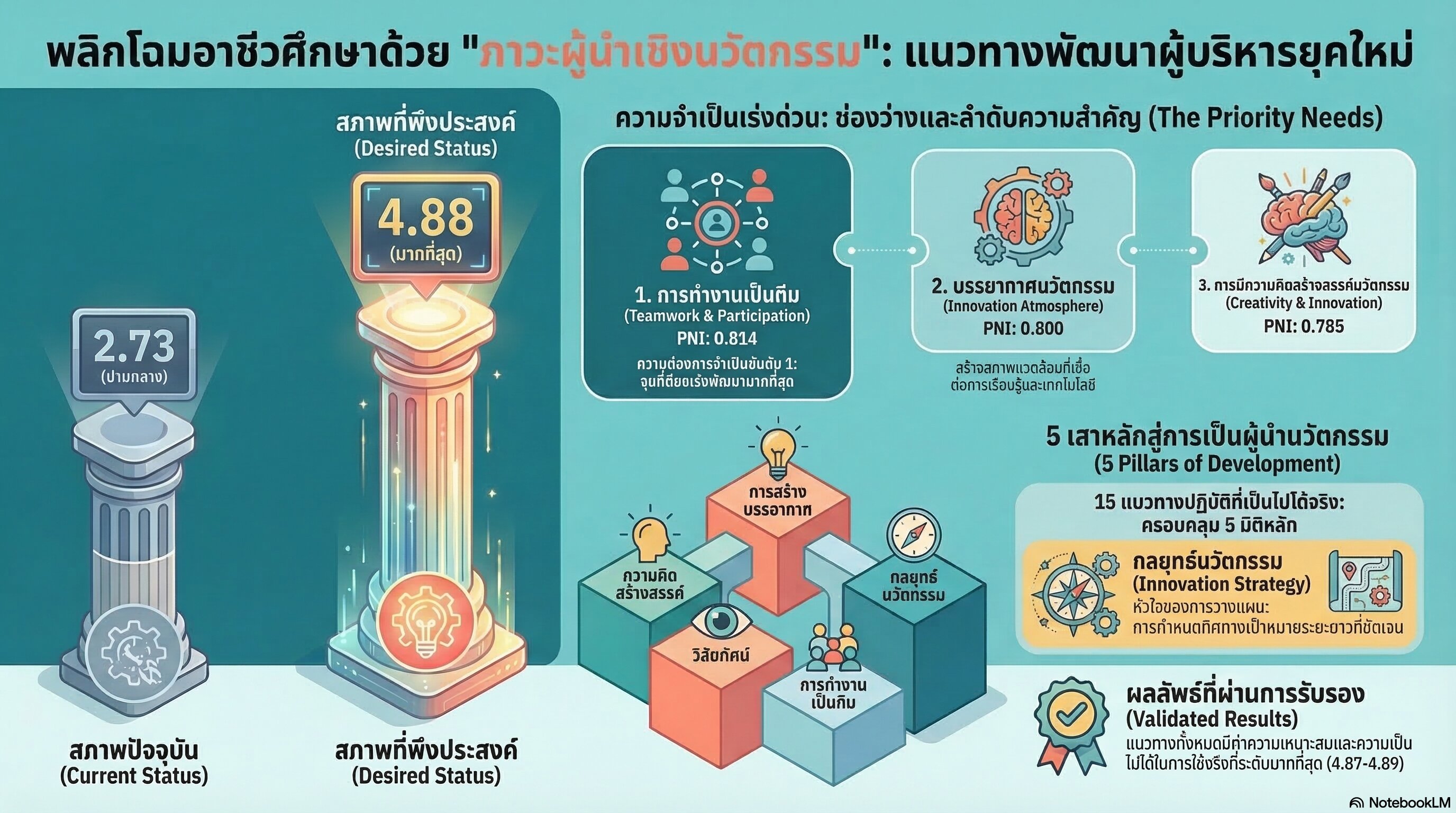
This research aimed to: 1) examine the current state, desired state, and priority needs of innovative leadership among school administrators under the Vocational Education Office in Khon Kaen Province; and 2) propose guidelines for developing such innovative leadership. The study employed a mixed-methods approach. The sample consisted of 214 school administrators and teachers, determined using the Krejcie and Morgan table, selected through stratified random sampling and simple random sampling. Research instruments included a five-point rating scale questionnaire, a semi-structured interview, and an evaluation form for suitability and feasibility. Data were analyzed using percentage, mean, standard deviation, the Priority Needs Index (PNI Modified), and content analysis. The findings revealed that: 1) the overall current state of innovative leadership was at a moderate level (x̄ = 2.73), with all aspects rated at a moderate level; the highest mean was in innovative strategy (x̄ = 2.77), while the lowest was in teamwork and participation (x̄ = 2.69). The desired state was at the highest level overall (x̄ = 4.88), with all aspects rated at the highest level; the highest mean was in innovative creativity (x̄ = 4.89), while the lowest was in vision for change (x̄ = 4.87). The overall priority needs index (PNI Modified = 0.781) ranked from highest to lowest as follows: teamwork and participation (0.814), creating an innovative climate (0.800), innovative creativity (0.785), vision for change (0.764), and innovative strategy (0.762). 2) The guidelines for developing innovative leadership consisted of five aspects, each with three approaches, totaling 15 approaches: teamwork and participation (3 approaches), creating an innovative climate (3 approaches), innovative creativity (3 approaches), vision for change (3 approaches), and innovative strategy (3 approaches). Overall, the guidelines were rated at the highest level in terms of suitability (x̄ = 4.87) and feasibility (x̄ = 4.89).
References
กุลชลี จงเจริญ. (2562). ภาวะผู้นำเชิงนวัตกรรม. ใน ประมวลสาระชุดวิชานวัตกรรมการบริหารการศึกษาและภาวะผู้นำ (หน่วยที่ 8–15, น. 1–36). สาขาวิชาศึกษาศาสตร์ มหาวิทยาลัยสุโขทัยธรรมาธิราช.
ฐิตินันท์ นันทะศรี. (2563). การพัฒนาตัวบ่งชี้ภาวะผู้นำเชิงนวัตกรรมของผู้บริหารสถานศึกษา สังกัดสำนักงานเขตพื้นที่การศึกษาประถมศึกษาในภาคตะวันออกเฉียงเหนือ [วิทยานิพนธ์ปรัชญาดุษฎีบัณฑิต, มหาวิทยาลัยราชภัฏสกลนคร].
ทิศนา แขมมณี. (2548). การปฏิรูปทั้งโรงเรียนเรื่องยากทำได้จริง. เมธีทิปส์.
ณิชาภา สุนทรไชย. (2561). แนวทางการพัฒนาภาวะผู้นำเชิงนวัตกรรมของผู้บริหารโรงเรียนเอกชนในจังหวัดกาฬสินธุ์ [วิทยานิพนธ์ศึกษาศาสตรมหาบัณฑิต, มหาวิทยาลัยขอนแก่น].
ประรัดดา ใจเมตตา. (2566). แนวทางการพัฒนาภาวะผู้นำเชิงนวัตกรรมของผู้บริหารสถานศึกษา สังกัดสำนักงานเขตพื้นที่การศึกษาประถมศึกษากาฬสินธุ์ เขต 1. วารสารครุศาสตร์ มหาวิทยาลัยราชภัฏมหาสารคาม, 20(2), พฤษภาคม–สิงหาคม.
แพรวพรรณ เปรมลาภ. (2565). แนวทางการพัฒนาภาวะผู้นำเชิงนวัตกรรมของผู้บริหารสถานศึกษาสังกัดสำนักงานเขตพื้นที่การศึกษาประถมศึกษานครสวรรค์ เขต 2 [การค้นคว้าอิสระศึกษาศาสตรมหาบัณฑิต, มหาวิทยาลัยนเรศวร].
ลัดดาวัลย์ ซาซิโย. (2566). แนวทางการพัฒนาภาวะผู้นำเชิงนวัตกรรมของผู้บริหารสถานศึกษาสังกัดสำนักงานเขตพื้นที่การศึกษาประถมศึกษาร้อยเอ็ด เขต 1 [วิทยานิพนธ์ครุศาสตรมหาบัณฑิต, มหาวิทยาลัยราชภัฏมหาสารคาม].
ศิริพร พงษ์เนตร. (2564). การศึกษาภาวะผู้นำเชิงนวัตกรรมของผู้บริหารสถานศึกษา สังกัดสำนักงานเขตพื้นที่การศึกษาประถมศึกษาปทุมธานี เขต 2 [วิทยานิพนธ์ศึกษาศาสตรมหาบัณฑิต, มหาวิทยาลัยเทคโนโลยีราชมงคลธัญบุรี].
สำนักงานคณะกรรมการพัฒนาเศรษฐกิจและสังคมแห่งชาติ. (2564). แผนพัฒนาเศรษฐกิจและสังคมแห่งชาติ ฉบับที่ 13 (พ.ศ. 2566–2570). สำนักพิมพ์คณะรัฐมนตรีและราชกิจจานุเบกษา.
สำนักงานบริหารพื้นที่นวัตกรรมการศึกษา. (2562). พระราชบัญญัติพื้นที่นวัตกรรมการศึกษา พ.ศ. 2562. เล่ม 136 ตอนที่ 56 ก.
สำนักงานเลขาธิการสภาการศึกษา. (2560). แผนการศึกษาแห่งชาติ พ.ศ. 2560–2579. โรงพิมพ์พริกหวานกราฟฟิค.
สำนักงานอาชีวศึกษาขอนแก่น. (2567). ผลการทดสอบทางการวิจัยระดับชาติด้านอาชีวศึกษา (V-NET) ระดับประกาศนียบัตรวิชาชีพ ชั้นปีที่ 3 ปีการศึกษา 2566. สำนักงานอาชีวศึกษาขอนแก่น.
Couros, G. (2019). Innovative leadership in education. Retrieved from https://georgecouros.ca/blog/archives/tag/innovative-leadership-in-education
Robert, F. B., & Jeff, Z. (2010). Leadership vacuums and overcoming barriers to innovation. Retrieved from http://www.business-strategy-innovation.com/2010/04/leadershipvacuums-and-overcoming.html
Ubaidillah, M. (2018). Innovation leadership in improving the quality of education. International Journal of Mechanical Engineering and Technology, 9(7), 1288–1299.
Downloads
Published
How to Cite
Issue
Section
Categories
License
Copyright (c) 2026 Journal of Buddhist Education and Research (JBER)

This work is licensed under a Creative Commons Attribution-NonCommercial-NoDerivatives 4.0 International License.