Educational Institution Management towards Becoming a Prototype for Vocational Education Innovation in the Digital Era
Abstract
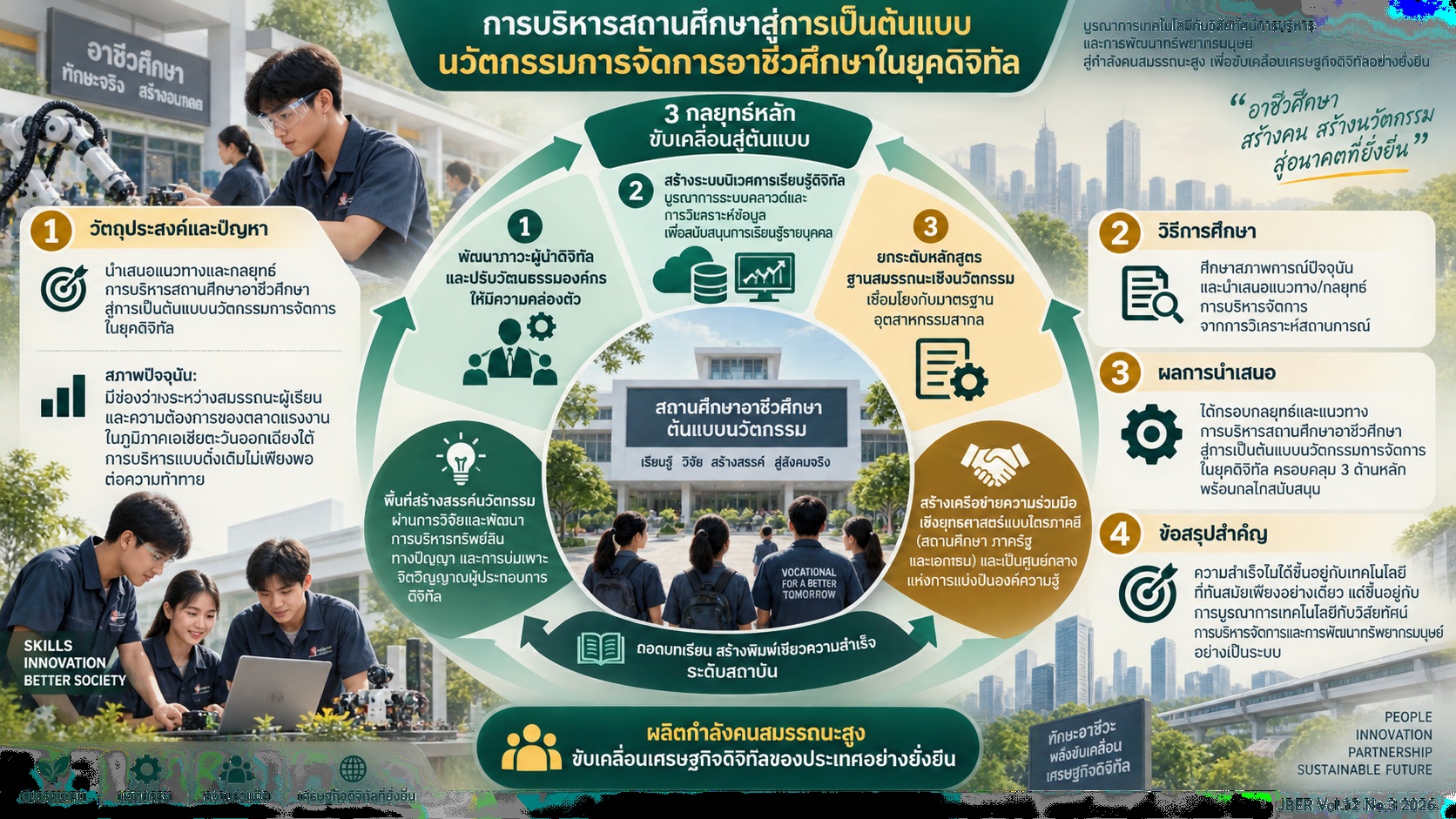
This academic article aims to present strategies for managing vocational education institutions to become prototypes for innovative management in the digital era. The rapid advancement of digital technology has significantly transformed the context of vocational education, necessitating educational institution administrators to adapt their management approaches to keep pace with these changes. This article synthesizes concepts, theories, and relevant research to propose guidelines for educational institution management consisting of the following components: 1) Leadership and vision of administrators in driving digital innovation, 2) Development of digital infrastructure and technology to support teaching and learning management, 3) Development of teacher and personnel competencies in digital technology utilization, 4) Curriculum development and instructional management that integrates digital technology, 5) Building networks and cooperation with the business and industrial sectors, and 6) Research and development (R&D) to create innovations in educational management. The implementation of these strategies will enable vocational education institutions to develop into prototypes of digital innovation management that can serve as models for other educational institutions, thereby enhancing the quality and efficiency of vocational education management to meet the needs of the labor market and sustainable national development in the digital era.
Downloads
Published
How to Cite
Issue
Section
Categories
License
Copyright (c) 2026 Journal of Buddhist Education and Research (JBER)

This work is licensed under a Creative Commons Attribution-NonCommercial-NoDerivatives 4.0 International License.