Empowering Sophomores’ Higher-Order Thinking Skills in Analytical and Critical Reading Course through Utilizing KWL Plus Strategy
Keywords:
Analytical and Critical Reading, Higher-Order Thinking Skills, KWL Plus Strategy, SophomoresAbstract
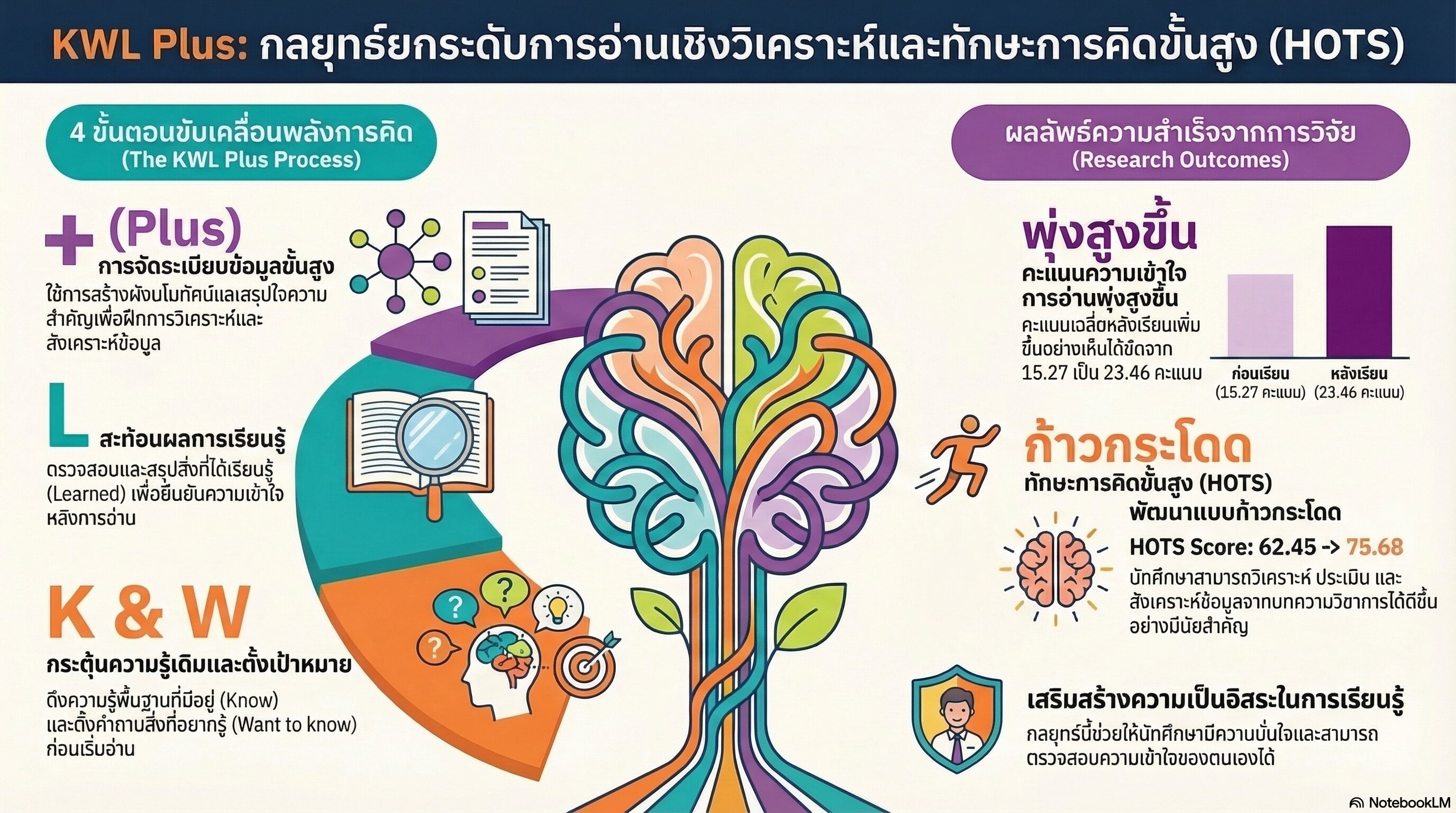
Developing higher-order thinking skills (HOTS) has become a crucial objective in tertiary-level English reading instruction, particularly in courses emphasizing analytical and critical reading. To achieve this goal, instructional strategies that actively engage learners and foster metacognitive awareness are essential for enhancing reading comprehension and critical thinking. This study aimed to empower sophomores’ higher-order thinking skills in an Analytical and Critical Reading course through the utilization of the KWL Plus strategy. The purposes of the study were twofold: (1) to compare sophomores’ reading comprehension achievement before and after learning through the KWL Plus strategy, and (2) to examine changes in their higher-order thinking skills before and after engaging in analytical and critical reading instruction using the KWL-plus strategy. The participants were 48 sophomore students enrolled in the Analytical and Critical Reading course during the second semester of the 2025 academic year. A one-group pretest–posttest research design was employed. The KWL Plus strategy was systematically implemented throughout the instructional period to encourage active reading, metacognitive reflection, and deeper textual analysis. Research instruments consisted of a reading comprehension test and a higher-order thinking skills assessment focusing on analysis, evaluation, and synthesis. Data were analyzed using descriptive statistics and paired-samples t-tests. The results revealed statistically significant improvements in both reading comprehension and higher-order thinking skills following the implementation of the KWL Plus strategy. These findings suggest that the KWL Plus strategy is an effective instructional approach for enhancing sophomores’ analytical and critical reading abilities while promoting higher-order thinking skills at the tertiary level.
References
Alshaikh, A. (2023). The impact of KWL Plus strategy on the development of perceived self-efficacy. The International Journal of Pedagogy and Curriculum, 30(1), 37–47.
Amali, L. N., Bharati, D. A. L., & Rozi, F. (2022). The implementation of higher-order thinking skills (HOTS) assessment to evaluate students’ reading comprehension achievement. English Education Journal, 12(1), 10–18.
Anderson, L. W., & Krathwohl, D. R. (2001). A taxonomy for learning, teaching, and assessing: A revision of Bloom’s taxonomy of educational objectives. Longman.
Anderson, N. J. (2008). Active skills for reading: Student book 3 (2nd ed.). Heinle Cengage Learning.
Anderson, N. J., & Nunan, D. (2008). Practical English language teaching: Reading. McGraw-Hill ESL/ELT.
Azwar, T. A., Ristiyanti, S. H., & Puspita, H. (2024). Enhancing Indonesian EFL students’ reading comprehension of report texts through KWL strategy with multimedia: A classroom action research. Jambura Journal of English Teaching and Literature, 5(2), 102–113.
Carrell, P. L. (1988). SLA and classroom instruction: Reading. Annual Review of Applied Linguistics, 9, 223–242.
Chimwong, C., Naphatthalung, N., & Khattiyamarn, W. (2024). The effects of collaborative strategic reading and KWL Plus technique on reading comprehension and English learning achievement. Kasetsart Journal of Social Sciences, 45(3), 1–10.
Diasti, K. S., Murniati, C. T., & Hartono, H. (2023). The implementation of KWL strategy in EFL students’ reading comprehension. Journal of English Teaching, 9(2), 176–185.
Fatmawan, A. R., Sari, D. M., Subroto, D. E., Hs, N., & Husain, D. L. (2023). The Know–Want–Learn (KWL) strategy in English learning of junior high school students. Journal of English Development, 3(2), 80–89.
Fitriani, R., Tahrun, T., & Firdaus, M. (2025). Influence of KWL strategy and reading habit on students’ reading comprehension achievement. Alacrity: Journal of Education, 1039–1051.
Guo, X., & Ibrahim, N. M. (2023). Enhancing college English reading pedagogy through the integration of the KWL teaching mode. Innovation, 11, 231–236.
Indriastuti, N. R., Mustikawati, D. A., & Asiyah, S. (2023). Analysis on students’ HOTS through extensive reading in the English department of University of Muhammadiyah Ponorogo. Premise: Journal of English Education and Applied Linguistics, 12(2), 507–521.
Japah, P. V., Pansa, B., & Chantimachaiamorn, C. (2025). Development of reading comprehension skills through Jatakas in Theravada Buddhism using KWL Plus model for first-year undergraduate students. Journal of Contemporary Buddhist Society, 4(2), 66–88.
Jaroentasanasiri, S., & Jeanjaroonsri, R. (2023). The study of reading anxiety and the use of reading strategies among two groups of Thai EFL students (Unpublished master’s thesis). Thammasat University.
Javorcikova, J., & Badinská, M. (2021). Reading and critical thinking skills of undergraduate students: A quantitative analysis. Journal of Teaching English for Specific and Academic Purposes, 655–666.
Jittisukpong, P. (2023). Developing English reading comprehension ability of EFL undergraduate students through the KWL-Plus technique. University of the Thai Chamber of Commerce Journal of Humanities and Social Sciences, 43(4), 121–141.
Karagöl, E. (2025). The impact of the KWL Plus strategy on university students’ note-taking and academic listening skills: A mixed-methods research. SAGE Open, 15(4), 21582440251379210.
Makhlouf, A., & Al-Qaisi, W. (2025). Pedagogical strategies for teaching children’s literature in higher education. Journal of Languages and Translation, 5(5), 83–90.
Masruroh, L. (2024). Using KWL (Know, Want, and Learned) strategy to improve students’ reading comprehension. International Journal of English Language and Pedagogy, 2(1), 75–84.
Mukhlis, M., Suwandi, S., Rohmadi, M., & Setiawan, B. (2023). Higher-order thinking skills in reading literacy questions at vocational high schools in Indonesia. IJoLE: International Journal of Language Education, 7(4), 615–632.
Nourdad, N., Masoudi, S., & Rahimali, P. (2018). The effect of higher order thinking skill instruction on EFL reading ability. International Journal of Applied Linguistics and English Literature, 7(3), 231–237.
Ogle, D. M. (1986). K-W-L: A teaching model that develops active reading of expository text. The Reading Teacher, 39(6), 564–570.
Pakpahan, S. F., Pakpahan, S., Purba, I. D. S., & Nasution, J. (2021). Analysis of reading comprehension questions using revised Bloom’s taxonomy on higher-order thinking skills (HOTS). IDEAS: Journal on English Language Teaching and Learning, Linguistics and Literature, 9(1), 259–271.
Prommak, S., & Bunchuay, K. (2025). Developing Critical Thinking of Thai Primary Learners: Applications and Implications. Journal of Buddhist Education and Research (JBER), 11(3), 217-230.
Pratama, A. J. (2023). The strategies in using KWL to improve students’ reading comprehension achievement. EFL Education Journal, 10(2), 55–67.
Sornkeaw, J. (2021). The effects of using KWL-Plus strategy through infographics on Thai EFL students’ reading comprehension skills. Social Sciences Research and Academic Journal, 16(3), 27–40.
Wahyuni, S., & Fitrawati, F. (2023). The effectiveness of KWLA (Know, Want, Learned, Affect) strategy in improving students’ reading comprehension. Journal of English Language Teaching, 12(4), 1287–1295.
Zambrano, M. Y. R., & Alcívar, Y. A. C. (2023). Importance of strengthening reading comprehension strategies in higher education institutions. Revista San Gregorio, 1, 194–204.
Zuriah, S., & Mutia, U. (2023). The effect of KWL strategy on EFL students’ reading comprehension achievement. EEdJ: English Education Journal, 3(1), 39–46.
Downloads
Published
How to Cite
Issue
Section
Categories
License
Copyright (c) 2026 Journal of Buddhist Education and Research (JBER)

This work is licensed under a Creative Commons Attribution-NonCommercial-NoDerivatives 4.0 International License.