Effects of the Payment of Loan Interest by a Debtor Where the Creditor Charges Interest Exceeding the Statutory Rate
Keywords:
money loan; interest exceeding the statutory rate; voidAbstract
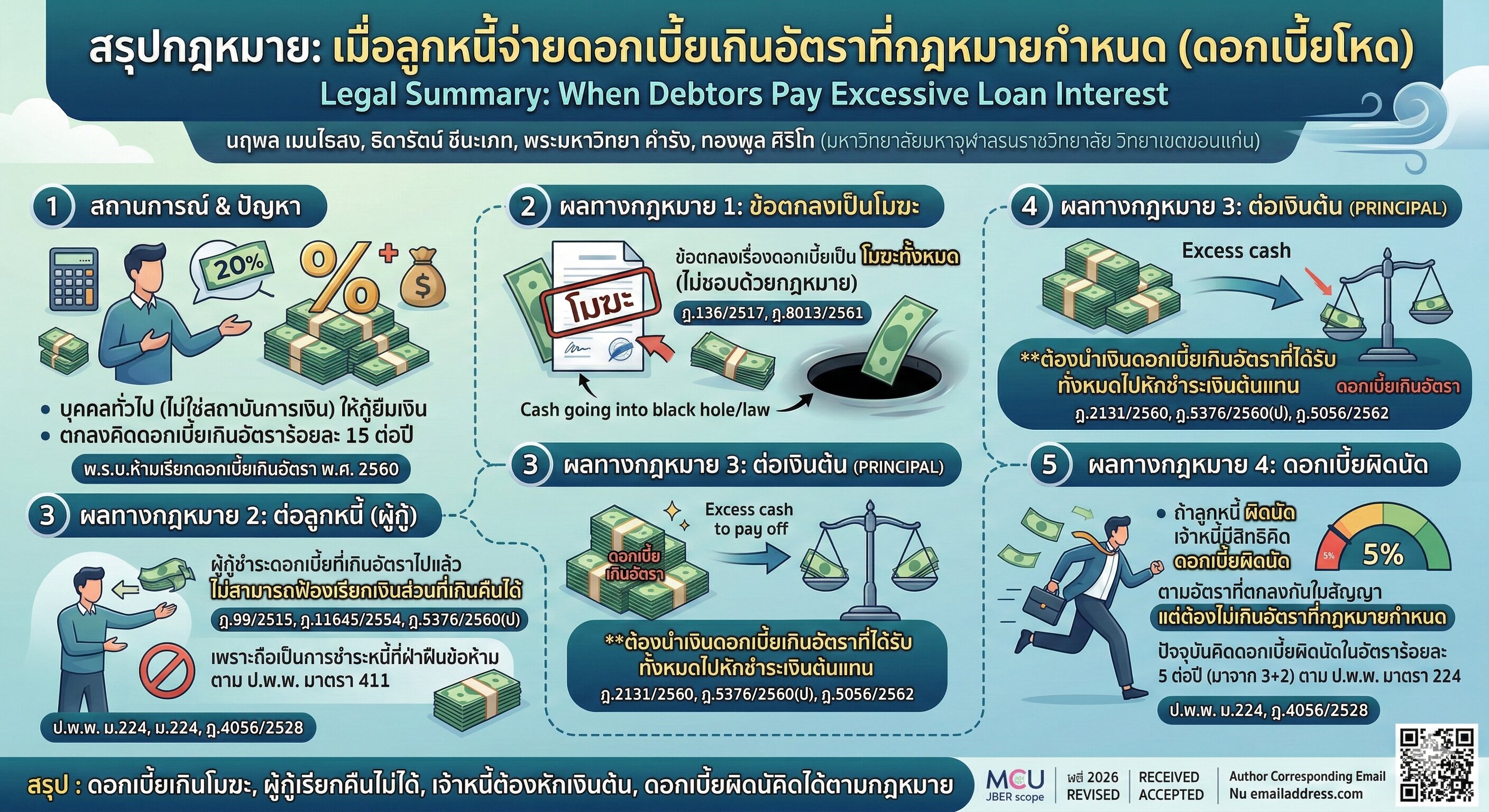
This academic article aims to study the legal effects of the payment of loan interest by a debtor in cases where the creditor charges interest exceeding the rate prescribed by law, regardless of whether the loan is made in the form of a loan agreement, a borrowing contract, or a money loan contract. Such contracts constitute a type of consumable loan as provided under the Civil and Commercial Code, Book III, Specific Contracts, Title IX: Loan. The study focuses on money loan agreements entered into between private individuals, examining the relevant legal provisions under Title IX: Loan, particularly those relating to money lending. This includes Section 653 of the Civil and Commercial Code, which requires that a loan must be evidenced in writing and signed by the borrower as essential evidence, and which allows the parties to agree on interest or not. Where interest is agreed upon, Section 654 prohibits charging interest exceeding the rate of 15 percent per annum. The study also analyzes relevant Supreme Court judgments concerning money lending. The findings indicate that where a private individual (who is not a financial institution) lends money and agrees to charge interest exceeding 15 percent per annum, such an agreement on interest is unlawful and constitutes a criminal offense under Section 4 of the Prohibition of Charging Excessive Interest Act B.E. 2560 (2017). Consequently, the agreement is entirely void, not merely void in respect of the portion of interest exceeding the statutory rate. As a result, a borrower who has already paid interest exceeding the legal rate is unable to bring an action to recover the excess interest paid, as such payment is deemed to be a performance of an obligation in violation of a statutory prohibition under Section 411 of the Civil and Commercial Code. At the same time, the creditor has no right to receive interest exceeding the rate prescribed by law. Therefore, any amount received by the creditor as excess interest must be applied toward the repayment of the principal instead. With regard to default interest, if the borrower is in default, the creditor is entitled to charge default interest at the rate agreed upon in the contract, provided that such rate does not exceed the rate prescribed by law. Currently, the statutory rate of default interest is 5 percent per annum.
References
ปัญญา ถนอมรอด. (2564). คำอธิบายประมวลกฎหมายแพ่งและพาณิชย์ว่าด้วยยืม ค้ำประกัน จำนอง จำนำ (พิมพ์ครั้งที่ 16). สำนักอบรมศึกษากฎหมายแห่งเนติบัณฑิตยสภา.
ประมวลกฎหมายแพ่งและพาณิชย์. (2568, 11 พฤศจิกายน). ราชกิจจานุเบกษา, เล่ม 42, หน้า 1.
พระราชบัญญัติห้ามเรียกดอกเบี้ยเกินอัตรา พ.ศ. 2560. (2560, 15 มกราคม). ราชกิจจานุเบกษา, เล่ม 134 ตอน 5 ก.
พิมพ์ใจ รื่นเริง. (2564). กฎหมายแพ่งและพาณิชย์ว่าด้วยยืม ฝากทรัพย์ เก็บของในคลังสินค้า ประนีประนอมยอมความ การพนันและขันต่อ (พิมพ์ครั้งที่ 6). โรงพิมพ์มหาวิทยาลัยรามคำแหง.
วิวัฒน์ ว่องวิวัฒน์ไวทยะ. (2566). สรุปย่อหลักกฎหมายกู้ยืม ค้ำประกัน จำนอง จำนำ (พิมพ์ครั้งที่ 2). กรุงสยามพับลิชชิ่ง.
ศาลฎีกา. (2568). ระบบสืบค้นคำพิพากษาศาลฎีกา คำสั่งคำร้อง และคำวินิจฉัยศาลฎีกา. สืบค้นเมื่อ 16 ธันวาคม 2568 จาก https://deka.supremecourt.or.th/
Downloads
Published
How to Cite
Issue
Section
License
Copyright (c) 2026 Authors

This work is licensed under a Creative Commons Attribution-NonCommercial-NoDerivatives 4.0 International License.