Hybrid Language Practices and Linguistic Errors in the Linguistic Landscape of Nakhon Sawan
คำสำคัญ:
Linguistic landscape, Thailand, language use, language mixing, language prominence, linguistic errorsบทคัดย่อ
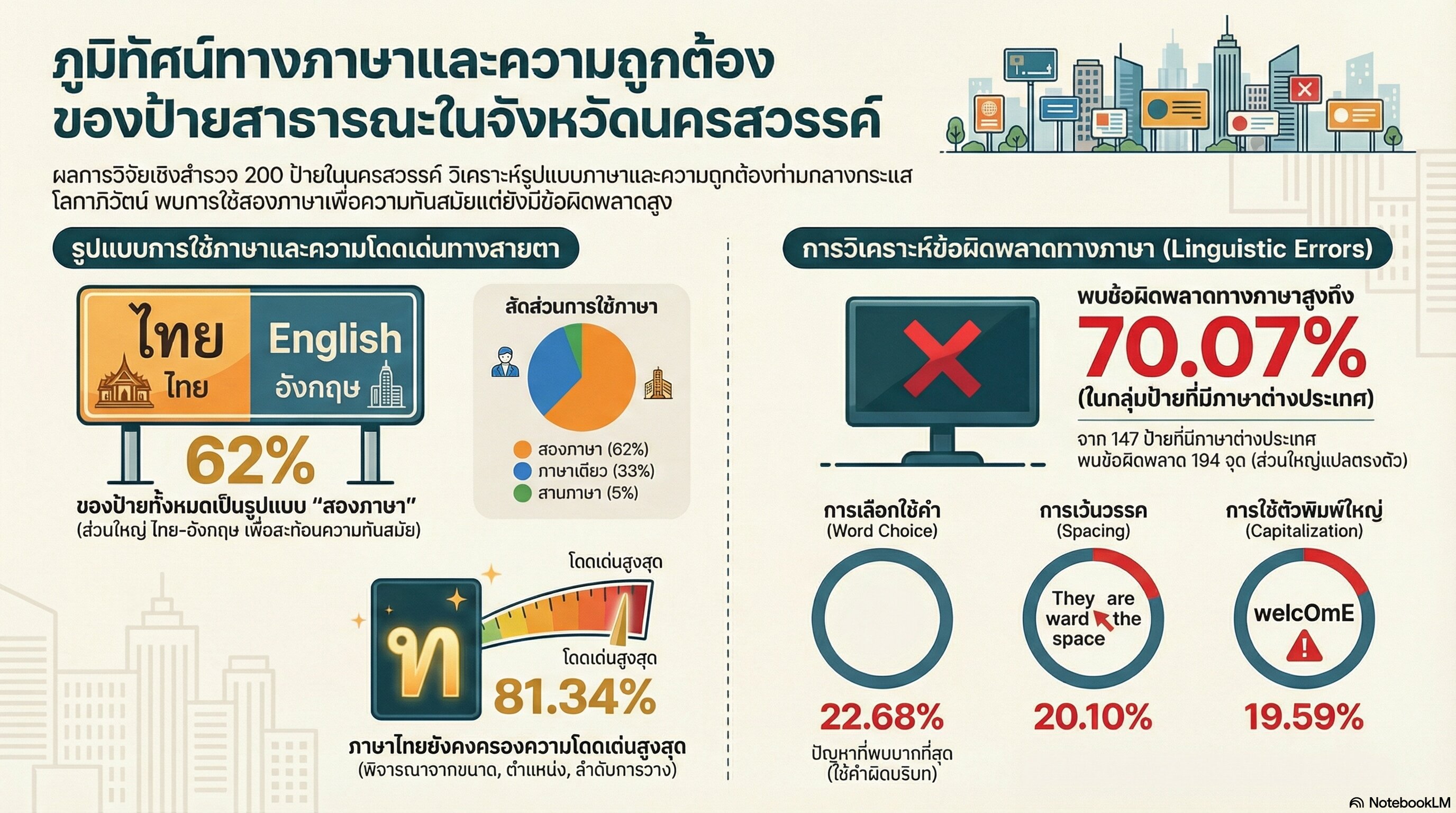
This paper presents an empirical study of the linguistic landscape of Nakhon Sawan, examining language use, mixing, prominence, and errors in public signage. A total of 200 signs were analysed, revealing that bilingual signs predominated (62%), followed by monolingual signs (33%; Thai 24.5%, English 8.5%) and trilingual signs (5%). Thai was the dominant language across all sign types, while English served as the principal secondary language, reflecting both communicative functions and symbolic associations with globalization, modernity, and prestige. Analysis of monolingual and bilingual signs showed frequent language mixing through lexical borrowing, transliteration, and syntactic influence from English. Language prominence, assessed via font size, placement, colour, and visual hierarchy, identified Thai as visually dominant in 81.34% of cases. Across all signage types, 194 linguistic errors were found in 147 signs, with word choice, spacing, and capitalization errors most common. Although these errors seldom cause serious misunderstandings, they may occasionally distort meaning or produce unintended humor. Overall, the findings highlight a hybridized and dynamic linguistic landscape in Nakhon Sawan, reflecting the balance between communicative functionality and symbolic expressions of globalization and local identity, and offer practical implications for effective signage design in Thailand.
เอกสารอ้างอิง
Ariani, N., & Artawa, K. (2021). Analysis of the grammatical errors of English public signs translations in Ubud, Bali, Indonesia. Journal of Language and Linguistic Studies, 18(Special Issue 2), 899–909.
Backhaus, P. (2006). Multilingualism in Tokyo: A look into the linguistic landscape. In D. Gorter (Ed.), Linguistic landscape: A new approach to multilingualism (pp. 52–66). Multilingual Matters.
Backhaus, P. (2007). Linguistic landscapes: A comparative study of urban multilingualism in Tokyo. Multilingual Matters.
Bennui, P. (2023). English and other languages in the linguistic landscape of Koh Lipe, Satun: Distribution, domains, functions, and glocalization. Journal of Multidisciplinary in Social Sciences, 19(3), 32–47.
Ben-Rafael, E., Shohamy, E., Amara, M., & Trumper-Hecht, N. (2006). Linguistic landscape as symbolic construction of the public space: The case of Israel. In D. Gorter (Ed.), Linguistic landscape: A new approach to multilingualism (pp. 7–30). Multilingual Matters.
Cenoz, J., & Gorter, D. (2006). Linguistic landscape and minority languages. In D. Gorter (Ed.), Linguistic landscape: A new approach to multilingualism (pp. 67–80). Multilingual Matters.
Chaiyasit, S., & Richter, K. (2025). The role of English in the linguistic landscape of the Bangkok Bus Terminal (Mo Chit): A linguistic landscape study. Journal of English Language and Linguistics, 6(2), 280–296. https://doi.org/10.62819/jel.2025.1172
Cook, V. (2004). The English writing system. Arnold.
Corder, S. (1967). The significance of learners' errors. International Review of Applied Linguistics in Language Teaching, 5(4), 161–170.
Economics Tourism and Sports Division. (2025a). Ministry of Tourism and Sports. https://www.mots.go.th/news/category/759
Economics Tourism and Sports Division. (2025b). Ministry of Tourism and Sports. https://www.mots.go.th/news/category/805
Fraenkel, J., Wallen, N. E., & Hyun, H. H. (2012). How to design and evaluate research in education (8th ed.). McGraw Hill.
Gorter, D. (Ed.). (2006). Linguistic landscape: A new approach to multilingualism. Multilingual Matters.
Gorter, D. (2013). Linguistic landscapes in a multilingual world. Annual Review of Applied Linguistics, 33, 190–212.
Gorter, D., & Cenoz, J. (2023). A panorama of linguistic landscape studies. Multilingual Matters. https://zenodo.org/records/8214590
Halliday, M. A. K. (1994). An introduction to functional grammar (2nd ed.). Edward Arnold.
Huebner, T. (2006). Bangkok's linguistic landscapes: Environmental print, codemixing and language change. In D. Gorter (Ed.), Linguistic landscape: A new approach to multilingualism (pp. 31–51). Multilingual Matters.
Huebner, T. (2009). A framework for the linguistic analysis of linguistic landscapes. In E. Shohamy & D. Gorter (Eds.), Linguistic landscape: Expanding the scenery (pp. 70–87). Routledge.
Huebner, T. (2016). Linguistic landscape: History, trajectory and pedagogy. Manusya: Journal of Humanities, Special Issue 22, 1–11. http://www.manusya.journals.chula.ac.th/archives/vol-19/
Imbert-Bouchard Ribera, D. (2021). The use of signage as a tool for social integration in tourist cities: Examples of relevant cases in Catalonia. International Journal of Tourism Cities, 7(2), 294–312.
James, C. (2013). Errors in language learning and use: Exploring error analysis (2nd ed.). Routledge.
Kasanga, L. (2012). Mapping the linguistic landscape of a commercial neighbourhood in Central Phnom Penh. Journal of Multilingual and Multicultural Development, 33(6), 553–567.
Kavilanan, S. (2024). The linguistic landscape of business signage at 'KAD KONG TA' Market in Lampang Province: A reflection of lost cultural diversity. Humanity and Social Science Journal, Ubon Ratchathani University, 15(1), 257–283.
Klebsamut, J., Tanatudtaveechot, T., Vitaksabut, A., & Chanpradit, T. (2022). Linguistic landscape: Linguistic diversity and strategies used in writing public signs at Pattaya Walking Street. In Proceedings of the 19th KU KPS National Conference (pp. 1876–1886).
Kongkaew, S., & Lerdpaisalwong, S. (2025). Error investigation of public signs and foreigners' perceptions of business signs in Bangkok: A case study of Sathorn and Sukhumvit areas. Journal of Liberal Arts, Prince of Songkla University, 17(1), 1–19. https://doi.org/10.14456/jlapsu.2025.1
Landry, R., & Bourhis, R. Y. (1997). Linguistic landscape and ethnolinguistic vitality: An empirical study. Journal of Language and Social Psychology, 16(1), 23–49. https://doi.org/10.1177/0261927X970161002
Mohebbi, A., & Firoozkohi, A. H. (2021). A typological investigation of errors in the use of English in the bilingual and multilingual linguistic landscape of Tehran. International Journal of Multilingualism, 18(1), 24–40.
Nenotek, S. A., Beeh, N., & Benu, N. N. (2024). Errors of written English on the outdoor signs in Kupang City, Indonesia: A linguistic landscape approach. Ganaya: Jurnal Ilmu Sosial dan Humaniora, 7(1), 1–10.
Ngampramuan, W. (2022). Linguistic landscape in Thailand: A case study of languages used on signs at Suvarnabhumi International Airport. The Liberal Arts Journal, Mahidol University, 5(2), 314–331.
Pan, Z. (2024). Linguistic uniscape: A comparative study of universities in Thailand. Manusya: Journal of Humanities, 27, 1–28.
Pathanasin, S. (2025). A study of the linguistic landscape on Phuket Island: Identity, tourism and policy. rEFLections, 32(1), 213–233.
Pipattarasakul, P. (2021). Linguistic landscape of the legendary century-old Bangkok railway station. Rangsit Journal of Social Sciences and Humanities, 8(2), 53–66.
Prapobratanakul, C. (2016). Inside the shop names: Hybridity, language awareness and globalization in the linguistic landscape of a local commercial neighborhood in Bangkok. Manusya: Journal of Humanities, Special Issue 22, 26–37.
Reh, M. (2004). Multilingual writing: A reader-oriented typology—With examples from Lira Municipality (Uganda). International Journal of the Sociology of Language, 170, 1–41.
Rungswang, A. (2023). Linguistic landscape: Forms and functions of signs on Khaosan Road, Thailand. Journal of Roi Kaensarn Academi, 8(10), 399–415.
Shohamy, E. (2006). Language policy: Hidden agendas and new approaches. Routledge.
Shohamy, E. (2019). Linguistic landscape after a decade: An overview of themes, debates and future directions. In M. Pütz & N. Mundt (Eds.), Expanding the linguistic landscape: Linguistic diversity, multimodality and the use of space as a semiotic resource (pp. 25–37). Multilingual Matters. https://doi.org/10.21832/9781788922166-004
Sirisattayawong, V. (2025). In 2025, the number of foreign tourists visiting Thailand is expected to reach 37.5 million. Kasokornthai Econ Analysis, 31(3543), 1–4.
Smalley, W. A. (1994). Linguistic diversity and national unity: Language ecology in Thailand. University of Chicago Press.
Sutthinaraphan, K. (2016). A linguistic landscape study of advertising signage on skytrain. Manusya: Journal of Humanities, Special Issue 22, 53–71. http://www.manusya.journals.chula.ac.th/wp-content/uploads/2021/06/2016190305_Sutthinaraphan_53-71-S22.pdf
Thongtong, T. (2016). A linguistic landscape study of signage on Nimmanhemin Road, a Lanna Chiang Mai chill-out street. Manusya: Journal of Humanities, Special Issue 22, 72–87.
Tran, T. (2021). Pho as the embodiment of Vietnamese national identity in the linguistic landscape of a western Canadian city. International Journal of Multilingualism, 18(1), 73–89.
Vettorel, P., & Franceschi, V. (2013). English and lexical inventiveness in the Italian linguistic landscape. English Text Construction, 6(2), 238–270. https://doi.org/10.1075/etc.6.2.02vet
Wing, A. M., & Baddeley, A. D. (1980). Spelling errors in handwriting: A corpus and a distributional analysis. In U. Frith (Ed.), Cognitive processes in spelling (pp. 251–285). Academic Press.
ดาวน์โหลด
เผยแพร่แล้ว
รูปแบบการอ้างอิง
ฉบับ
ประเภทบทความ
หมวดหมู่
สัญญาอนุญาต
ลิขสิทธิ์ (c) 2026 Journal of Buddhist Education and Research (JBER)

อนุญาตภายใต้เงื่อนไข Creative Commons Attribution-NonCommercial-NoDerivatives 4.0 International License.