Problems and Strategies for the Enhancement of Communicative English Usage in Multilingual Societies: A Case Study of Guangxi University of Foreign Languages in Guangxi, China
Abstract
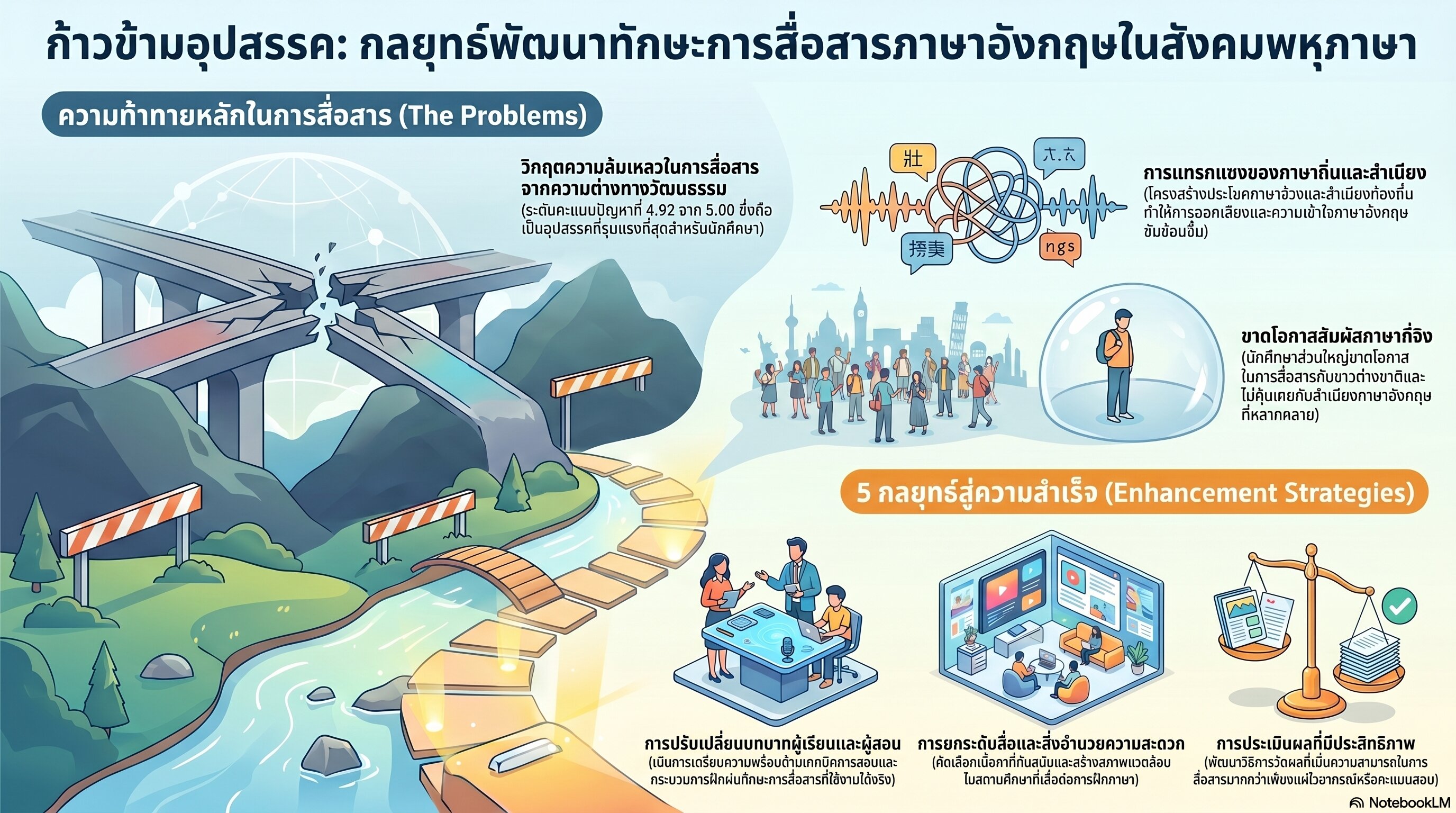
The objectives of this research were: to enhance problems of Guangxi University of Foreign Languages as an example to explore the issue of English communication skills among Chinese university students and develop corresponding improvement strategies. The purpose is to 1) identify specific issues regarding the English communication skills of students at Guangxi University of Foreign Languages, and 2) develop effective improvement strategies based on these issues. This is a survey-based study. The survey subjects are students from Guangxi University of Foreign Languages, and 386 students and 263 teachers were selected through appropriate sampling methods. Two main research tools were used: 1) a questionnaire aimed at investigating students' self-perception issues in English communication, including vocabulary comprehension, accent adaptation, and listening concentration; 2) An English communication test that objectively evaluates students' communication skills and identifies specific error patterns in content understanding, detail mastery, and reasoning. The collected data, including questionnaire responses and test results, are analyzed using content analysis and statistical methods such as frequency count and percentage calculation. The research results indicate that: 1) the problems with students' English communication skills are mainly reflected in multiple aspects. The difficulty of understanding vocabulary in context, adapting to different English accents (including British, American, and other accents in dialogue materials), and maintaining long-term focus during communication is relatively high. In addition, there are also issues with skills such as inferring implicit meanings and mastering key details. 2) The Enhancement Strategies of Communicative Skill of Chinese University Students is composed of 5 chapters ; namely, chapter 1: About Learners , chapter 2: About Instructors, Chapter 3: About teaching materials , chapter 4: About Teaching-learning Facilities, and chapter 5 About teaching-learning evaluation: All the 5 chapters were approved by the three specialists in terms of correctness and suitability. All the 5 chapters were evaluated and approved by the three specialists; therefore, the constructed Enhancement Strategies of Communicative Skill of Chinese University Students could be used as guidelines for the enhancement of English communicative skill of Chinese university students in China.
References
Sirikit, S., Paengkamhag, W., & Pansa, B. (2025). The development model of English communication skill by using bilingual method to enhance English communication ability, learning strategies and problem-solving skill. Journal of Asian Language Teaching and Learning (Online), 6(1), 211–226. https://so10.tci-thaijo.org/index.php/jote/article/view/2325
Suwannatrai, B., & Yanapalo, D. T. (2023). Transcending boundaries: English language communication in contemporary Buddhist contexts. Journal of Dhamma for Life, 29(3), 250–267. https://so08.tci-thaijo.org/index.php/dhammalife/article/view/2165
Songsiengchai, S., Baikum, S., & Juarez, E. M. (2020). Developing and equipping effective English communication skills for non-native English students: Creating and nurturing English speaking environments. Journal of Humanities and Social Science, Baansomdejchaopraya Rajabhat University, 14(1), 266–287. https://so08.tci-thaijo.org/index.php/jhusocbru/article/view/1602
Thongsookularn, S. (2020). English communication for a staff car dealer company in Pathumtani Province, Thailand. Journal of Applied Buddhism Psychology for Society, 6(1), 199–209. https://so03.tci-thaijo.org/index.php/human/article/view/239993
Thach, O. N., Kanokkmalade, V., & Klinchan, N. (2021). English communication skills of Cambodian students at Mahachulalongkornrajavidyalaya University based on linguistic approach. Journal of Applied Buddhism Psychology for Society, 7(1), 391–406. https://so03.tci-thaijo.org/index.php/human/article/view/251413
Lohyita, R., Chomchuen, A., Waelateh, B., & Waelateh, B. (2024). The effects of using task-based learning with edutainment to develop English communication skills in an intensive Islamic studies of an opportunity expansion school. NEU Academic and Research Journal, 14(3), 108–122. https://so04.tci-thaijo.org/index.php/neuarj/article/view/270358
Pholying, T., & Ambele, E. A. (2024). Enhancing vocabulary acquisition in vocational dramatic arts education at Kalasin College: Task-based learning and implications for English communication skills. Journal of Nakhonratchasima College, Humanities and Social Sciences Branch, 18(2), 413–428. https://so03.tci-thaijo.org/index.php/hsjournalnmc/article/view/273367
Thammakhan, N. (2024). An analysis of factors having impacts on translation from the Thai language (L1) to the English language (L2) in the group of first-year students studying English for Communication Programme at Thaksin University. Journal of Asian Language Teaching and Learning (Online), 5(2), 26–40. https://so10.tci-thaijo.org/index.php/jote/article/view/1196
Monklom, P. (2019). Exploring communication strategies in cross-cultural interaction between native English teachers and Thai EFL teachers. Trends of Humanities and Social Sciences Research, 4(1), 16–25. https://so03.tci-thaijo.org/index.php/Humanties-up/article/view/200304
Intorn, P. Y., Chantimachaiamorn, C., & Paengkamhag, W. (2025). Development of English communication: Speaking skills in daily-life of the first-year students English Program in Faculty of Education at MCU. Journal of Asian Language Teaching and Learning (Online), 6(1), 94–103. https://so10.tci-thaijo.org/index.php/jote/article/view/2081
Jing, L. (2024). Mediation effect of multilingual awareness on family language management. Academic Journal in Public and Private Management, 6(1), 251–263. https://doi.org/10.14456/jappm.2024.18
Disa, T. (2025). Work-life balance through the eyes of Gen Z: A multimodal analysis of multilingual students’ perspectives. Journal for Strategy and Enterprise Competitiveness, 4(10), 46–58. https://so07.tci-thaijo.org/index.php/STECOJournal/article/view/6815
Rattanaphumma, R., & Visuttakul, C. (2022). Impact of study abroad experiences on the multilingual development of Chinese students: A case study in Thailand. Journal of Research and Curriculum Development, 12(1), 43–57. https://so03.tci-thaijo.org/index.php/jrcd/article/view/259824
Panyapaeng, J., Mahaviro, P. S., & วิชัยวงษ์, M. (2023). Guidelines for the educational management of multilingual concepts based on the mother tongue languages of elementary school students at Kaenoisuksa School. MCU Haripunchai Review, 7(3), 134–148. https://so04.tci-thaijo.org/index.php/JMHR/article/view/a10
Brückner, M. (2016). Information management framework for multilingual education management information systems. Journal of Education and Innovation, 18(2), 276–287. https://so06.tci-thaijo.org/index.php/edujournal_nu/article/view/62047
Prommarak, C., & Rittikoop, W. (2021). The development of learning management based on the multilingual concept using the mother tongue with task-based language teaching to strengthen English listening and speaking skills for Lahu tribe students in Grade 3. Journal of Graduate Research, 12(2), 45–60. https://so02.tci-thaijo.org/index.php/banditvijai/article/view/251147
Sawaengmongkon, C. (2014). A comparison of standard Thai achievement of ethnic Karen first grade students in monolingual Thai, informal bilingual Thai-Karen, and mother tongue-based multilingual education classrooms. Journal of Education Studies, Chulalongkorn University, 42, 33–47. https://so02.tci-thaijo.org/index.php/EDUCU/article/view/26458
Srikrai, P. S., & Wannaruk, A. (2022). Attitudes toward English as a lingua franca in multilingual university contexts of Northeast Thailand. Journal of Mekong Societies, 18(3), 159–181. https://so03.tci-thaijo.org/index.php/mekongjournal/article/view/261339
Leslie, C. (2025). Looking back on predictions of global English: Applying technology theory to develop critical multilingual language awareness. FOYER: The Journal of Humanities, Social Sciences, and Education, 8(1), 1–40. https://so02.tci-thaijo.org/index.php/lajournal/article/view/271976
Zhang, S., Wang, Y., Jiang, Y., & Li, C. (2024). A scoping review of translanguaging research in L2 class in China based on CNKI. International Chinese Language Teaching, 4(2), 83–98. https://so04.tci-thaijo.org/index.php/iclt/article/view/276309
Downloads
Published
How to Cite
Issue
Section
Categories
License
Copyright (c) 2026 Journal of Buddhist Education and Research (JBER)

This work is licensed under a Creative Commons Attribution-NonCommercial-NoDerivatives 4.0 International License.