A Study of Shandong Folk Song Teaching at Shandong Media Vocational College in Shandong Province
Keywords:
Survey, Shandong Folk song, TeachingAbstract
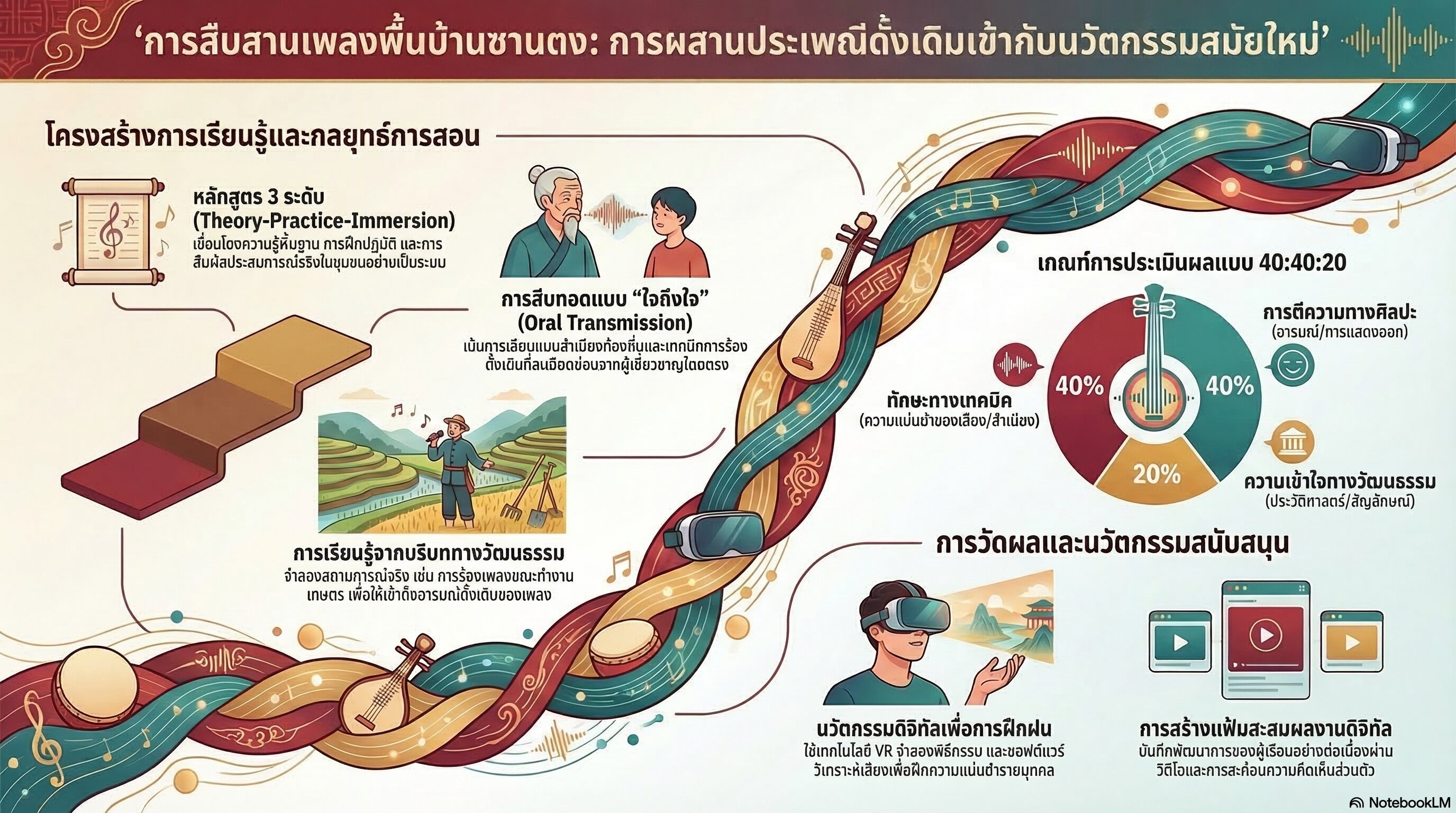
This study aims to Survey on the Shandong Folk song teaching at Shandong Media Vocational College in Shandong Province. This research will adopt a qualitative research approach; qualitative data will be collected through interviews, focus groups, and observations. Interviews and focus groups will be carried out using semi-structured question guides. This approach allows for flexibility, enabling the exploration of unanticipated but relevant topics that may arise during the interaction with participants. At the same time, it ensures that key topics, such as students' understanding of the cultural background of Shandong folk songs, their personal experiences in learning these songs, and their suggestions for improving the teaching, are covered. Observations will be systematically recorded in educational settings. The results show that the most important aspect of teaching Shandong folk songs is the preservation and transmission of cultural charm through the integration of local dialect and traditional vocal techniques. This emphasis on dialect enriches the musical expression, ensuring authenticity in performance. Mastering regional vocal ornaments distinguishes authentic folk performances and connects students not only to the music but also to their cultural heritage. The curriculum fosters cultural confidence by deepening emotional connections to the songs and their historical significance. Additionally, while modern teaching methods and technology are incorporated, maintaining the authenticity of folk traditions is paramount, allowing Shandong's cultural identity to thrive as a living art form.
References
Chen, Y. M. (2025, June). The value and path of ancient poetry songs in national vocal music teaching in the new era. Contemporary Music, 75–77.
Gong, Y. J. (2025). Research on the application of piano accompaniment in national vocal music performance teaching. Popular Literature and Art, (10), 108–110. https://doi.org/10.20112/j.cnki.ISSN1007-5828.2025.10.035
Ji, C. (2025, July 9). Tang Caimei: The clear-singing lark of the Zhuang ethnic group. Music Weekly, A08.
Li, L., & Xu, T. X. (2025, June). Rich achievements in the research of running: After reading The study of running in Chinese national vocal music. People’s Music, 92–95.
Miao, H. F., & Sun, Y. N. (2025). Modular teaching design and practice of vocal music courses for preschool education in higher vocational colleges. Drama Home, (16), 166–168.
Tang, H. T. (2025). An analysis of the musical style and singing characteristics of Northeast folk songs: Taking Watching Yangko as an example. Comedy World (Second Half-Month), (05), 115–117.
Tian, J. (2025). Application strategies of traditional Chinese opera singing techniques in national vocal music singing. Famous Artists and Famous Works, (17), 88–90.
Wang, X. Y. (2025). Artistic features of the art song Variations of Mayila and the application of coloratura singing techniques. Sound of the Yellow River, (10), 150–153. https://doi.org/10.19340/j.cnki.hhzs.2025.10.031
Wu, J. J. (2025). An analysis of the collaborative art between piano art guidance and vocal music performers. Drama Home, (17), 63–65.
Wu, W. J. (2025). Research on the emotional expression of national vocal music singing from the perspective of vocal aesthetics. Drama Home, (15), 74–76.
Xia, Z. Y. (2025). Exploration of the character-cavity singing of modern and contemporary poetry works. Popular Literature and Art, (10), 35–37. https://doi.org/10.20112/j.cnki.ISSN1007-5828.2025.10.012
Xu, Z. J. (2025). Research on the reference and integration of modern national vocal music singing to traditional opera art. New Legend, (19), 56–58. https://doi.org/10.26938/j.cnki.CN42-1794/Z.2025.19.018
Yang, H. Q., & Jin, S. A. (2025). The entanglement relationship between Northeast folk minor songs and “local accent.” Contention in Literature and Art, (05), 193–197.
Yang, L. K. (2025). The style presentation and innovative application path of ornamentation in national vocal music singing. Drama Home, (19), 78–80. https://doi.org/10.26959/j.cnki.CN42-1410/J.2025.19.025
Xing, Z. (2024). Shandong folk songs: Exploration of the aesthetic characteristics and melodic commonalities. Journal of Humanities, Arts and Social Science, 8(9), 2101–2107.
Zeng, X. H. (2025). The application of sound-control skills in national vocal music singing teaching. Drama Home, (17), 99–101.
Zhang, L. (2025). The ancient charm rejuvenation of national vocal music. Cloud, (22), 39–41.
Downloads
Published
How to Cite
Issue
Section
Categories
License
Copyright (c) 2026 Journal of Buddhist Education and Research (JBER)

This work is licensed under a Creative Commons Attribution-NonCommercial-NoDerivatives 4.0 International License.