Guidelines for Developing Teachers’ Learning Leadership in the Digital Age under the Khon Kaen Primary Educational Service Area Office 1
Abstract
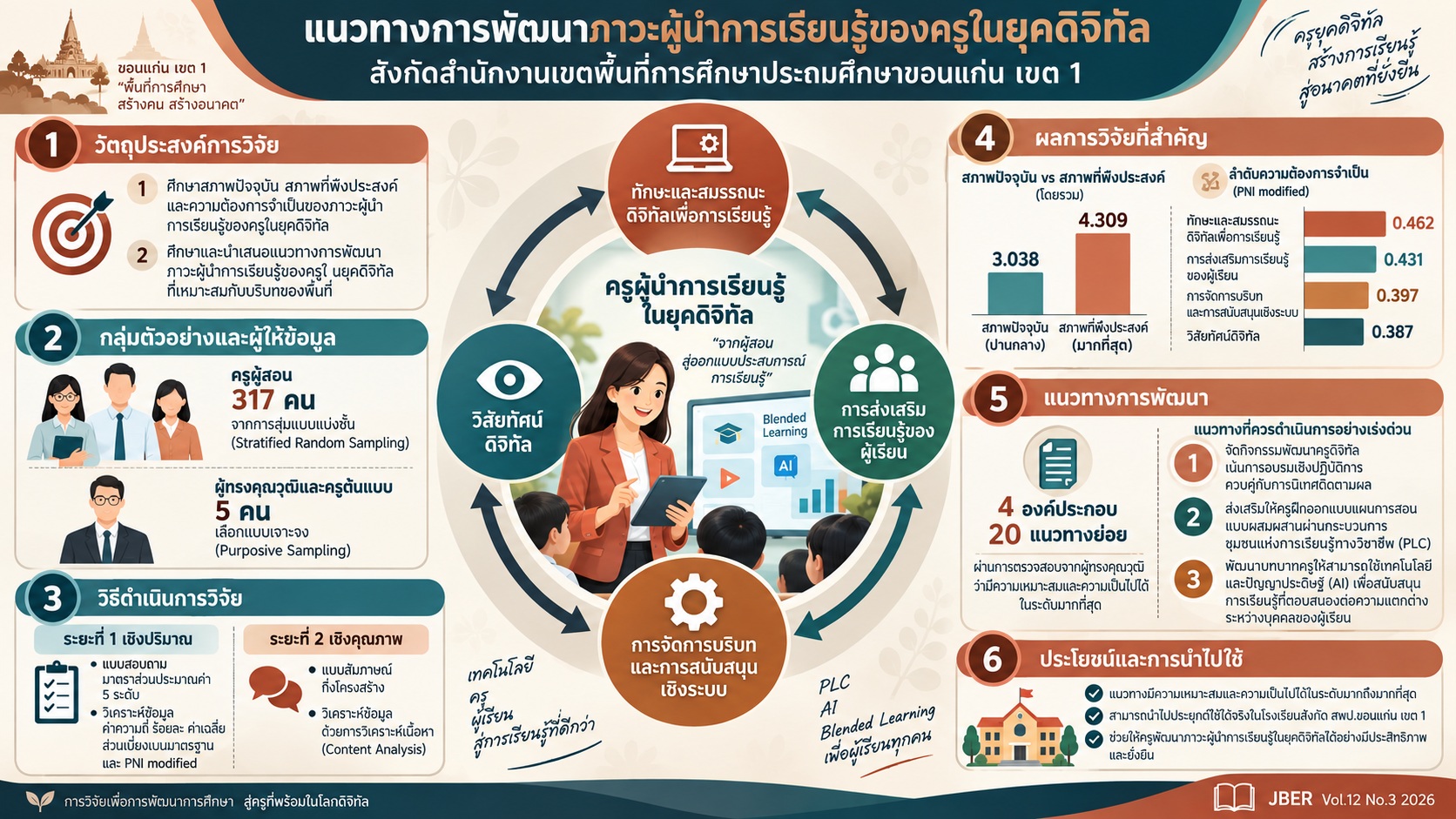
This study, titled "Guidelines for the Development of Teachers' Learning Leadership in the Digital Age under the Khon Kaen Primary Educational Service Area Office 1," employed a mixed-methods research design. Its objectives were: 1) to investigate the current state, desirable state, and priority needs for the development of teachers' learning leadership in the digital age, and 2) to study and propose appropriate development guidelines for the context of the specified area. The research was conducted in two phases. Phase 1 involved quantitative research, collecting data from a sample of 317 teachers, obtained through stratified random sampling, using a 5-level rating scale questionnaire. The data were analyzed using descriptive statistics, including frequency, percentage, mean, standard deviation, and the Priority Needs Index (PNI modified) . Phase 2 was qualitative research, conducted through semi-structured interviews with 5 key informants, comprising experts and model teachers selected via purposive sampling, with data analyzed using content analysis.
The research findings revealed that the overall current state of teachers' learning leadership was at a moderate level ( x=3.038), whereas the desirable state was at the highest level ( x=4.309), indicating a significant development gap. The analysis of priority needs, ranked from highest to lowest, was as follows: 1st, Digital Competencies for Learning (PNI modified =0.462); 2nd, Fostering Student Learning (PNI modified =0.431); 3rd, System Support and Context Management (PNI modified=0.397); and 4th, Digital Visionary (PNI modified =0.387).
The qualitative findings confirmed and elaborated on the quantitative results, with experts suggesting a focus on developing skills in designing blended learning, shifting the teacher's role from "instructor" to "learning experience designer," and establishing a robust systemic support structure. Based on these findings, development guidelines consisting of 4 main components and 20 sub-guidelines were synthesized . These guidelines were validated by experts and found to have the highest level of appropriateness ( x=4.34) and feasibility ( x=4.28). The most urgent guidelines for implementation include: 1) organizing "Digital Teacher" development activities focusing on practical workshops with continuous monitoring and supervision; 2) encouraging teachers to practice designing blended learning lesson plans through Professional Learning Community (PLC) processes; and 3) developing teachers' roles to enable the use of technology and Artificial Intelligence (AI) to genuinely support learning that addresses individual student differences.
The evaluation of the appropriateness and feasibility of the guidelines by experts found that the developed guidelines are appropriate and feasible at a high to the highest level. This reflects that these guidelines can be practically applied in the context of schools under the Khon Kaen Primary Educational Service Area Office 1, which will help teachers develop their learning leadership in the digital age effectively and sustainably.
References
กระทรวงเทคโนโลยีสารสนเทศและการสื่อสาร. (2559). แผนพัฒนาดิจิทัลเพื่อเศรษฐกิจและสังคม.
พิมพ์ครั้งที่ 1. กรุงเทพมหานคร : กระทรวงเทคโนโลยีสารสนเทศและการสื่อสาร.
กระทรวงดิจิทัลเพื่อเศรษฐกิจและสังคม. (2567). รายงานนโยบายการขับเคลื่อนดิจิทัล 4.0 ประจำปีพ.ศ. 2567. กรุงเทพฯ: กระทรวงฯ.คณะครุศาสตร์ มหาวิทยาลัยราชภัฏอุบลราชธานี
กระทรวงศึกษาธิการ. (2553). หลักสูตรแกนกลางการศึกษาขั้นพื้นฐาน พุทธศักราช 2551.
(พิมพ์ครั้งที่ 3 ). กรุงเทพฯ : ชุมนุมสหกรณ์การเกษตรแห่งประเทศไทย.
กมลทิพย์ บุญโพธิ์. (2561). ภาวะผู้นำทางวิชาการของผู้บริหารสถานศึกษาในสังกัดองค์กรบริหาร
ส่วนจังหวัดชัยภูมิ. ชัยภูมิ: มหาวิทยาลัยราชภัฏชัยภูมิ.
แก้วมณี ปัทมะ. (2564). แนวทางการพัฒนาภาวะผู้นำเชิงสร้างสรรค์ของผู้บริหารสถานศึกษา
สังกัดสำนักงานเขตพื้นที่ การศึกษามัธยมศึกษาสุรินทร์. วิทยานิพนธ์การศึกษามหาบัณฑิต
สาขาวิชาการบริหารและพัฒนาการศึกษา. มหาสารคาม : มหาวิทยาลัยมหาสารคาม
ขวัญนภา นามแก้ว. 2566. แนวทางการพัฒนาภาวะผู้นำยุคดิจิทัลของผู้บริหารสถานศึกษา สังกัด
สำนักงานเขตพื้นที่การศึกษามัธยมศึกษาบุรีรัมย์. วิทยานิพนธ์ปริญญาศึกษาศาสตรมหาบัณฑิต สาขาวิชาการบริหารการศึกษา วิทยาลัยบัณฑิตเอเซีย
คุรุสภา. (2565). กรอบสมรรถนะครูแห่งชาติ (Thailand Teacher Competency Framework)
สืบค้นจาก https://www.ksp.or.th
จิณณวัตร ปะโคทัง. (2561). ภาวะผู้นำยุคดิจิทัลสำหรับผู้บริหารสถานศึกษามืออาชีพ.
(พิมพ์ครั้งที่ 1). อุบลราชธานี : ศิริธรรมออฟเซ็ท
มนธิรา จันทร์เชื้อ. (2566). แนวทางการพัฒนาภาวะผู้นำแห่งการเรียนรู้ของครูในยุคดิจิทัล สังกัดสำนักงานเขตพื้นที่การศึกษาประถมศึกษาพิจิตร เขต 1. วิทยานิพนธ์ปริญญามหาบัณฑิต, มหาวิทยาลัยนเรศวร.
มัตติกา ผาลี. (2565). การพัฒนาภาวะผู้นำดิจิทัลของครูประถมศึกษาในเขตพื้นที่การศึกษาภาคตะวันออกเฉียงเหนือ. วารสารวิจัยและสาระวิชาการทางการศึกษา, 16(2), 55–70.
ลักษวิงษ์ จิระสุวิรรณภักดี, สมชาย เทพแสง, และ สนัน ประจงจิตร. (2566). ภาวะผู้นำแห่งการเรียนรู้ในยุคดิจิทัล. วารสารร่มพฤกษ์ มหาวิทยาลัยเกริก, 41(2).
สำนักงานเขตพื้นที่การศึกษาประถมศึกษาขอนแก่น เขต 1. (2566). แผนปฏิบัติราชการประจำปีงบประมาณ พ.ศ. 2566. ขอนแก่น: สพป.ขอนแก่น เขต 1.
สำนักงานเลขาธิการสภาการศึกษา. (2564). รายงานการศึกษารูปแบบและแนวทางการพัฒนาวิชาชีพครูในศตวรรษที่ 21. กรุงเทพฯ: สกศ.
สำนักงานเลขาธิการสภาการศึกษา. (2565). คุณลักษณะและสมรรถนะของผู้นำการเปลี่ยนแปลงใน
สุกัญญา แช่มช้อย. (2561). การบริหารสถานศึกษาในยุคดิจิทัล. สำนักพิมพ์แห่งจุฬาลงกรณ์
สุธีรา จันทรพิทักษ์. (2567). การจัดการเรียนรู้เชิงนวัตกรรมเพื่อสร้างสมรรถนะผู้เรียนในศตวรรษที่ 21. กรุงเทพฯ: สถาบันวิจัยเพื่อการพัฒนาการศึกษา.
Fullan, M. (2021). The right drivers for whole system success. Centre for Strategic
Education.
Hargreaves, A., & Fullan, M. (2020). Professional capital: Transforming teaching in every school. Teachers College Press.
Hattie, J. (2015). What works best in education: The politics of collaborative
expertise. London: Pearson.Jossey-Bass.
Leithwood, K., Harris, A., & Hopkins, D. (2020). Seven strong claims about successful school leadership revisited. School Leadership & Management, 40(1), 5–22. https://doi.org/10.1080/13632434.2019.1596077
UNESCO. (2022). Reimagining our futures together: A new social contract for education. United Nations Educational, Scientific and Cultural Organization. Retrieved from https://unesdoc.unesco.org/
Woodward, O. & DeMille, O. (2015). What is Social Leadership?. Retrieved August 1,
, from https://thesocialleader.com/social-leadership/.
Yukl, G. A. (2002). Leadership in Organizations. 5th ed. Upper Saddle River. NJ :
Prentice Hall.
________. (2010). Leadership in Organizations. 7th ed. New Jersey : Prentice-Hall.
Yusof, M. R., Yaakob, M. F.M. & Ibrahim, M. Y. (2019). Digital Leadership Among School
Leaders in Malaysia. International Journal of Innovative Technology and
Exploring Engineering (IJITEE). 8(9) : 1481-1485.
Zhong, L. (2017). The Effectiveness of K-12 Principal’s Digital Leadership in Supporting
and Promoting Communication and Collaboration Regarding CCSS Implementation. Journal of Educational Technology Development and Exchange (JETDE). 10(2) : 54-77.
Downloads
Published
How to Cite
Issue
Section
Categories
License
Copyright (c) 2026 Journal of Buddhist Education and Research (JBER)

This work is licensed under a Creative Commons Attribution-NonCommercial-NoDerivatives 4.0 International License.