The Development of English Student Teachers’ Knowledge and Competence in Constructing Multiple-Choice Tests Using Active Learning together with Scaffolding Technique
Keywords:
knowledge and competence in test construction, multiple-choice tests, English student teachers, active learning, scaffolding techniqueAbstract
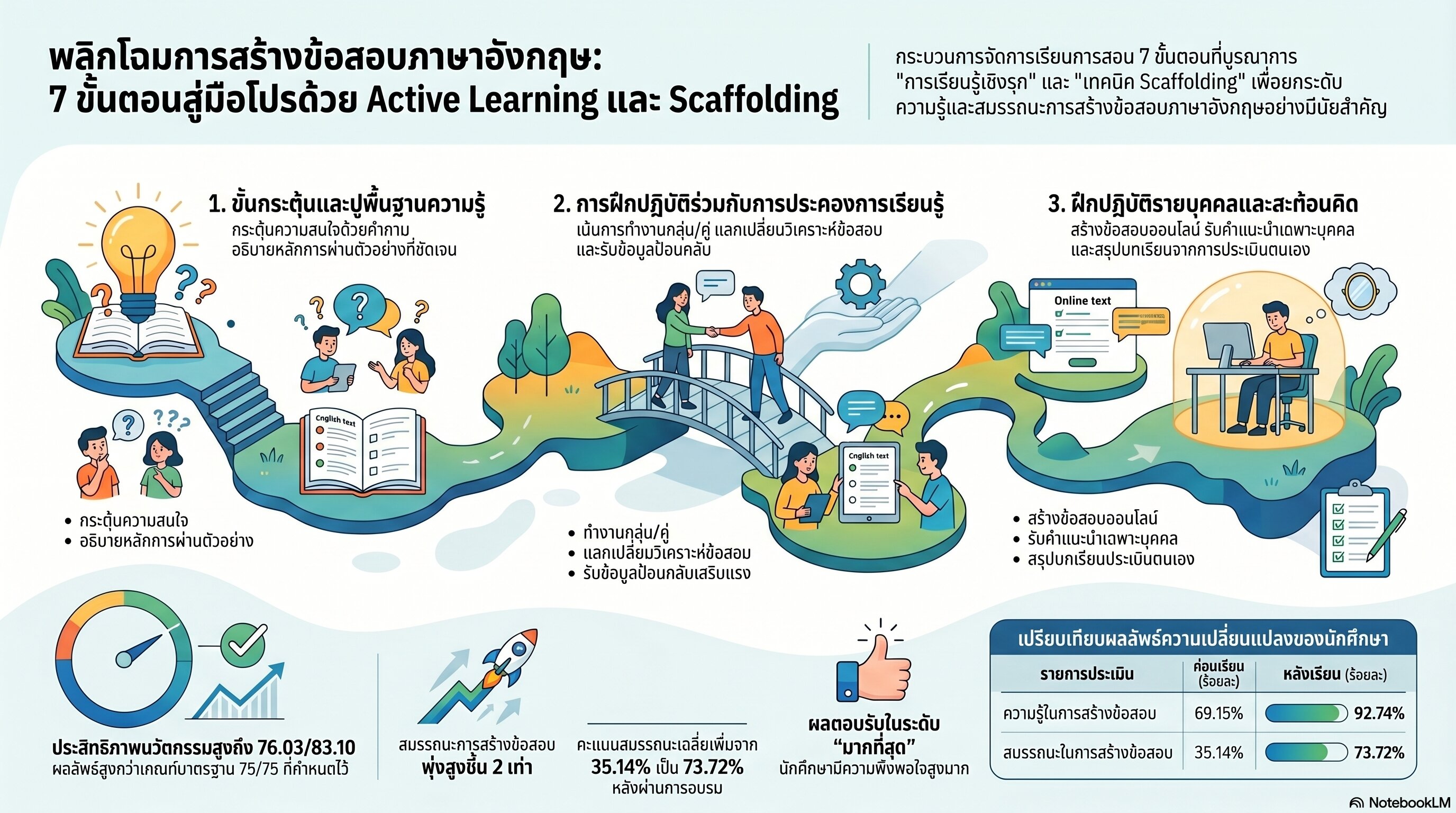
This Quasi-Experimental Research aimed 1) to develop an instructional process innovation using Active Learning together with Scaffolding Technique to enhance English student teachers’ knowledge and competence in constructing multiple-choice tests to meet the efficiency criteria of E1/E2 (75/75) and 2) to investigate the effectiveness of an instructional process with the following purposes: to compare the students’ knowledge and competence in constructing multiple-choice tests before and after the instruction and their effect size, and to investigate students’ opinions on the instructional process. The samples were 56 fourth-year English student teachers in the Academic Year 2024 at the Faculty of Education in a university in Songkhla, using convenience sampling. The research instruments included six lessons of test construction, a pretest and posttest on multiple-choice test knowledge and competence, and a focus group. Statistics used for quantitative data were percentage, mean, standard deviation, independent t-test, and effect size. Qualitative data were analyzed using content analysis. The findings revealed that 1) implementing the instructional process innovation using Active Learning and the Scaffolding Technique reached the efficiency criteria of 75/75 with the formative assessment score (E1) = 76.03 and the summative assessment score (E2) = 83.10, which was higher than the established requirement. After implementing the instructional innovation, the average percentage of students’ knowledge and competence in the posttest (x̄ = 92.74 and 69.15) was found significantly higher than that of the pretest ( x̄ = 73.72 and 35.14) at the 0.05 level with a very large effect size (d = 1.94 and 2.75). The students shared their overall opinions on the instructional process at a high level. During the instruction, however, limited English knowledge and skills were reflected as a challenge by weak students. To sum up, the instructional process innovation using Active Learning and Scaffolding Technique satisfied students, and their knowledge and competence in constructing multiple-choice tests were actually developed.
References
ชัยยงค์ พรหมวงศ์. (2556). การทดสอบประสิทธิภาพสื่อหรือชุดการสอน. วารสารศิลปากรศึกษาศาสตร์วิจัย, 5(1), 5–20.
ชัยวัฒน์ บวรวัฒนเศรษฐ์. (2559). ยุทธศาสตร์การจัดการเรียนการสอนตามทฤษฎีการเสริมต่อการเรียนรู้. วารสารแพรวากาฬสินธุ์ มหาวิทยาลัยกาฬสินธุ์, 3(2), 154–179.
พิมพันธ์ เดชะคุปต์. (2561). การเรียนรู้เชิงรุกแบบรวมพลังกับ PLC เพื่อการพัฒนา. สำนักพิมพ์จุฬาลงกรณ์มหาวิทยาลัย.
พรพิศ งามพงษ์. (2564, สิงหาคม). การพัฒนาความสามารถภาษาอังกฤษด้วยการเรียนรู้แบบเชิงรุก (Active Learning) [Paper presentation]. งานประชุมวิชาการนำเสนอผลงานวิจัยระดับชาติและนานาชาติ ครั้งที่ 14, กรุงเทพฯ, ประเทศไทย.
ภริมา วินิธาสถิตกุล, & ชนินันท์ แย้มขวัญยืน. (2565). การเรียนรู้เชิงรุก: แนวทางการเรียนการสอนที่เป็นเลิศในศตวรรษที่ 21. วารสารนวัตกรรมการศึกษาและการวิจัย, 6(3), 921–933.
ยุวดี อยู่สบาย, ศิรินยา พิพัฒน์ศรีสวัสดิ์, & จิตรา จันทราเกตุรวิ. (2563). การพัฒนาชุดการเรียนรู้ฝึกทักษะการฟังและการพูดภาษาอังกฤษ โดยการจัดการเรียนการสอนเชิงรุกสำหรับนักศึกษาวิชาชีพครู คณะศึกษาศาสตร์ สถาบันอุดมศึกษาเอกชน. วารสารวิชาการศรีปทุม ชลบุรี, 16(4), 133–141.
วรพงษ์ แสงประเสริฐ, รุ่งทิวา แย้มรุ่ง, & ลัดดาวัลย์ เกษมเนตร. (2560). การพัฒนากระบวนการจัดการเรียนรู้ตามแนวคิดการเรียนรู้เชิงรุกเพื่อส่งเสริมความสามารถในการพูดภาษาอังกฤษอย่างมีวิจารณญาณของนักเรียนระดับมัธยมศึกษาตอนปลาย. วารสารวิชาการศึกษาศาสตร์ คณะศึกษาศาสตร์ มหาวิทยาลัยศรีนครินทรวิโรฒ, 18(1), 106–124.
สมทรง สุภาพ. (2557). การพัฒนาโมดูลการอ่านภาษาอังกฤษวิทยาศาสตร์และเทคโนโลยีที่เน้นรูปแบบการสอนเทคนิคการเสริมต่อการเรียนรู้เพื่อพัฒนาความสามารถในการอ่านภาษาอังกฤษวิทยาศาสตร์และเทคโนโลยีของนักศึกษาคณะวิศวกรรมศาสตร์ มหาวิทยาลัยเทคโนโลยีราชมงคลพระนคร [วิทยานิพนธ์ปริญญาดุษฎีบัณฑิต, มหาวิทยาลัยศิลปากร]. DSpace at Silpakorn University. http://ithesis-ir.su.ac.th/dspace/handle/123456789/569
อานุภาพ เลขะกุล. (2564). การสร้างข้อสอบแบบเลือกตอบ (Multiple choice question). สหมิตรพัฒนาการพิมพ์.
Aguirre Clores, M., & Ricafort Reganit, A. A. (2020). Investigating the assessment literacy of teachers in private junior high schools in the Philippines. Humanities, Arts and Social Sciences Studies, 20(2), 461–476.
Alkharusi, H., Aldhafri, S., Alnabhani, H., & Alkalbani, M. (2012). Educational assessment attitudes, competence, knowledge, and practices: An exploratory study of Muscat teachers in the Sultanate of Oman. Journal of Education and Learning, 1(2), 217–232.
Cohen, J. (1988). Statistical power analysis for the behavioral sciences (2nd ed.). Routledge.
Danli, L. (2011). Scaffolding in the second language learning of target forms in peer interaction. Chinese Journal of Applied Linguistics, 34(4), 107–126.
Denton, D. W. (2012). Enhancing instruction through constructivism, cooperative learning, and cloud computing. TechTrends, 56(4), 34–41.
Mamun, M. A., Lawrie, G., & Wright, T. (2020). Instructional design of scaffolded online learning modules for self-directed and inquiry-based learning environments. Computers & Education, 144, 103695. https://doi.org/10.1016/j.compedu.2019.103695
Ouynok, B., & Sroinam, R. (2021). Using scaffolding techniques to improve Matthayomsuksa 3 students’ English reading comprehension ability. Udon Thani Rajabhat University Journal of Humanities and Social Science, 10(2), 179–196.
Prince, M. (2004). Does active learning work? A review of the research. Journal of Engineering Education, 93(3), 223–231.
Richards, J. C. (2013). Curriculum approaches in language teaching: Forward, central, and backward design. RELC Journal, 44(1), 5–33. https://doi.org/10.1177/003368821247329
Van de Pol, J., Volman, M., & Beishuizen, J. (2010). Scaffolding in teacher-student interaction: A decade of research. Educational Psychology Review, 22, 271–297.
Wu, D., & Zhang, S. (2022). A study on the construction of language assessment literacy of English teachers in pre-service secondary schools in ethnic areas. Journal of Language Testing & Assessment, 5(1), 53–59. http://dx.doi.org/10.23977/langta.2022.050105
Downloads
Published
How to Cite
Issue
Section
Categories
License
Copyright (c) 2026 Journal of Buddhist Education and Research (JBER)

This work is licensed under a Creative Commons Attribution-NonCommercial-NoDerivatives 4.0 International License.