Development of an Instructional Package to Enhance Public Mind based on Sangahavatthu IV through Cooperative Learning for Grade 8 Students at Romklao School
Abstract
Abstract
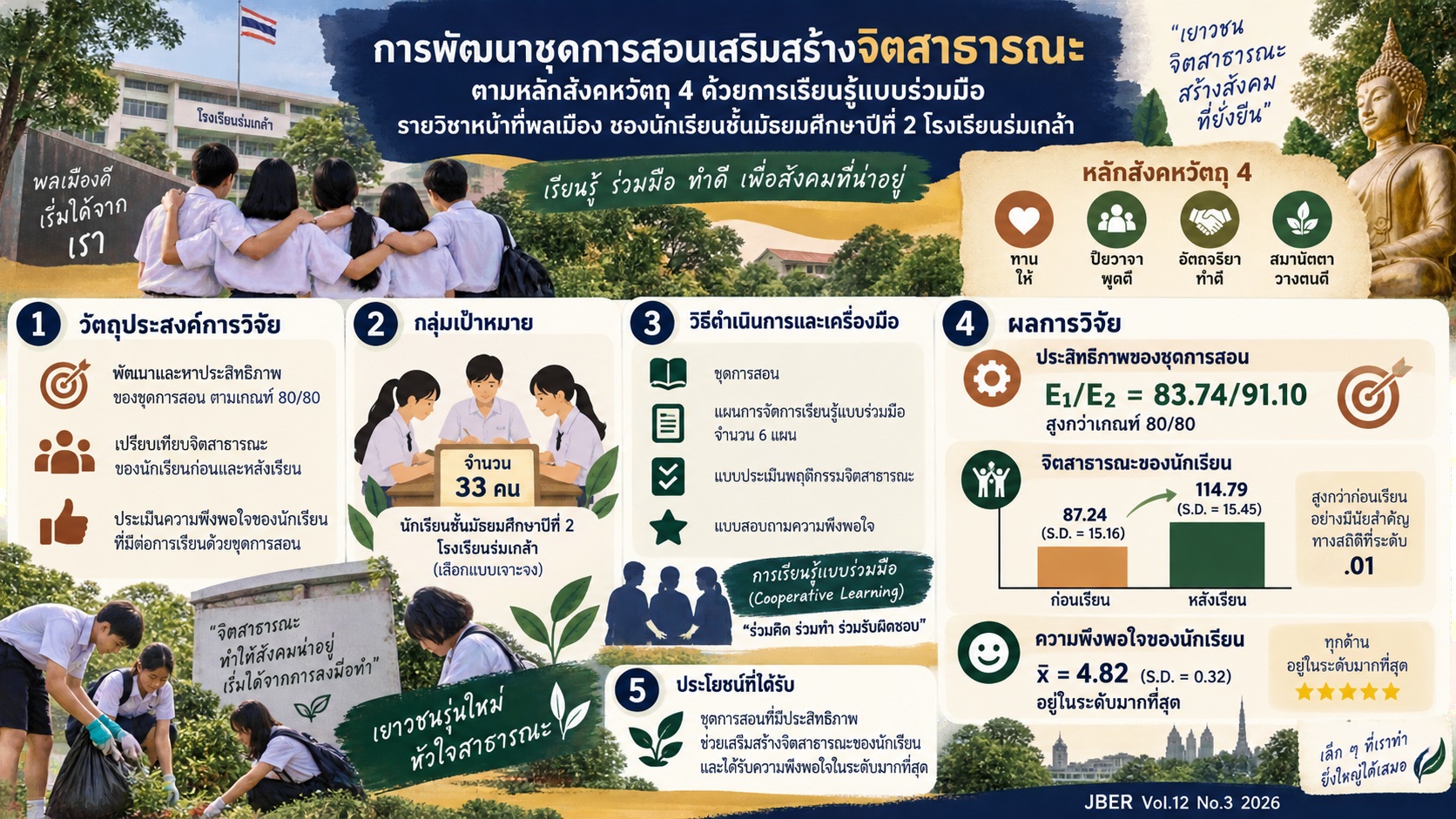
This research aimed to: (1) examine the efficiency of an instructional package designed to promote public mindedness based on the Four Principles of Sa gahavatthu through cooperative learning in the Civic Education course for Grade 8 students at Romklao School, Nong Bua Lamphu Province, according to the 80/80 efficiency criterion; (2) compare students’ learning achievement before and after learning through the instructional package; and (3) evaluate students’ satisfaction toward the instructional package designed to promote public mindedness based on the Four Principles of Sa gahavatthu through cooperative learning in the Civic Education course. The research employed an experimental design using the One Group Pretest–Posttest Design. The target population consisted of 33 students selected through purposive sampling. The research instruments included: (1) a public-mindedness behavior assessment form, (2) six cooperative learning lesson plans, and (3) a satisfaction questionnaire toward the instructional package. The statistical methods used for data analysis included percentage, mean, standard deviation, and the dependent t-test.
The research results were as follows:
- 1. The developed instructional package on promoting public mindedness based on the Four Principles of Sa gahavatthu through cooperative learning in the Civic Education course for Grade 8 students at Romklao School, Nong Bua Lamphu Province demonstrated efficiency (E1/E2). The learning process efficiency (E1) was 50.24 out of 60 points (83.74%, S.D. = 3.04), while the post-learning efficiency (E2) was 114.79 out of 126 points (91.10%, S.D. = 15.45). The overall efficiency of the instructional package was therefore 83.74/91.10, which exceeded the standard criterion of 80/80.
- 2. The comparison of learning achievement before and after the implementation of the instructional package revealed that the pretest mean score was 87.24 out of 126 points (S.D. = 15.16), whereas the posttest mean score increased to 114.79 out of 126 points (S.D. = 15.45). The mean difference between pretest and posttest scores was 27.58 (S.D. = 12.40), with statistical results showing t(32) = 12.90, p < .001. This indicates that students’ learning achievement after the learning activities was significantly higher than before the learning activities at the .01 level of significance, demonstrating that the developed instructional package effectively enhanced students’ knowledge and understanding of public mindedness.
- 3. The analysis of students’ satisfaction toward the development of public mindedness based on the Four Principles of Sa gahavatthu through cooperative learning in the Civic Education course revealed that overall satisfaction across four aspects was at the highest level ( = 4.82, S.D. = 0.32). When considering each aspect individually, all aspects were rated at the highest level. The aspect with the highest mean score was teaching ( = 4.85, S.D. = 0.23), followed by learning activities ( = 4.84, S.D. = 0.35), measurement and evaluation ( = 4.81, S.D. = 0.48), and learning content ( = 4.76, S.D. = 0.32), respectively.
Keywords: Development of Instructional Packages, Public Mind (Public Spirit), the Four Principles of Sangahavatthu, Cooperative Learning
Downloads
Published
How to Cite
Issue
Section
Categories
License
Copyright (c) 2026 Journal of Buddhist Education and Research (JBER)

This work is licensed under a Creative Commons Attribution-NonCommercial-NoDerivatives 4.0 International License.