Development Of Analytical Reading and Creative Thinking Skills Based through the 7E Learning Model Integrated with Exercise for Mathayomseuksa 3 Students
Abstract
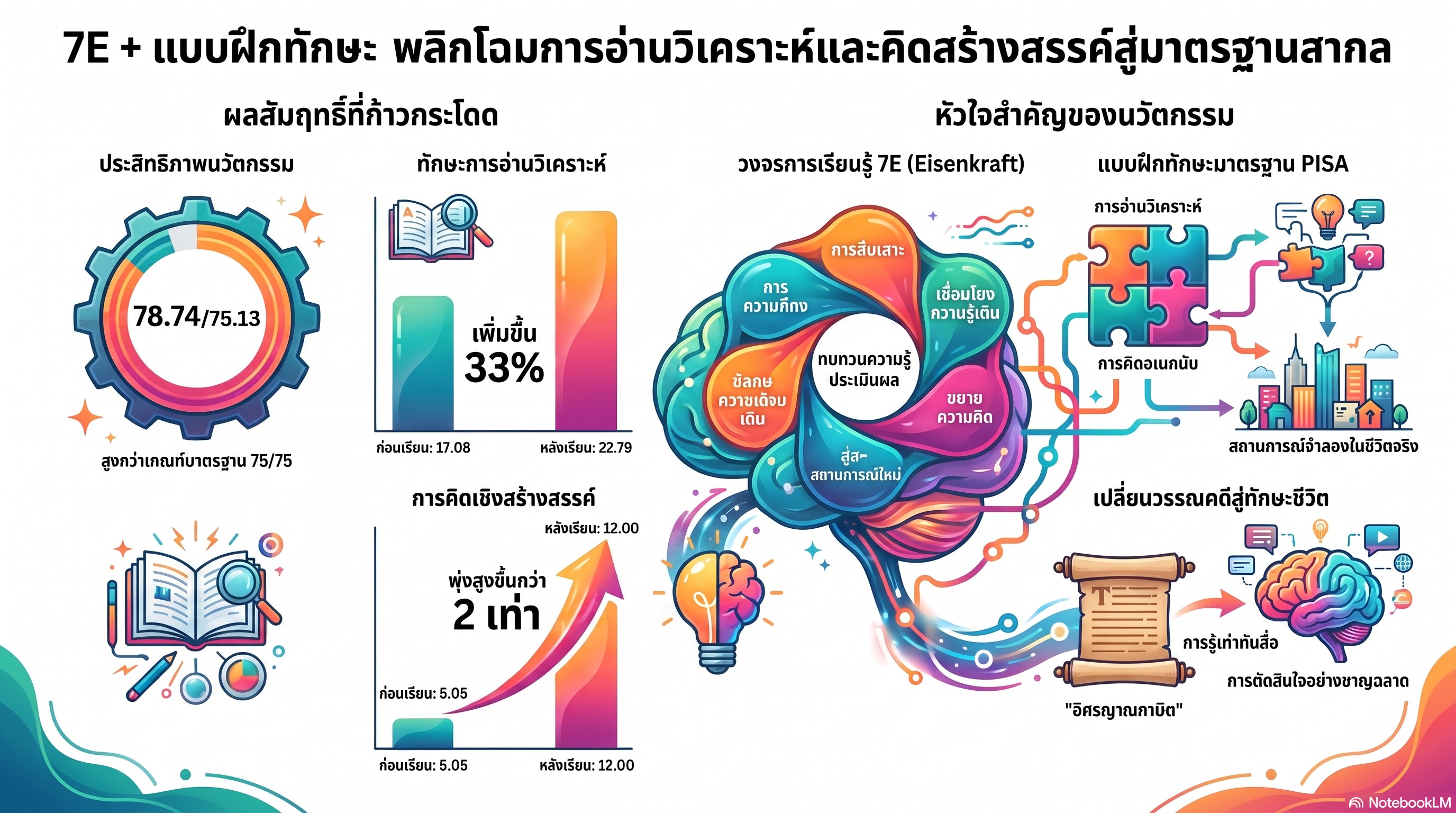
This research article aims to 1) to develop and determine the efficiency of learning management using the 7-step inquiry-based learning approach in conjunction with skill exercises to meet the 75/75 efficiency criterion 2) to compare the analytical reading skills of Grade 9 students before and after learning through the 7-step inquiry-based learning approach with skill exercises and 3) to compare the creative thinking skills of Grade 9 students before and after learning through the 7-step inquiry-based learning approach with skill exercises. This study employs quasi-experimental research. The sample group consisted of 39 Grade 9 students in the academic year 2025 from Ban Pluk Rad School, selected through cluster sampling using classrooms as the sampling units. The research instruments included 1) skill exercises, 2) lesson plans based on the 7-step inquiry-based learning approach combined with skill exercises, 3) an analytical reading skills test and 4) a creative thinking skills test. The statistics used for data analysis were efficiency (E1/E2), mean, standard deviation, and paired t-test. The research findings are as follows: 1) the efficiency of the learning management using the 7-step inquiry-based learning approach with skill exercises was 78.74/75.13, which met the specified criterion of 75/75, 2) The students’ analytical reading skills after the learning management ( 22.79, S.D. = 3.33) were significantly higher than before the learning management ( 17.08, S.D. = 2.81) at the .05 level; and 3) the creative thinking skills after the learning management ( 12.00, S.D. = 1.08) were significantly higher than before the learning management ( 5.05, S.D. = 1.34) at the .05 level.
References
กองพัฒนาข้อมูลและตัวชี้วัดสังคม. (2566). พลิกมุม PISA: ปัจจัยที่กระทบต่อคุณภาพการศึกษาและคุณภาพชีวิตของเด็กไทย. กองพัฒนาข้อมูลและตัวชี้วัดสังคม, 4(4), 1–8. https://www.nesdc.go.th/wordpress/wp-content/uploads/2025/06/2566_article_q4_004.pdf
ณิชกานต์ ไชยจักร์. (2567). การสร้างแรงบันดาลใจด้วยกระบวนการทางศิลปะเพื่อขับเคลื่อนแนวคิดของเด็กปฐมวัย. Journal of Roi Kaensarn Academi, 9(4), 158–182.
ณิชาภาท์ กันขุนทศ, สฤษดิ์ ศรีขาว, & นิราศ จันทรจิตร. (2565). รูปแบบการจัดการเรียนรู้เสริมสร้างความสามารถการอ่านเชิงวิเคราะห์และการเขียนอย่างมีวิจารณญาณวิชาภาษาไทยของนักเรียนชั้นประถมศึกษาปีที่ 5. Journal of Roi Kaensarn Academi, 7(11), 99–113.
ธนภรณ์ แซ่ลิ่ม, ทิพาพร สุจารี, ณัฏฐชัย จันทชุม, & ปวริศ สารมะโน. (2567). การพัฒนาหลักสูตรฝึกอบรมการจัดประสบการณ์เรียนรู้เพื่อเสริมสร้างความคิดสร้างสรรค์สำหรับนักศึกษาครู สาขาวิชาการศึกษาปฐมวัย. วารสารเสียงธรรมจากมหายาน, 10(3), 101–118.
ธีระเดช เจียรสุขสกุล. (2567). กรอบการประเมินของ PISA 2025. สถาบันส่งเสริมการสอนวิทยาศาสตร์และเทคโนโลยี. https://opec.go.th/uploads/2024/pisa/20240508_173306_277_%E0%B8%81%E0%B8%A3%E0%B8%AD%E0%B8%9A%E0%B8%81%E0%B8%B2%E0%B8%A3%E0%B8%9B%E0%B8%A3%E0%B8%B0%E0%B9%80%E0%B8%A1%E0%B8%B4%E0%B8%99PISA_%E0%B8%9B%E0%B8%A3%E0%B8%B0%E0%B8%8A%E0%B8%B8%E0%B8%A1%E0%B8%9C%E0%B8%B9%E0%B9%89%E0%B8%9A%E0%B8%A3%E0%B8%B4%E0%B8%AB%E0%B8%B2%E0%B8%A3%E0%B8%AA%E0%B8%9E%E0%B8%908%E0%B8%9E%E0%B8%84_update3May.pdf
นริศรา ชยธวัช. (2563). การพัฒนาทักษะการอ่านเชิงวิเคราะห์ด้วยการจัดการเรียนรู้แบบ SQ4R ร่วมกับผังกราฟิกสำหรับนักเรียนชั้นมัธยมศึกษาปีที่ 2 [วิทยานิพนธ์ปริญญามหาบัณฑิต, มหาวิทยาลัยศิลปากร].
นวรัตน์ สุขวัฒนาสินิทธิ์. (2560). ผลของการใช้รูปแบบการสอน 7E ร่วมกับเทคนิคกลุ่มร่วมมือแข่งขัน วิชาหลักภาษาไทยที่มีต่อผลสัมฤทธิ์ทางการเรียนวิชาหลักภาษาไทยและทักษะชีวิตของนักเรียนชั้นประถมศึกษาปีที่ 1. วารสารครุศาสตร์ จุฬาลงกรณ์มหาวิทยาลัย, 45(4), 72–88.
ภัทราดา เอี่ยมบุญญฤทธิ์, ชลธิชา ภูริปาณิก, & ฐิติชัย รักบำรุง. (2563). การสอนอ่านเชิงวิเคราะห์ผ่านกระบวนการเรียนรู้แบบ Active Learning เพื่อพัฒนาทักษะการคิดวิเคราะห์ของเด็กไทยยุค Gen Z [วิทยานิพนธ์ปริญญามหาบัณฑิต, มหาวิทยาลัยบูรพา].
วรางคณา ชั่งโต. (2559). ผลของการใช้รูปแบบการสอน 7E ที่มีต่อผลสัมฤทธิ์ทางการเรียนวรรณคดีไทย และความสามารถในการอ่านอย่างมีวิจารณญาณของนักเรียนชั้นมัธยมศึกษาปีที่ 3 [วิทยานิพนธ์ปริญญามหาบัณฑิต, มหาวิทยาลัยศรีนครินทรวิโรฒ].
Eisenkraft, A. (2003). Expanding the 5E model. The Science Teacher, 70(6), 56–59.
Guilford, J. P. (1984). Varieties of divergent production. The Journal of Creative Behavior, 18(1), 1–10. https://doi.org/10.1002/j.2162-6057.1984.tb00984.x
Hair, J. F., Gabriel, M. L. D. S., da Silva, D., & Braga Junior, S. (2019). Development and validation of attitudes measurement scales: Fundamental and practical aspects. RAUSP Management Journal, 54(4), 490–507. https://doi.org/10.1108/RAUSP-05-2019-0098
Lawa, J., Cali, H., Salic-Hairulla, M., & Madale, V. (2025). Developing 7E model lesson plan for Grade 9 students: Fostering science literacy and environmental awareness of climate change. Journal of Innovation, Advancement, and Methodology in STEM Education, 2(5), 348–360. https://so13.tci-thaijo.org/index.php/J_IAMSTEM/article/view/1160
Mukurunge, E., Reid, M., Fichardt, A., & Nel, M. (2021). Interactive workshops as a learning and teaching method for primary healthcare nurses. Health SA Gesondheid, 26, 1643. https://doi.org/10.4102/hsag.v26i0.1643
Thorndike, E. L. (1927). The law of effect. The American Journal of Psychology, 39(1/4), 212–222. https://doi.org/10.2307/1415413
Downloads
Published
How to Cite
Issue
Section
Categories
License
Copyright (c) 2026 Journal of Buddhist Education and Research (JBER)

This work is licensed under a Creative Commons Attribution-NonCommercial-NoDerivatives 4.0 International License.