The Concept of Ma in Spatial Organization and Aesthetic Perception within Japanese Tea House Architecture
Abstract
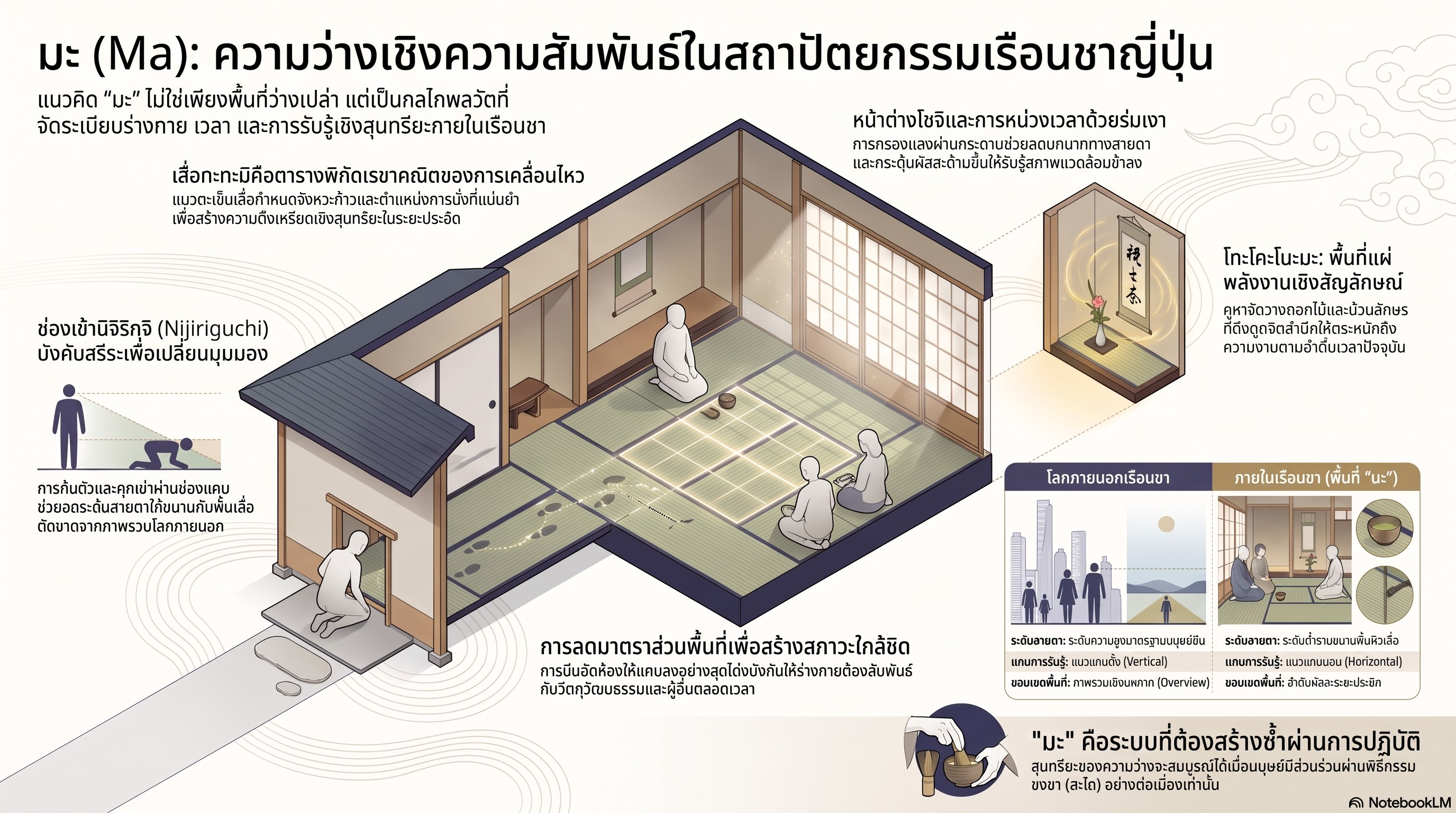
This research article aims to: 1) analyze the role of the concept of ma as the primary mechanism for spatial organization within the Japanese tea house; 2) examine the integration of architectural elements in determining experiential distance and rhythm; and 3) explain the aesthetic perception process emerging from the relational void within tea house architecture. Utilizing a documentary research methodology, this study synthesizes architectural history, aesthetics, and cultural dynamics. The findings reveal that: 1) the concept of ma functions as an operational mechanism that regulates physical bodily distances and coordinates cultural objects, thereby establishing a dynamic spatial relationship system; 2) architectural elements integrate as a unified system to govern kinesthetic perception, whereby the nijiriguchi entrance lowers the user's line of sight and restricts structural visualization, while the grid layout of tatami mats defines precise stepping coordinates and seating orientations in close proximity; and 3) the aesthetic perception process is formed through the chronological moderation of visual perception via light and shadow control at the shoji windows, while the tokonoma space extends aesthetic energy alongside the traditions of flower arrangement (kado) and tea ceremony (sado) to prompt bodily awareness of the relational void at each specific moment.
References
Architectural Institute of Japan. (1993). Chashitsu kūkan nyūmon [Introduction to teahouse spaces]. Shokokusha.
Conder, J. (1899). The flowers of Japan and the art of floral arrangement (2nd ed.). Hakubunsha.
Ema, T. (1969). Cha: Watashi no mikata [茶 私の見方] [Tea: My perspective]. Shunjusha.
Furuta, S. (1976). Soan chashitsu no bigaku [草庵茶室の美学] [Aesthetics of thatched tea rooms]. Tankosha.
Gomi, F. (2025). Cha no bunkashi [茶の文化史] [Cultural history of tea]. Bunkashuppankyoku.
Heidegger, M. (1971). Poetry, language, thought (A. Hofstadter, Trans.). Harper & Row.
Into Japan Waraku. (2026, January 15). Why is the nijiriguchi entrance so small? Exploring its meaning in tea culture. https://intojapanwaraku.com/culture/226206/
Isozaki, A., & Cooper-Hewitt Museum. (1979). Ma: Space-time in Japan. Cooper-Hewitt Museum.
Koren, L. (1994). Wabi-sabi for artists, designers, poets & philosophers. Stone Bridge Press.
Koryu. (2026). About tokonoma. https://koryuikebana.com/
Kumakura, I., & Tanaka, H. (Eds.). (1989–1994). Sadogaku taikei (Vols. 1–20) [茶道学大系] [Compendium of tea way studies]. Tankosha.
Liberty Times Net. (2026, March 10). Reconstruction of Hideyoshi and Rikyu’s golden tea room. https://news.ltn.com.tw/news/world/breakingnews/2999009
Merleau-Ponty, M. (2012). Phenomenology of perception (D. A. Landes, Trans.). Routledge.
Nakamura, M. (1978). Rikyu chashitsu no kenkyu [利休茶室の研究] [A study of Rikyu's tea rooms]. Tankosha.
Okakura, K. (1906). The book of tea. G. P. Putnam’s Sons.
Saito, Y. (2007). Everyday aesthetics. Oxford University Press.
Suzuki, D. T. (1959). Zen and Japanese culture. Princeton University Press.
Tanizaki, J. (1977). In praise of shadows (T. J. Harper & E. G. Seidensticker, Trans.). Leete’s Island Books.
Yanagi, S. (1972). The unknown craftsman: A Japanese insight into beauty. Kodansha International.
Downloads
Published
How to Cite
Issue
Section
Categories
License
Copyright (c) 2026 Journal of Buddhist Education and Research (JBER)

This work is licensed under a Creative Commons Attribution-NonCommercial-NoDerivatives 4.0 International License.