A Study of Teacher's Soft Skills Components
Abstract
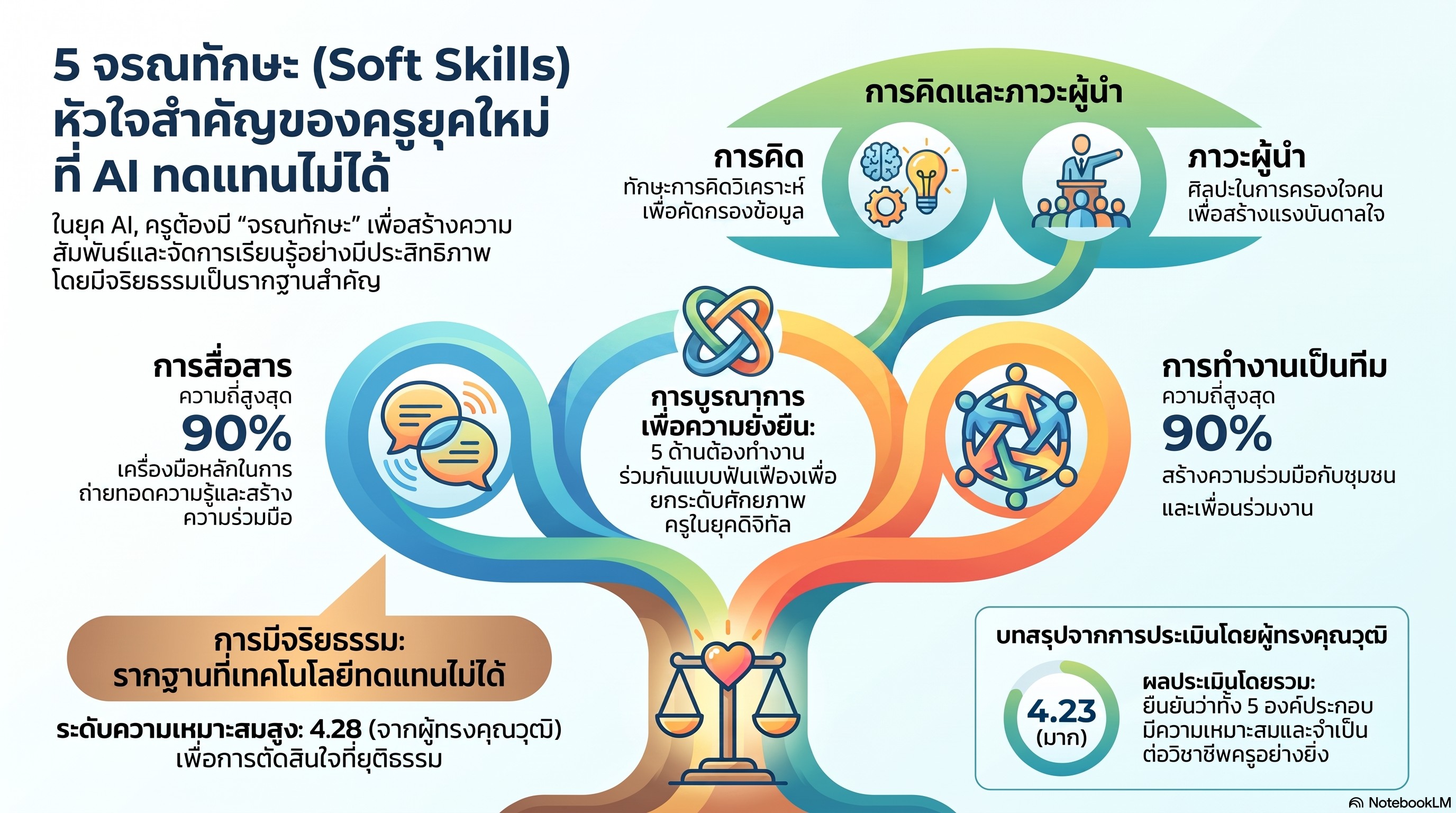
The objective of this research was to study the components of teachers' soft skills. The study was conducted in two phases. The first phase involved synthesizing the components of teachers' soft skills through a review of 10 relevant documents and research articles published within the last decade (2016–2025), applying a component frequency threshold of at least 40%. A document synthesis form was utilized as the research instrument, and the data were analyzed using frequencies and percentages. The second phase evaluated the suitability of the synthesized soft skill components. This assessment was conducted by a panel of five experts using a 5-point rating scale questionnaire. The data from this phase were analyzed using means and standard deviations. The findings revealed that teachers' soft skills comprise five core elements: 1) Communication, 2) Teamwork, 3) Thinking Skills, 4) Leadership, and 5) Ethics. Furthermore, the expert evaluation indicated that the suitability of all components was at a high level (x̄=4.23, S.D. =1.01)
References
คณะกรรมการจัดทำพจนานุกรมศัพท์ศึกษาศาสตร์ร่วมสมัย ราชบัณฑิตยสถาน. (2557). พจนานุกรมศัพท์ศึกษาศาสตร์ร่วมสมัย.
จิตราภรณ์ วงศ์คำจันทร์. (2566). รายงานโครงการวิจัยฉบับสมบูรณ์: โครงการการพัฒนารูปแบบการจัดการเรียนรู้ในศตวรรษที่ 21 ตามแนวจิตตปัญญาศึกษาผสานการเรียนรู้แบบเชิงรุก เพื่อเสริมสร้าง soft skills ของนักศึกษาวิชาชีพครูมหาวิทยาลัยราชภัฏร้อยเอ็ด.
ชลวิช นัทธี. (2566). หลักสูตรการพัฒนาทักษะทางสังคมที่จำเป็นในยุคดิจิทัลเพื่อรองรับการพัฒนาแห่งอนาคต [เอกสารที่ไม่ได้ตีพิมพ์]. สำนักงานคณะกรรมการดิจิทัลเพื่อเศรษฐกิจและสังคมแห่งชาติ.
ปิยพงษ์ คล้ายคลึง. (2564). การพัฒนาครูทั้งระบบ. สำนักงานเลขาธิการสภาการศึกษา.
มนตรี อินทา. (2562). Soft skills: ทักษะที่จำเป็นสู่ความเป็นมืออาชีพของครูยุคใหม่. วารสารวิชาการศึกษาศาสตร์ มหาวิทยาลัยศรีนครินทรวิโรฒ, 20(1), 153–167.
มนัสวาท ไชยแสง. (2567). แนวทางการพัฒนา soft skills ของครูสังกัดสำนักงานเขตพื้นที่การศึกษาประถมศึกษาหนองคาย. วารสาร มจร อุบลปริทรรศน์, 10(1), 687–702.
ไหมไทย ไชยพันธุ์. (2565). Soft skills: ทักษะสำคัญสำหรับครูในสังคมพหุวัฒนธรรม. วารสารมหาวิทยาลัยนราธิวาสราชนครินทร์ สาขามนุษยศาสตร์และสังคมศาสตร์, 10(1), 334–351.
รัตนากร มหัตกุล. (2561). ประสิทธิผลการดำเนินงานส่งเสริมคุณธรรม จริยธรรมนักเรียนโรงเรียนในเครืออัครสังฆมณฑลท่าแร่–หนองแสง [วิทยานิพนธ์ครุศาสตรมหาบัณฑิต, มหาวิทยาลัยราชภัฏสกลนคร].
รพีพร ภูแล่นดี. (2562). แนวทางการพัฒนาภาวะผู้นำของผู้บริหารสถานศึกษา สังกัดสำนักงานเขตพื้นที่การศึกษาประถมศึกษากาฬสินธุ์ เขต 3 [วิทยานิพนธ์ครุศาสตรมหาบัณฑิต, มหาวิทยาลัยราชภัฏมหาสารคาม].
สุทธิกานต์ บริเอก. (2564). ภาวะผู้นำของผู้บริหารสถานศึกษาที่ส่งผลต่อการปฏิบัติงานของครูผู้สอนในโรงเรียน สังกัดสำนักงานเขตพื้นที่การศึกษามัธยมศึกษา เขต 22 [วิทยานิพนธ์ครุศาสตรมหาบัณฑิต, มหาวิทยาลัยราชภัฏสกลนคร].
อมรรัตน์ วงศ์ศรียา. (2562). การพัฒนาคุณธรรม จริยธรรมนักเรียนในโรงเรียนคุณธรรม สพฐ.: กรณีโรงเรียนบ้านนาแมด สังกัดสำนักงานเขตพื้นที่การศึกษาประถมศึกษาอุบลราชธานี เขต 2 [วิทยานิพนธ์ครุศาสตรมหาบัณฑิต, มหาวิทยาลัยราชภัฏสกลนคร].
วิทยาลัยการศึกษาตลอดชีวิต มหาวิทยาลัยเชียงใหม่. (2568). หลักสูตร Skills4Life. มหาวิทยาลัยเชียงใหม่. https://www.lifelong.cmu.ac.th/
สำนักงานเลขาธิการคุรุสภา. (2560). มาตรฐานวิชาชีพครู. สำนักงานเลขาธิการคุรุสภา.
สำนักงานเลขาธิการสภาการศึกษา. (2560). นโยบายและแผนการศึกษาแห่งชาติ. สำนักงานเลขาธิการสภาการศึกษา.
อนวัช จิตรักษ์. (2562). ทักษะชีวิตและการทำงาน (soft skills) ของครูผู้ช่วยในโรงเรียนสังกัดสำนักงานเขตพื้นที่การศึกษาประถมศึกษาในภาคตะวันออกเฉียงเหนือ [วิทยานิพนธ์ศึกษาศาสตรมหาบัณฑิต, มหาวิทยาลัยขอนแก่น].
Alfayez, W. B., & Al-Omari, A. (2024). The degree of Jordanian science teachers' practice of soft skills in the classroom. Pegem Journal of Education and Instruction, 14(2), 192–204. https://doi.org/10.47750/pegegog.14.02.21
Di Carlo, E., et al. (2023). "I should do her finger here, on her cheek—Hmm, to play or to draw? That's how one thinks": What preschoolers tell us about thinking through drawing. Education Sciences, 13(12), 1225. https://doi.org/10.3390/educsci13121225
Fennell, K. (2021). Conceptualizations of leadership and relevance to health and human service workforce development: A scoping review. Journal of Multidisciplinary Healthcare, 14, 3035–3051. https://doi.org/10.2147/JMDH.S329628
Fernandes, P. R., Jardim, J., & Lopes, M. C. (2021). The soft skills of special education teachers: Evidence from the literature. Education Sciences, 11(3), 125. https://doi.org/10.3390/educsci11030125
Kurniadi, W., & Mahaputra, M. R. (2021). Determination of communication in the organization: Non-verbal, oral, and written (A literature review). Journal of Law, Politic and Humanities, 1(4), 164–172.
McEwan, D., Ruissen, G. R., Eys, M. A., Zumbo, B. D., & Beauchamp, M. R. (2017). The effectiveness of teamwork training on teamwork behaviors and team performance: A systematic review and meta-analysis of controlled interventions. PLOS ONE, 12(1), Article e0169604. https://doi.org/10.1371/journal.pone.0169604
Oluwaseyi, J. (2024). Cognitive psychology [Unpublished manuscript]. ResearchGate. https://www.researchgate.net/publication/385884965_Cognitive_Psychology
Papandreou, M., & Kalouda, A. (2023). "I should do her finger here, on her cheek—Hmm, to play or to draw? That's how one thinks": What preschoolers tell us about thinking through drawing. Education Sciences, 13(12), 1225. https://doi.org/10.3390/educsci13121225
Rebrina, F. G., Khakimova, S. D., & Ishkinyaeva, A. R. (2019). Networking cooperation in forming soft skills of a new type of teacher. Space and Culture, India, 7(3), 168–177.
Singer, P. (2023). Ethics. In Encyclopaedia Britannica. https://www.britannica.com/topic/ethics-philosophy
Downloads
Published
How to Cite
Issue
Section
Categories
License
Copyright (c) 2026 Journal of Buddhist Education and Research (JBER)

This work is licensed under a Creative Commons Attribution-NonCommercial-NoDerivatives 4.0 International License.