Enhancing Operational Efficiency in Small Schools through Digital Technology
Keywords:
small-sized schools, operational efficiency, digital technology, lean management, administrative burdenAbstract
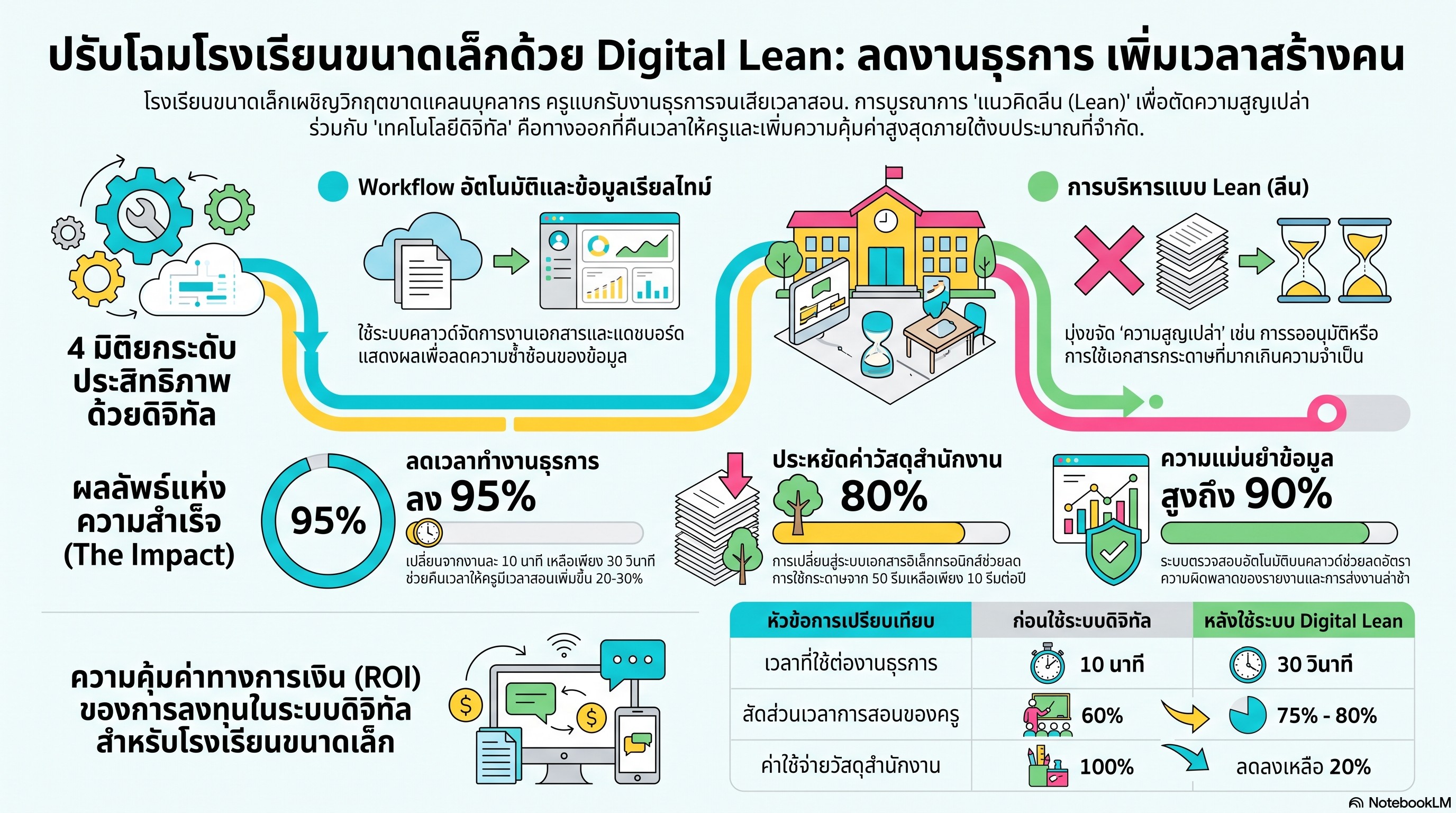
Small-sized schools play a crucial role in providing educational opportunities, particularly in rural and remote areas. However, these schools often face limitations in terms of personnel, budget, and administrative structures, resulting in teachers and administrators bearing a disproportionately high administrative workload. This scholarly article aims to analyze approaches for enhancing operational efficiency in small-sized schools through the application of digital technology. The study is based on Lean Management principles combined with the concept of cost-effectiveness of digital tools. A documentary research approach and conceptual analysis were employed, focusing on four key dimensions: (1) administrative and document management, (2) data management and reporting, (3) resource and financial management, and (4) internal and external communication. The analysis indicates that digital technology can significantly reduce working time, operational costs, process redundancy, and data errors, while improving the accuracy and accessibility of information. The article proposes strategic guidelines for selecting and integrating accessible digital technologies that are appropriate to the context of small-sized schools and effectively reduce teachers’ administrative burden.
References
ศุภวรรณ สุธัมมา, ศุภชัย ทวี, และ สาธร ทรัพย์รวงทอง. (2564). แนวทางการบริหารงานวิชาการในโรงเรียนขนาดเล็ก สังกัดสำนักงานเขตพื้นที่การศึกษาประถมศึกษานครสวรรค์ เขต 2. วารสารวิจยวิชาการ, 4(2), 153–166. https://doi.org/10.14456/jra.2021.39
สำนักงานพัฒนาธุรกรรมทางอิเล็กทรอนิกส์. (2565). ETDA พาสำรวจ 5 ประเทศต้นแบบรัฐบาลดิจิทัล พัฒนา e-Government สร้างบริการสุดล้ำเพื่อประชาชน. สำนักงานพัฒนาธุรกรรมทางอิเล็กทรอนิกส์. https://www.etda.or.th/th/Useful-Resource/5e-Government.aspx
สำนักนโยบายและแผนการศึกษาขั้นพื้นฐาน. (2563). สถิติข้อมูลทางการศึกษา ปีการศึกษา 2563. https://www.bopp.go.th/?page_id=860
Ahiaku, P. K. A., Uleanya, C., & Muyambi, G. C. (2025). Rural schools and tech use for sustainability: The challenge of disconnection. Education and Information Technologies, 30(9), 12557–12571. https://doi.org/10.1007/s10639-024-13311-9
Akter, S. (2024). DIGITALIZATION OF EDUCATION IN RURAL SCHOOLS: A STUDY OF ACCESS, UTILIZATION, AND IMPACT TOWARD DIGITALIZATION IN BANGLADESH. American International Journal of Multidisciplinary Scientific Research, 15(1), 1–9. https://doi.org/10.46281/aijmsr.v15i1.2205
Brynjolfsson, E., & McAfee, A. (2014). The Second Machine Age: Work Progress And Prosperity In A Time Of Brilliant Technologies. W. W. Norton & Company.
Douglas, J., Antony, J., & Douglas, A. (2015). Waste identification and elimination in HEIs: The role of Lean thinking. International Journal of Quality & Reliability Management, 32(9), 970–981. https://doi.org/10.1108/IJQRM-10-2014-0160
Gavin, M., & McGrath-Champ, S. (2024). Teacher workload and the organisation of work: A research agenda for a post-pandemic future. Labour and Industry, 34(1), 88–99. https://doi.org/10.1080/10301763.2024.2357891
Gento, A. M., Pimentel, C., & Pascual, J. A. (2021). Lean school: An example of industry-university collaboration. Production Planning & Control, 32(6), 473–488. https://doi.org/10.1080/09537287.2020.1742373
Janthapass, S., Chanthapassa, N., & Kenaphoom, S. (2024). THE EVOLUTION OF LIFELONG LEARNING: FROM TRADITIONAL CLASSROOMS TO ANYWHERE, ANYTIME EDUCATION. Asian Education and Learning Review, 2(1), 42–54. https://doi.org/10.14456/aelr.2024.4
Khandan, R., & Shannon, L. (2021). The Effect of Teaching–Learning Environments on Student’s Engagement with Lean Mindset. Education Sciences, 11(9), 466. https://doi.org/10.3390/educsci11090466
Kim, J., & Wargo, E. (2025). Empowering educational leaders for AI integration in rural STEM education: Challenges and strategies. Frontiers in Education, 10. https://doi.org/10.3389/feduc.2025.1567698
Kim, K.-N. (2019). Teachers’ administrative workload crowding out instructional activities. Asia Pacific Journal of Education, 39(1), 31–49. https://doi.org/10.1080/02188791.2019.1572592
Klein, L. L., Alves, A. C., Abreu, M. F., & Feltrin, T. S. (2022). Lean management and sustainable practices in Higher Education Institutions of Brazil and Portugal: A cross country perspective. Journal of Cleaner Production, 342, 130868. https://doi.org/10.1016/j.jclepro.2022.130868
Klein, L. L., De Guimarães, J. C. F., Severo, E. A., Dorion, E. C. H., & Schirmer Feltrin, T. (2021). Lean practices toward a balanced sustainability in higher education institutions: A Brazilian experience. International Journal of Sustainability in Higher Education, 24(2), 259–278. https://doi.org/10.1108/IJSHE-10-2020-0406
Lai, J. W. M., & Bower, M. (2019). How is the use of technology in education evaluated? A systematic review. Computers & Education, 133, 27–42. https://doi.org/10.1016/j.compedu.2019.01.010
Nguyen, L. T., Kanjug, I., Lowatcharin, G., Manakul, T., Poonpon, K., Sarakorn, W., Somabut, A., Srisawasdi, N., Traiyarach, S., & Tuamsuk, K. (2023). Digital Learning Ecosystem for Classroom Teaching in Thailand High Schools. Sage Open, 13(1), 21582440231158303. https://doi.org/10.1177/21582440231158303
OECD. (2025). The demands of teaching: Results from TALIS 2024. OECD Publishing. https://www.oecd.org/en/publications/results-from-talis-2024_90df6235-en/full-report/the-demands-of-teaching_0e941e2f.html
Phakamach, P., Panjarattanakorn, D., & Seenonlee, A. (2025). Innovative Leadership for Professional Education Administrators in the Digital Age. Journal of Education and Learning Reviews, 2(3), 153–170. https://doi.org/10.60027/jelr.2025.1765
UNESCO. (2020). Education in a post-COVID world: Nine ideas for public action (น. 1–26). UNESCO. https://unesdoc.unesco.org/ark:/48223/pf0000373717
Wiegel, V. (2020). Lean in the Classroom: The Powerful Strategy for Improving Student Performance and Developing Efficient Processes. Routledge & CRC Press. https://www.routledge.com/Lean-in-the-Classroom-The-Powerful-Strategy-for-Improving-Student-Performance-and-Developing-Efficient-Processes/Wiegel/p/book/9781138323131
Womack, J. P., & Jones, D. T. (2010). Lean Thinking: Banish Waste and Create Wealth in Your Corporation. Simon and Schuster.
World Bank. (2016). Thailand’s small school challenge and options for quality education. World Bank Blogs. https://blogs.worldbank.org/en/eastasiapacific/thailand-s-small-school-challenge-and-options-quality-education
Downloads
Published
How to Cite
Issue
Section
Categories
License
Copyright (c) 2026 Journal of Buddhist Education and Research (JBER)

This work is licensed under a Creative Commons Attribution-NonCommercial-NoDerivatives 4.0 International License.