การเพิ่มประสิทธิภาพการดำเนินงานในโรงเรียนขนาดเล็กผ่านเทคโนโลยีดิจิทัล
คำสำคัญ:
โรงเรียนขนาดเล็ก, ประสิทธิภาพการดำเนินงาน, เทคโนโลยีดิจิทัล, การบริหารแบบลีน, ภาระงานครูบทคัดย่อ
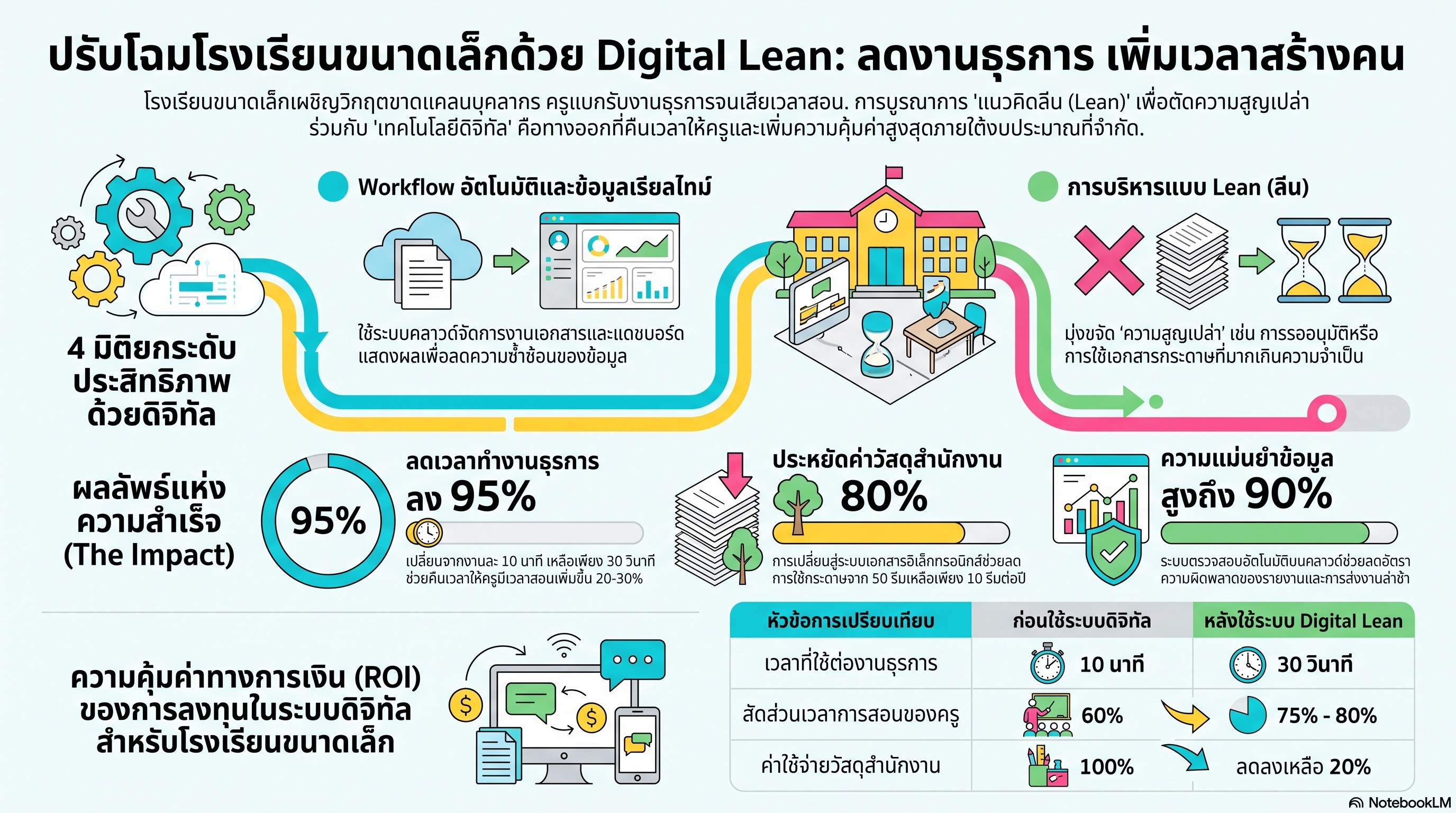
โรงเรียนขนาดเล็กเป็นหน่วยงานทางการศึกษาที่มีบทบาทสำคัญต่อการสร้างโอกาสทางการเรียนรู้ให้แก่ผู้เรียนในพื้นที่ชนบทและพื้นที่ห่างไกล อย่างไรก็ตาม โรงเรียนขนาดเล็กมักประสบปัญหาข้อจำกัดด้านทรัพยากรบุคคล งบประมาณ และโครงสร้างการบริหารจัดการ ส่งผลให้ครูและผู้บริหารต้องรับภาระงานด้านธุรการและการจัดการในสัดส่วนที่สูง มีวัตถุประสงค์เพื่อวิเคราะห์แนวทางการเพิ่มประสิทธิภาพการดำเนินงาน (Operational Efficiency) ในโรงเรียนขนาดเล็กผ่านการประยุกต์ใช้เทคโนโลยีดิจิทัล โดยใช้กรอบแนวคิดการบริหารแบบลีน (Lean Management) ร่วมกับแนวคิดความคุ้มค่าของเทคโนโลยีดิจิทัล (Cost-Effectiveness of Digital Tools) การศึกษาใช้วิธีการวิจัยเชิงเอกสารและการวิเคราะห์เชิงแนวคิด (Documentary Research and Conceptual Analysis) ครอบคลุม 4 มิติหลัก ได้แก่ (1) การจัดการงานธุรการและเอกสาร (2) การจัดการข้อมูลและการรายงานผล (3) การจัดการทรัพยากรและการเงิน และ (4) การสื่อสารและการประสานงานภายในและภายนอกองค์กร ผลการวิเคราะห์พบว่าเทคโนโลยีดิจิทัลสามารถช่วยลดระยะเวลาการทำงาน ลดต้นทุนการใช้ทรัพยากร ลดความซ้ำซ้อนของกระบวนการ และเพิ่มความถูกต้องของข้อมูลได้อย่างมีนัยสำคัญ บทความนี้จึงเสนอแนวทางเชิงกลยุทธ์สำหรับการเลือกใช้และบูรณาการเทคโนโลยีดิจิทัลที่เข้าถึงง่าย เหมาะสมกับบริบทของโรงเรียนขนาดเล็ก และสามารถลดภาระงานของครูได้อย่างเป็นรูปธรรม
เอกสารอ้างอิง
ศุภวรรณ สุธัมมา, ศุภชัย ทวี, และ สาธร ทรัพย์รวงทอง. (2564). แนวทางการบริหารงานวิชาการในโรงเรียนขนาดเล็ก สังกัดสำนักงานเขตพื้นที่การศึกษาประถมศึกษานครสวรรค์ เขต 2. วารสารวิจยวิชาการ, 4(2), 153–166. https://doi.org/10.14456/jra.2021.39
สำนักงานพัฒนาธุรกรรมทางอิเล็กทรอนิกส์. (2565). ETDA พาสำรวจ 5 ประเทศต้นแบบรัฐบาลดิจิทัล พัฒนา e-Government สร้างบริการสุดล้ำเพื่อประชาชน. สำนักงานพัฒนาธุรกรรมทางอิเล็กทรอนิกส์. https://www.etda.or.th/th/Useful-Resource/5e-Government.aspx
สำนักนโยบายและแผนการศึกษาขั้นพื้นฐาน. (2563). สถิติข้อมูลทางการศึกษา ปีการศึกษา 2563. https://www.bopp.go.th/?page_id=860
Ahiaku, P. K. A., Uleanya, C., & Muyambi, G. C. (2025). Rural schools and tech use for sustainability: The challenge of disconnection. Education and Information Technologies, 30(9), 12557–12571. https://doi.org/10.1007/s10639-024-13311-9
Akter, S. (2024). DIGITALIZATION OF EDUCATION IN RURAL SCHOOLS: A STUDY OF ACCESS, UTILIZATION, AND IMPACT TOWARD DIGITALIZATION IN BANGLADESH. American International Journal of Multidisciplinary Scientific Research, 15(1), 1–9. https://doi.org/10.46281/aijmsr.v15i1.2205
Brynjolfsson, E., & McAfee, A. (2014). The Second Machine Age: Work Progress And Prosperity In A Time Of Brilliant Technologies. W. W. Norton & Company.
Douglas, J., Antony, J., & Douglas, A. (2015). Waste identification and elimination in HEIs: The role of Lean thinking. International Journal of Quality & Reliability Management, 32(9), 970–981. https://doi.org/10.1108/IJQRM-10-2014-0160
Gavin, M., & McGrath-Champ, S. (2024). Teacher workload and the organisation of work: A research agenda for a post-pandemic future. Labour and Industry, 34(1), 88–99. https://doi.org/10.1080/10301763.2024.2357891
Gento, A. M., Pimentel, C., & Pascual, J. A. (2021). Lean school: An example of industry-university collaboration. Production Planning & Control, 32(6), 473–488. https://doi.org/10.1080/09537287.2020.1742373
Janthapass, S., Chanthapassa, N., & Kenaphoom, S. (2024). THE EVOLUTION OF LIFELONG LEARNING: FROM TRADITIONAL CLASSROOMS TO ANYWHERE, ANYTIME EDUCATION. Asian Education and Learning Review, 2(1), 42–54. https://doi.org/10.14456/aelr.2024.4
Khandan, R., & Shannon, L. (2021). The Effect of Teaching–Learning Environments on Student’s Engagement with Lean Mindset. Education Sciences, 11(9), 466. https://doi.org/10.3390/educsci11090466
Kim, J., & Wargo, E. (2025). Empowering educational leaders for AI integration in rural STEM education: Challenges and strategies. Frontiers in Education, 10. https://doi.org/10.3389/feduc.2025.1567698
Kim, K.-N. (2019). Teachers’ administrative workload crowding out instructional activities. Asia Pacific Journal of Education, 39(1), 31–49. https://doi.org/10.1080/02188791.2019.1572592
Klein, L. L., Alves, A. C., Abreu, M. F., & Feltrin, T. S. (2022). Lean management and sustainable practices in Higher Education Institutions of Brazil and Portugal: A cross country perspective. Journal of Cleaner Production, 342, 130868. https://doi.org/10.1016/j.jclepro.2022.130868
Klein, L. L., De Guimarães, J. C. F., Severo, E. A., Dorion, E. C. H., & Schirmer Feltrin, T. (2021). Lean practices toward a balanced sustainability in higher education institutions: A Brazilian experience. International Journal of Sustainability in Higher Education, 24(2), 259–278. https://doi.org/10.1108/IJSHE-10-2020-0406
Lai, J. W. M., & Bower, M. (2019). How is the use of technology in education evaluated? A systematic review. Computers & Education, 133, 27–42. https://doi.org/10.1016/j.compedu.2019.01.010
Nguyen, L. T., Kanjug, I., Lowatcharin, G., Manakul, T., Poonpon, K., Sarakorn, W., Somabut, A., Srisawasdi, N., Traiyarach, S., & Tuamsuk, K. (2023). Digital Learning Ecosystem for Classroom Teaching in Thailand High Schools. Sage Open, 13(1), 21582440231158303. https://doi.org/10.1177/21582440231158303
OECD. (2025). The demands of teaching: Results from TALIS 2024. OECD Publishing. https://www.oecd.org/en/publications/results-from-talis-2024_90df6235-en/full-report/the-demands-of-teaching_0e941e2f.html
Phakamach, P., Panjarattanakorn, D., & Seenonlee, A. (2025). Innovative Leadership for Professional Education Administrators in the Digital Age. Journal of Education and Learning Reviews, 2(3), 153–170. https://doi.org/10.60027/jelr.2025.1765
UNESCO. (2020). Education in a post-COVID world: Nine ideas for public action (น. 1–26). UNESCO. https://unesdoc.unesco.org/ark:/48223/pf0000373717
Wiegel, V. (2020). Lean in the Classroom: The Powerful Strategy for Improving Student Performance and Developing Efficient Processes. Routledge & CRC Press. https://www.routledge.com/Lean-in-the-Classroom-The-Powerful-Strategy-for-Improving-Student-Performance-and-Developing-Efficient-Processes/Wiegel/p/book/9781138323131
Womack, J. P., & Jones, D. T. (2010). Lean Thinking: Banish Waste and Create Wealth in Your Corporation. Simon and Schuster.
World Bank. (2016). Thailand’s small school challenge and options for quality education. World Bank Blogs. https://blogs.worldbank.org/en/eastasiapacific/thailand-s-small-school-challenge-and-options-quality-education
ดาวน์โหลด
เผยแพร่แล้ว
รูปแบบการอ้างอิง
ฉบับ
ประเภทบทความ
หมวดหมู่
สัญญาอนุญาต
ลิขสิทธิ์ (c) 2026 Journal of Buddhist Education and Research (JBER)

อนุญาตภายใต้เงื่อนไข Creative Commons Attribution-NonCommercial-NoDerivatives 4.0 International License.