Development of Problem-Based Learning Activities on Atmosphere to Promote Scientific Problem-Solving Ability for Mathayom 1 Students
Keywords:
Learning activities, Problem-Solving ability, Problem-based learning activitiesAbstract
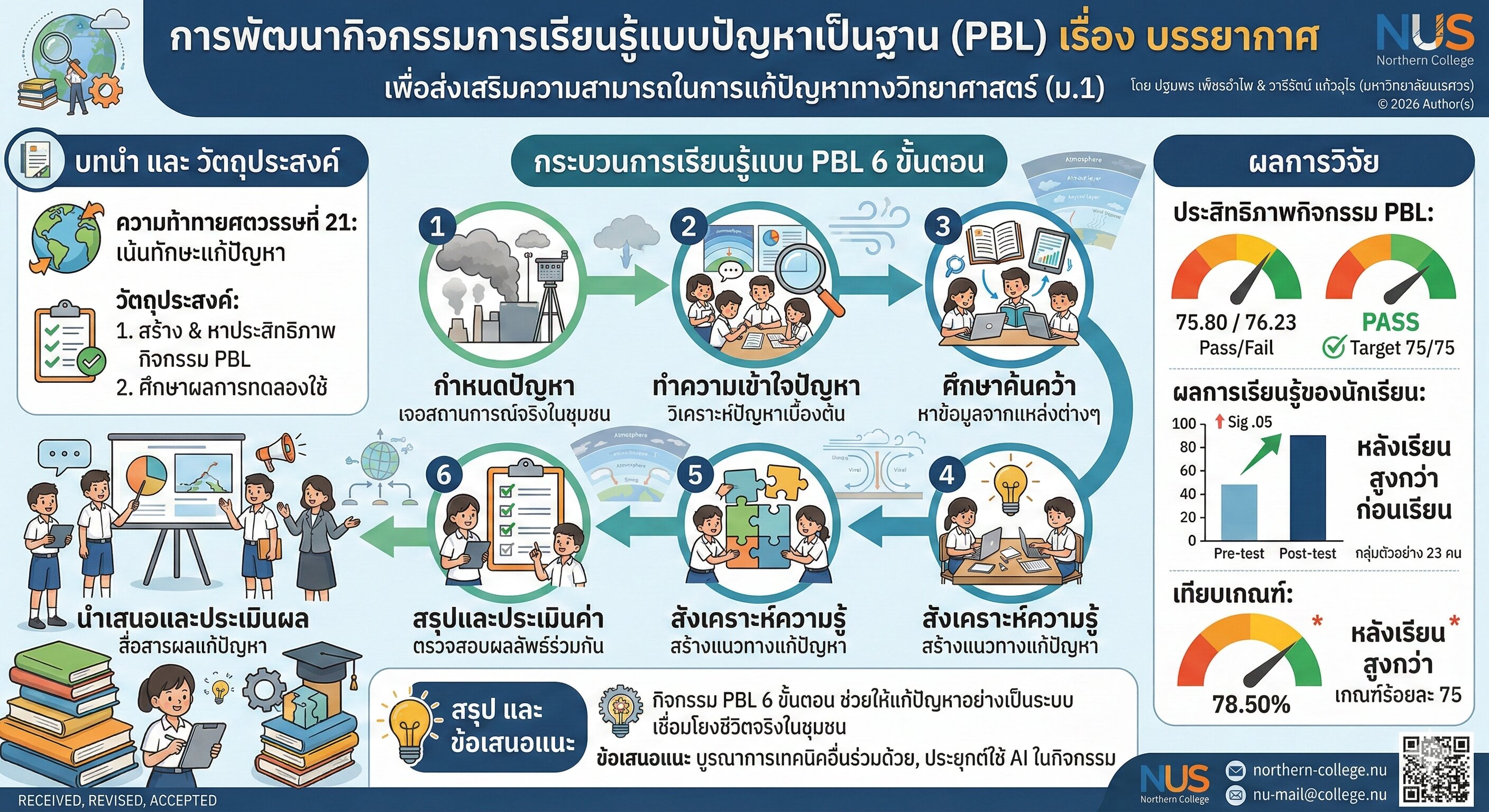
The purposes of the research were to (1) create and evaluate the efficiency of problem-based learning activities on Atmosphere to promote scientific problem-solving ability for Mathayom 1 students following the 75/75 efficiency criteria; (2) Apply and investigate the results of problem-based learning activities on Atmosphere to promote scientific problem-solving ability for Mathayom 1 students. The sample consisted of 21 seventh-grade students of Tha Sao Pittayakhom School, semester 2, academic year 2024, selected by purposive sampling. The instruments used were problem-based learning activities and problem-solving ability tests. The statistics used in data analysis included means, standard deviations, a T-test dependent samples, and a one-sample T-test. Based on the findings, it was concluded that: (1) create and evaluate the efficiency of problem-based learning activities on Atmosphere to promote scientific problem-solving ability for Mathayom 1 students following the 75/75 (1.1) Problem-based learning activities on Atmosphere to promote scientific problem-solving ability for Mathayom 1 students follow a six-step process: 1) Problem definition, 2) Problem comprehension, 3) Research, 4) Knowledge synthesis, 5) Summarization and evaluation, and 6) Presentation and assessments. The appropriateness was at the highest level ( x̄ = 4.11, S.D. = 0.82). (1.2) The efficiency of problem-based learning activities on Atmosphere to promote scientific problem-solving ability for Mathayom 1 students was 75.80/76.23, related to the specified criteria. (2) Apply and investigate the results of problem-based learning activities on Atmosphere to promote scientific problem-solving ability for Mathayom 1 students. (2.1) After applying problem-based learning activities, the students' scientific problem-solving ability was significantly higher than before-class at a statistical level of .05. (2.2) The 7th-grade students’ scientific problem-solving ability after problem-based learning activities classes was significantly higher than the specified criteria at a statistical level of .05.
References
กนกกาญจน์ บุดดี. (2561). การพัฒนากิจกรรมการเรียนรู้วิทยาศาสตร์โดยใช้ปัญหาเป็นฐานร่วมกับการสืบเสาะหาความรู้ เพื่อเสริมสร้างทักษะกระบวนการทางวิทยาศาสตร์และความสามารถในการแก้ปัญหา สำหรับนักเรียนชั้นประถมศึกษาปีที่ 3 (วิทยานิพนธ์ศึกษาศาสตรมหาบัณฑิตที่ไม่ได้ตีพิมพ์). มหาวิทยาลัยศิลปากร.
นวลจันทร์ ทองประเสริฐ. (2563). การจัดการเรียนรู้แบบปัญหาเป็นฐานกับการพัฒนาทักษะการแก้ปัญหาทางวิทยาศาสตร์. สำนักพิมพ์การศึกษา.
บุญชม ศรีสะอาด. (2554). การวิจัยเบื้องต้น (พิมพ์ครั้งที่ 9). สุวีริยาสาส์น.
ประทุมศรี พรหมสวัสดิ์. (2562). การทำงานเป็นทีมกับการแก้ปัญหาทางวิทยาศาสตร์: การประยุกต์ใช้ PBL ในห้องเรียน. สำนักพิมพ์วิทยาศาสตร์ศึกษา.
ล้วน สายยศ, & อังคณา สายยศ. (2538). เทคนิคการวิจัยทางการศึกษา (พิมพ์ครั้งที่ 5). สุวีริยาสาส์น.
สถาบันส่งเสริมการสอนวิทยาศาสตร์และเทคโนโลยี. (2566, 6 ธันวาคม). รายงานผลการประเมินความสามารถของนักเรียนไทยในการประเมินผลนักเรียนนานาชาติ (PISA) ปี 2022. https://pisathailand.ipst.ac.th/news-21/
สุกัญญา คงทัน. (2563). พัฒนาชุดกิจกรรมการเรียนรู้วิทยาศาสตร์โดยใช้ปัญหาเป็นฐาน เพื่อส่งเสริมความสามารถในการแก้ปัญหา เรื่องแรงและการเคลื่อนที่ สำหรับนักเรียนชั้นประถมศึกษาปีที่ 3 (วิทยานิพนธ์ศึกษาศาสตรมหาบัณฑิตที่ไม่ได้ตีพิมพ์). มหาวิทยาลัยนเรศวร.
สุริยา ชัยเกษม. (2562). วิทยาศาสตร์กับการพัฒนาทักษะชีวิต. สำนักพิมพ์วิทยาศาสตร์ศึกษา.
สุวรรณา วงษ์วิเชียร. (2553). การเปรียบเทียบผลสัมฤทธิ์ทางการเรียนและความสามารถในการคิดแก้ปัญหาของนักเรียนชั้นมัธยมศึกษาปีที่ 5 ที่เรียนเรื่องการคุ้มครองสิทธิผู้บริโภค… (วิทยานิพนธ์ศึกษาศาสตรมหาบัณฑิตที่ไม่ได้ตีพิมพ์). มหาวิทยาลัยรามคำแหง.
สำนักงานเลขาธิการการศึกษา. (2550). การจัดการเรียนรู้แบบใช้ปัญหาเป็นฐาน. สำนักงานเลขาธิการการศึกษา.
สำนักส่งเสริมวิชาการและงานทะเบียน มหาวิทยาลัยราชภัฏวไลยอลงกรณ์ ในพระบรมราชูปถัมภ์. (2553). คู่มือการเขียนอ้างอิงและบรรณานุกรม. มหาวิทยาลัยราชภัฏวไลยอลงกรณ์.
ศศิธร เจียมโคกสูง. (2552). ผลการใช้วิธีสอนแบบสืบเสาะหาความรู้ที่มีต่อทักษะการแก้ปัญหาทางวิทยาศาสตร์ของนักเรียนชั้นประถมศึกษาปีที่ 4 (วิทยานิพนธ์ศึกษาศาสตรมหาบัณฑิต). มหาวิทยาลัยสุโขทัยธรรมาธิราช.
อาภรณ์ ใจเที่ยง. (2553). หลักการสอน (ฉบับปรับปรุง). โอเดียนสโตร์.
Andis, K., et al. (2013). Improvement in generic problem-solving abilities of students by use of tutor-less problem-based learning in a large classroom setting. CBE–Life Sciences Education, 12, 73–79.
Barell, J. (1998). Problem-based learning: An introduction (pp. 3–7). Corwin Press.
Barrows, H. S. (1986). A taxonomy of problem-based learning methods. Medical Education.
Christopher, A. G. (2014). A comparison of learner self-regulation in online and face-to-face problem-based learning courses (Doctoral dissertation). ProQuest Dissertations and Theses. (UMI No. 3648437)
Field, J. (2006). Lifelong learning and the new educational order. Trentham Books.
Brown, T. L., LeMay, H. E., Bursten, B. E., Murphy, C. J., Woodward, P. M., & Stoltzfus, M. W. (2018). Chemistry: The central science (14th ed.). Pearson.
Gallagher, S. A. (1997). Problem-based learning: Where learning begins. In A. L. Costa & R. M. Liebmann (Eds.), Supporting the spirit of learning (pp. 16–19). Teachers College Press.
Hmelo-Silver, C. E. (2004). Problem-based learning: What and how do students learn? Educational Psychology Review, 16(3), 235–266.
Savery, J. R. (2006). Overview of problem-based learning: Definitions and distinctions. The Interdisciplinary Journal of Problem-Based Learning, 1(1), 9–20.
Downloads
Published
How to Cite
Issue
Section
Categories
License
Copyright (c) 2026 Journal of Buddhist Education and Research (JBER)

This work is licensed under a Creative Commons Attribution-NonCommercial-NoDerivatives 4.0 International License.