Factors Affecting Household Solid Waste Management Behavior in Nongsua Subdistrict Municipality, Pathum Thani Province
Keywords:
Factors, Household Solid Waste Management, 3RAbstract
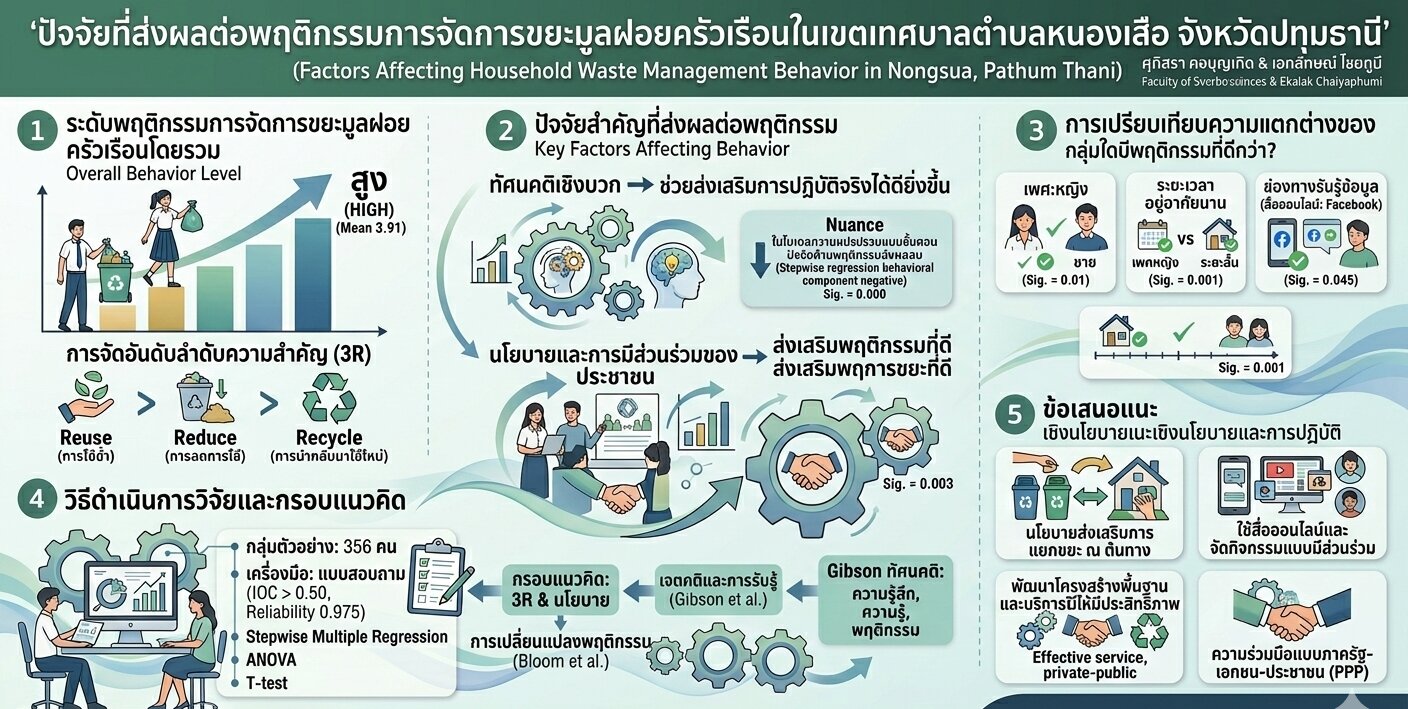
This cross sectional survey research aimed to: (1) study opinions toward household solid waste management behavior in the Nongsua Subdistrict Municipality, Pathum Thani Province; (2) compare household solid waste management behavior in the Nongsua Subdistrict Municipality, Pathum Thani Province, based on personal and household factors; and (3) investigate the factors influencing household solid waste management behavior in the Nongsua Subdistrict Municipality, Pathum Thani Province. The sample group consisted of 356 residents registered in Nongsua Subdistrict Municipality, Pathum Thani Province. Data were collected using a questionnaire, which was validated for content validity using the Index of Item-Objective Congruence (IOC) and tested for reliability using Cronbach's Alpha, yielding an overall reliability coefficient of 0.975. Data were analyzed using descriptive and inferential statistics, including mean, standard deviation, t-test, one-way ANOVA, Pearson’s correlation coefficient, and stepwise multiple regression analysis. The significance level for all statistical analyses was set at 0.05. The results showed that the overall level of household solid waste management behavior among the sample was high. A comparison of behavior by personal and household factors revealed that gender, duration of residence in the community, and channels of information on waste management were significantly associated with differences in household waste management behavior at the 0.05 level. Factors significantly related to and influencing household waste management behavior included behavioral components, as well as policy and community participation factors, all at a significance level of 0.05.
References
กรมควบคุมมลพิษ. (2566). รายงานสถานการณ์มลพิษของประเทศไทย ปี 2566. กรมควบคุมมลพิษ.
กรมส่งเสริมการปกครองท้องถิ่น. (2564). คู่มือแนวทางการจัดการขยะมูลฝอยสำหรับองค์กรปกครองส่วนท้องถิ่น. กรมส่งเสริมการปกครองท้องถิ่น.
สนธิ เตชานันท์. (2519). สาธารณสุขในอดีต: การจัดการสุขาภิบาลในกรุงเทพฯ. สำนักพิมพ์มหาวิทยาลัยธรรมศาสตร์.
วัลลภ รัฐฉัตรานนท์. (2556). การวิจัยทางพฤติกรรมศาสตร์และสังคมศาสตร์: แนวทางและตัวอย่าง. สำนักพิมพ์แห่งจุฬาลงกรณ์มหาวิทยาลัย.
เจญรัตน์ อินจันทร์. (2560). การส่งเสริมพฤติกรรมการจัดการขยะมูลฝอยตามแนวคิด 3R ของประชาชนในชุมชนเมือง (วิทยานิพนธ์ปริญญามหาบัณฑิต). มหาวิทยาลัยมหาสารคาม.
ทิฏฐานุรี พาโอภาส. (2559). ปัจจัยที่มีผลต่อพฤติกรรมการจัดการขยะมูลฝอยในครัวเรือนของประชาชน หมู่ที่ 9 เทศบาลตำบลปากน้ำชุมพร อำเภอเมือง จังหวัดชุมพร (วิทยานิพนธ์ปริญญามหาบัณฑิต). มหาวิทยาลัยราชภัฏสุราษฎร์ธานี.
นิภาภรณ์ จงวุฒิเวศย์, & ชุลีวรรณ ปราณีธรรม. (2564). ปัจจัยที่มีผลต่อพฤติกรรมการจัดการขยะมูลฝอยในครัวเรือน ตำบลหนองปลิง อำเภอเมือง จังหวัดมหาสารคาม. วารสารวิทยาศาสตร์และเทคโนโลยี มหาวิทยาลัยมหาสารคาม, 13(1), 95–106.
พรีมาดา ฉลองชัยสิทธิ์. (2568). การวิเคราะห์พฤติกรรมและความรู้ความเข้าใจของประชาชนในการจัดการขยะ กรณีศึกษา: คอนโดมิเนียมเขตห้วยขวาง กรุงเทพมหานคร (วิทยานิพนธ์ปริญญามหาบัณฑิต). มหาวิทยาลัยเกษตรศาสตร์.
เฟื่องฟ้า รัตนาคณหุตานนท์, นาตยา ดวงประทุม, & ฉัตรประภา ศิริรัตน์. (2567). ทัศนคติและพฤติกรรมการจัดการขยะมูลฝอยของประชาชนในเขตเมือง. วารสารสิ่งแวดล้อมศึกษา, 9(2), 43–57.
Best, J. W. (1977). Research in education (3rd ed.). Prentice-Hall.
Bloom, B. S. (1975). Taxonomy of educational objectives: The classification of educational goals. Longman.
Gibson, J. L., Ivancevich, J. M., & Konopaske, R. (2011). Organizations: Behavior, structure, processes (14th ed.). McGraw-Hill/Irwin.
Hawkins, D. I., & Mothersbaugh, D. L. (2012). Consumer behavior: Building marketing strategy (12th ed.). McGraw-Hill/Irwin.
Kassin, S., Fein, S., & Markus, H. R. (2013). Social psychology (9th ed.). Wadsworth Cengage Learning.
Downloads
Published
How to Cite
Issue
Section
Categories
License
Copyright (c) 2026 Journal of Buddhist Education and Research (JBER)

This work is licensed under a Creative Commons Attribution-NonCommercial-NoDerivatives 4.0 International License.