Development of Academic Leadership of Secondary School Teachers in the Eastern Economic Corridor
Keywords:
academic leadership, secondary school teachers, eastern economic corridorAbstract
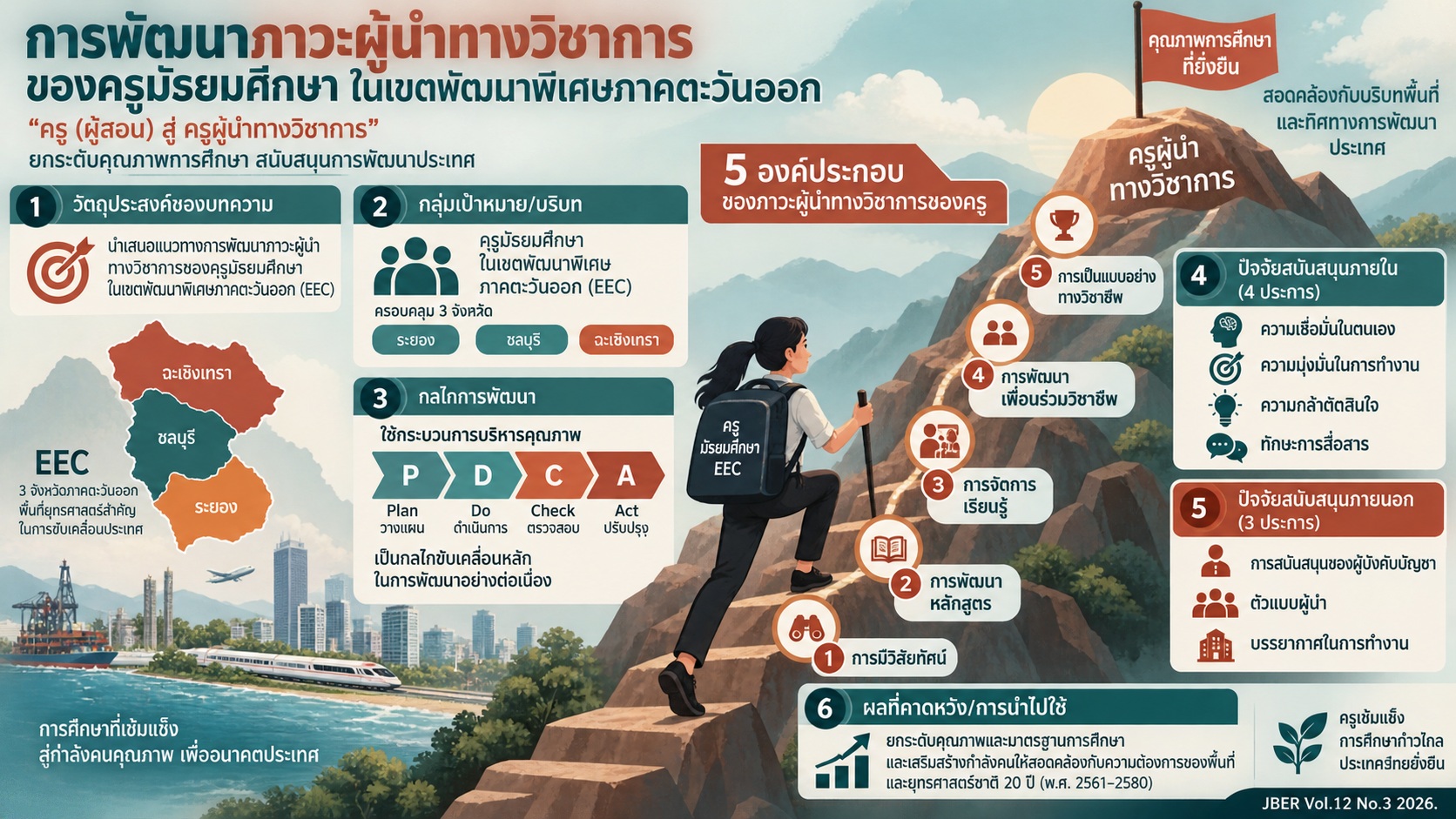
This article aims to present a management approach for developing the instructional leadership of secondary school teachers in the Eastern Economic Corridor (EEC), a strategic development area covering three eastern provinces of Thailand Rayong, Chonburi, and Chachoengsao, which plays a key role in driving national development under the 20 Year National Strategy (2018–2037). The approach underscores the centrality of teachers as a primary mechanism for enhancing educational quality and standards; therefore, teachers must be supported in shifting their roles from classroom instructors to competent instructional leaders. In this regard, teachers’ academic leadership comprises five key components: (1) vision, (2) curriculum development, (3) learning management, (4) professional collaboration and peer development, and (5) professional role modeling. At the same time, developing such leadership requires systematic support from both internal and external factors. Internal factors include self-efficacy, work commitment, decisiveness, and communication skills, whereas external factors include supervisory support, leadership role models, and the work climate. The Plan–Do–Check–Act (PDCA) quality management cycle is applied as a principal driving mechanism for continuous improvement to elevate educational quality and to develop human capital aligned with the local context, regional needs, and the country’s overall development direction.
Keywords: academic leadership, secondary school teachers, eastern economic corridor
References
ขันธ์ชัย อธิเกียรติ, & ธนารักษ์ สารเถื่อนแก้ว. (2561). การสอนแบบทันสมัยและเทคนิควิธีสอนแนวใหม่ [เอกสารออนไลน์]. http://regis.skru.ac.th/RegisWeb/webpage/addnews/data/2017-07-24_078.pdf
ธีรธร สุธีธร. (2559). ภาวะผู้นำเชิงสร้างสรรค์ของครูในยุคการศึกษา 4.0. พิมพ์ดี.
ทิศนา แสงระวี, & เรชา ชูสุวรรณ. (2565). ครูไทยกับการจัดการเรียนรู้ในยุค Digital Disruption. วารสารมหาจุฬานาครทรรศน์, 9(4), 13–26.
พรรณี กิจสมบูรณ์. (2560). กลยุทธ์การบริหารสถานศึกษากับการเสริมสร้างภาวะผู้นำครู. วารสารศึกษาศาสตร์, 23(2), 14–30.
วิชิต สุขสันติกูล, & สมศักดิ์ เอี่ยมคงสี. (2566). ความสัมพันธ์ระหว่างภาวะผู้นำทางวิชาการกับการเป็นชุมชนแห่งการเรียนรู้ทางวิชาชีพของสถานศึกษา สังกัดสำนักงานเขตพื้นที่การศึกษาประถมศึกษาฉะเชิงเทรา เขต 2. วารสารบริหารการศึกษา มศว, 20(38), 51–61.
วิวรรธณี วงศาชโย. (2558). บทบาทของครูกับการเปลี่ยนแปลงทางการศึกษาในยุคดิจิทัล. วารสารเทคโนโลยีสารสนเทศเพื่อการศึกษา, 8(2), 33–47.
วศิน สรรพกิจ. (2559). ภาวะผู้นำของผู้บริหารสถานศึกษากับการพัฒนาคุณภาพการศึกษา. วารสารครุศาสตร์, 40(3), 65–78.
สำนักงานคณะกรรมการการศึกษาขั้นพื้นฐาน. (2553). แนวทางการจัดการเรียนรู้แบบบูรณาการ. สำนักพัฒนาหลักสูตรและนิเทศการศึกษา.
สำนักงานเลขานุการของคณะกรรมการยุทธศาสตร์ชาติ. (2561). ยุทธศาสตร์ชาติ (พ.ศ. 2561–2580). สำนักนายกรัฐมนตรี.
สำนักงานเลขาธิการสภาการศึกษา. (2560). แผนการศึกษาแห่งชาติ พ.ศ. 2560–2579.
สำนักนโยบายและยุทธศาสตร์. (2561). แผนปฏิบัติราชการพัฒนาการศึกษาในพื้นที่เขตพัฒนาพิเศษภาคตะวันออก ประจำปีงบประมาณ พ.ศ. 2561. กระทรวงศึกษาธิการ.
สุพิชญ์ชญา มีแก้ว, นเรศ ขันธะรี, & จิณณวัตร ปะโคทัง. (2564). รูปแบบการพัฒนาภาวะผู้นำทางวิชาการของครูในยุคดิจิทัล โรงเรียนมัธยมศึกษาขนาดเล็ก สังกัดสำนักงานคณะกรรมการการศึกษาขั้นพื้นฐาน. วารสารสันติศึกษาปริทรรศน์ มจร, 9(5), 1952–1963.
Deming, W. E. (1986). Out of the crisis. MIT Center for Advanced Educational Services.
Harris, A., & Muijs, D. (2005). Improving schools through teacher leadership. Open University Press.
Katzenmeyer, M., & Moller, G. (2009). Awakening the sleeping giant: Helping teachers develop as leaders (3rd ed.). Corwin.
Nguyen, D., Harris, A., & Ng, D. (2019). A review of the empirical research on teacher leadership (2003–2017): Evidence, patterns and implications. Journal of Educational Administration, 58(1), 60–80.
York-Barr, J., & Duke, K. (2004). What do we know about teacher leadership? Findings from two decades of scholarship. Review of Educational Research, 74(3), 255–316.
Downloads
Published
How to Cite
Issue
Section
Categories
License
Copyright (c) 2026 Journal of Buddhist Education and Research (JBER)

This work is licensed under a Creative Commons Attribution-NonCommercial-NoDerivatives 4.0 International License.