การศึกษาเชิงเปรียบเทียบอุปลักษณ์ความรักในบทเพลงยอดนิยม ภาษาจีนและภาษาไทย
คำสำคัญ:
ภาษาศาสตร์ปริชาน, อุปลักษณ์เชิงมโนทัศน์ของความรัก, ภาษาจีนและภาษาไทยบทคัดย่อ
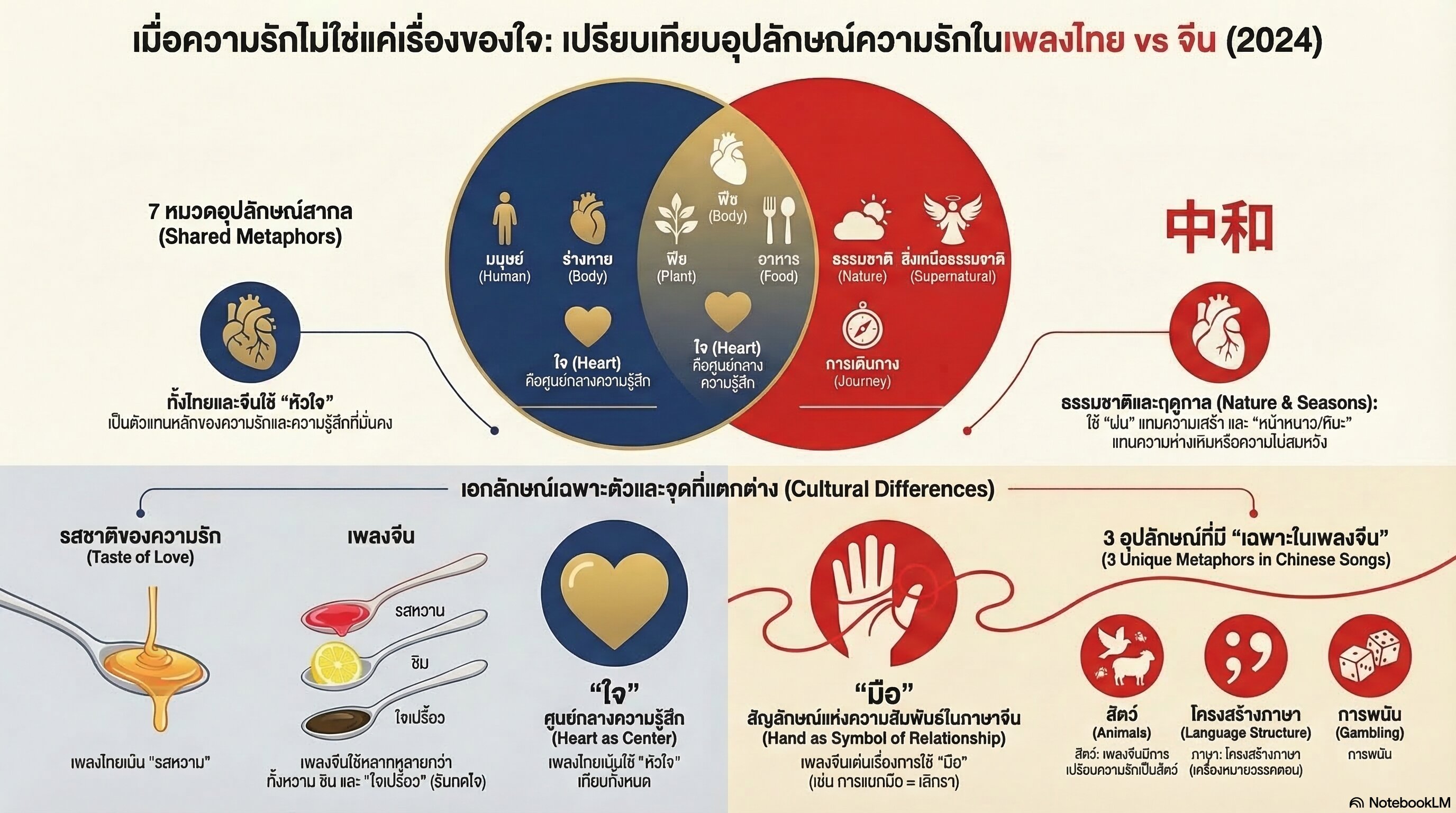
บทความนี้มุ่งศึกษาและเปรียบเทียบอุปลักษณ์เชิงมโนทัศน์ของความรักในบทเพลงร่วมสมัยภาษาจีนและภาษาไทย โดยอาศัยกรอบภาษาศาสตร์ปริชานและทฤษฎีอุปลักษณ์เชิงมโนทัศน์ ซึ่งมองว่าอุปลักษณ์เป็นกลไกพื้นฐานของการรับรู้ที่ช่วยให้มนุษย์สามารถทำความเข้าใจมโนทัศน์นามธรรมผ่านประสบการณ์รูปธรรม ข้อมูลวิจัยได้จากบทเพลงยอดนิยมตามการจัดอันดับของ Apple Music ประจำปี พ.ศ. 2567 จำนวนภาษาละ 100 เพลง โดยคัดเลือกเฉพาะบทเพลงที่ใช้ภาษาจีนหรือภาษาไทยเป็นภาษาหลักและมีการปรากฏของถ้อยคำอุปลักษณ์ที่เกี่ยวข้องกับความรักเพื่อนำมาวิเคราะห์ ผลการวิเคราะห์และการเปรียบเทียบข้ามภาษาพบว่า อุปลักษณ์ความรักสามารถจำแนกได้ทั้งหมด 10 หมวด โดยมี 7 หมวดที่ปรากฏร่วมกันในทั้งสองภาษา ได้แก่ ความรักในฐานะมนุษย์หรือสถานะทางสังคม ร่างกาย พืช อาหาร ธรรมชาติ สิ่งเหนือธรรมชาติ และการเดินทาง ขณะเดียวกันยังพบอุปลักษณ์อีก 3 หมวดที่ปรากฏเฉพาะในเนื้อเพลงภาษาจีน ได้แก่ อุปลักษณ์สัตว์ อุปลักษณ์ภาษา และ อุปลักษณ์การพนัน ผลการศึกษานี้สะท้อนให้เห็นทั้งลักษณะร่วมเชิงมโนทัศน์ในระดับสากลและความแตกต่างเชิงวัฒนธรรมในการอธิบายประสบการณ์ความรักของผู้ใช้ภาษา อีกทั้งยังมีคุณค่าในการสนับสนุนการศึกษาด้านภาษาศาสตร์ปริชาน และสามารถนำไปประยุกต์ใช้ในการเรียนการสอนภาษาจีนและภาษาไทยในฐานะภาษาต่างประเทศ รวมถึงการแปลระหว่างสองภาษาได้อย่างเหมาะสม
เอกสารอ้างอิง
ชัชวดี ศรลัมพ์. (2548). อุปลักษณ์ตามแนวคิดของทฤษฎีภาษาศาสตร์ปริชาน. วารสารศิลปศาสตร์ มหาวิทยาลัยธรรมศาสตร์, 5(1), 1–16.
ซิว ซิววัน. (2563). พจนานุกรมไทย–จีน ฉบับสมบูรณ์ทันสมัย. บุ๊คไทม์.
ทิพย์สุดา นัยทรัพย์. (2535). ภาษากับวัฒนธรรม. หน่วยศึกษานิเทศก์ กรมการฝึกหัดครู.
เธียรชัย เอี่ยมวรเมธ. (2546). พจนานุกรมจีน–ไทยฉบับใหม่ (ฉบับพิมพ์ย่อ). รวมสาส์น.
ปาลิตา ผลประดับเพ็ชร์. (2560). อุปลักษณ์แสดงอารมณ์ในภาษาไทย. วารสารวิวิธวรรณสาร, 1(1), 63–86.
ภัทรา พิเชษฐศิลป์. (2564). ความคิด ความรัก และอาหาร: การศึกษาอุปลักษณ์เชิงมโนทัศน์ในภาษาจีน. วารสารจีนศึกษา มหาวิทยาลัยเกษตรศาสตร์, 14(1), 1–22.
ภาณุเดช จริยฐิตินันท์. (2568). การวิเคราะห์เปรียบเทียบอุปลักษณ์เชิงพื้นที่ของคำว่า “ใจ” ในภาษาจีนและภาษาไทย. วารสารราชภัฏสุรินทร์วิชาการ, 3(3), 73–88.
สถาบันภาษา ศิลปะและวัฒนธรรม มหาวิทยาลัยราชภัฏเชียงใหม่. (2550). พจนานุกรมภาษาล้านนา. เชียงใหม่: โรงพิมพ์แสงศิลป์.
สินีนาฏ วัฒนสุข. (2549). อุปลักษณ์แสดงอารมณ์รักในเพลงไทยสากลสำหรับวัยรุ่นไทย (วิทยานิพนธ์ปริญญามหาบัณฑิต, มหาวิทยาลัยธรรมศาสตร์).
สำนักงานราชบัณฑิตยสภา. (ม.ป.ป.). พจนานุกรม ฉบับราชบัณฑิตยสถาน พ.ศ. 2554. https://dictionary.orst.go.th/
สำนักนายกรัฐมนตรี. (2543). เกณฑ์การถ่ายถอดเสียงภาษาจีนแมนดารินด้วยอักขรวิธีไทย. มหาวิทยาลัยธรรมศาสตร์.
สำนักบริหารศิลปวัฒนธรรม จุฬาลงกรณ์มหาวิทยาลัย. (2565, 28 กรกฎาคม). พระนิพนธ์ในพระราชชายาเจ้าดารารัศมี: น้อยไจยา. https://www.cuartculture.chula.ac.th/news/11680/
สุภัคธัช สุธนภิญโญ. (2565). มโนอุปลักษณ์ความรักในเพลงลูกทุ่งอีสาน. วารสารวรรณวิทัศน์, 22(2), 69–102.
Ao, X. G. (2024). Religion. In A. M. Cheng (Ed.), Understanding China (Rev. ed., pp. 108–125). Shanghai Foreign Language Education Press.
Apple Music. (2024a). Top songs of 2024: Mainland China [Playlist]. https://music.apple.com/cn/playlist/2024-%E5%B9%B4%E5%BA%A6%E6%9C%80%E7%83%AD%E6%AD%8C%E6%9B%B2-%E4%B8%AD%E5%9B%BD%E5%A4%A7%E9%99%86/pl.96eb3d9582634e47a02dc0a903b6d937
Apple Music. (2024b). Top songs of 2024: Thailand [Playlist]. https://music.apple.com/th/playlist/top-songs-of-2024-thailand/pl.ef8252c043d84b4d8caed959db89f4cb
Chen, C. M., & Uanhome, P. (2023). Comparison analysis of love metaphors in Chinese and Thai pop songs. Comparative Study of Cultural Innovation, 7(24), 102–107.
Chen, Z. (2005). Cognitive linguistics research. Shandong Education Press.
Cihai Editorial Committee. (2002). Cihai (1999 ed., reduced-size printing; Z. N. Xia, Ed.). Shanghai Lexicographical Publishing House.
Duan, J. Y. (2018). Cognitive reflection and cultural interpretation of the conceptual metaphor “love is a plant”: Focusing on the floral language of love. Sinogram Culture, (12), 49–51.
Lakoff, G., & Johnson, M. (2016). Metaphors we live by (W. Z. He, Trans.). Zhejiang University Press. (Original work published 1980)
Li, X. (2008). A comparative study of love metaphors in English and Chinese (Unpublished master’s thesis). Central China Normal University.
Liang, H. Q. (2020). A cognitive study of love metaphors in Chinese and Russian. Sinogram Culture, (22), 114–115.
Liu, J. X. (2015). An analysis of love metaphors in English and Chinese pop songs. Youth Literator, (18), 116–117.
Lu, W. P. (2013). Usage of punctuation marks. Southeast University Press.
Mei, M. (2017). A complete collection of Chinese idioms (3rd ed.). The Commercial Press International.
Nguyen, T. T. (2013). Comparison of metaphor in love in Chinese and Vietnamese (Unpublished doctoral dissertation). Central China Normal University.
Niu, L. H. (2007). An analysis of the characteristics of love metaphors in Russian. Foreign Languages Research, (5), 23–26.
Tamai, C. (2021). Comparison of love metaphors in Chinese and Thai languages (Unpublished doctoral dissertation). Wuhan University.
Wei, Y. Y. (2016). A comparative analysis of love metaphors in Chinese and Thai lyrics. Education Modernization, 3(19), 237–240.
Xia, J., & Zhu, L. (2023). An overview of China. Central China Normal University Press.
Yue, X. D. (2009). The psychology of love. China Machine Press.
ดาวน์โหลด
เผยแพร่แล้ว
รูปแบบการอ้างอิง
ฉบับ
ประเภทบทความ
หมวดหมู่
สัญญาอนุญาต
ลิขสิทธิ์ (c) 2026 Journal of Buddhist Education and Research (JBER)

อนุญาตภายใต้เงื่อนไข Creative Commons Attribution-NonCommercial-NoDerivatives 4.0 International License.