Management Model for Development of The Educational Innovator of Secondary School Teachers in The Eastern Area Education Sandbox
Abstract
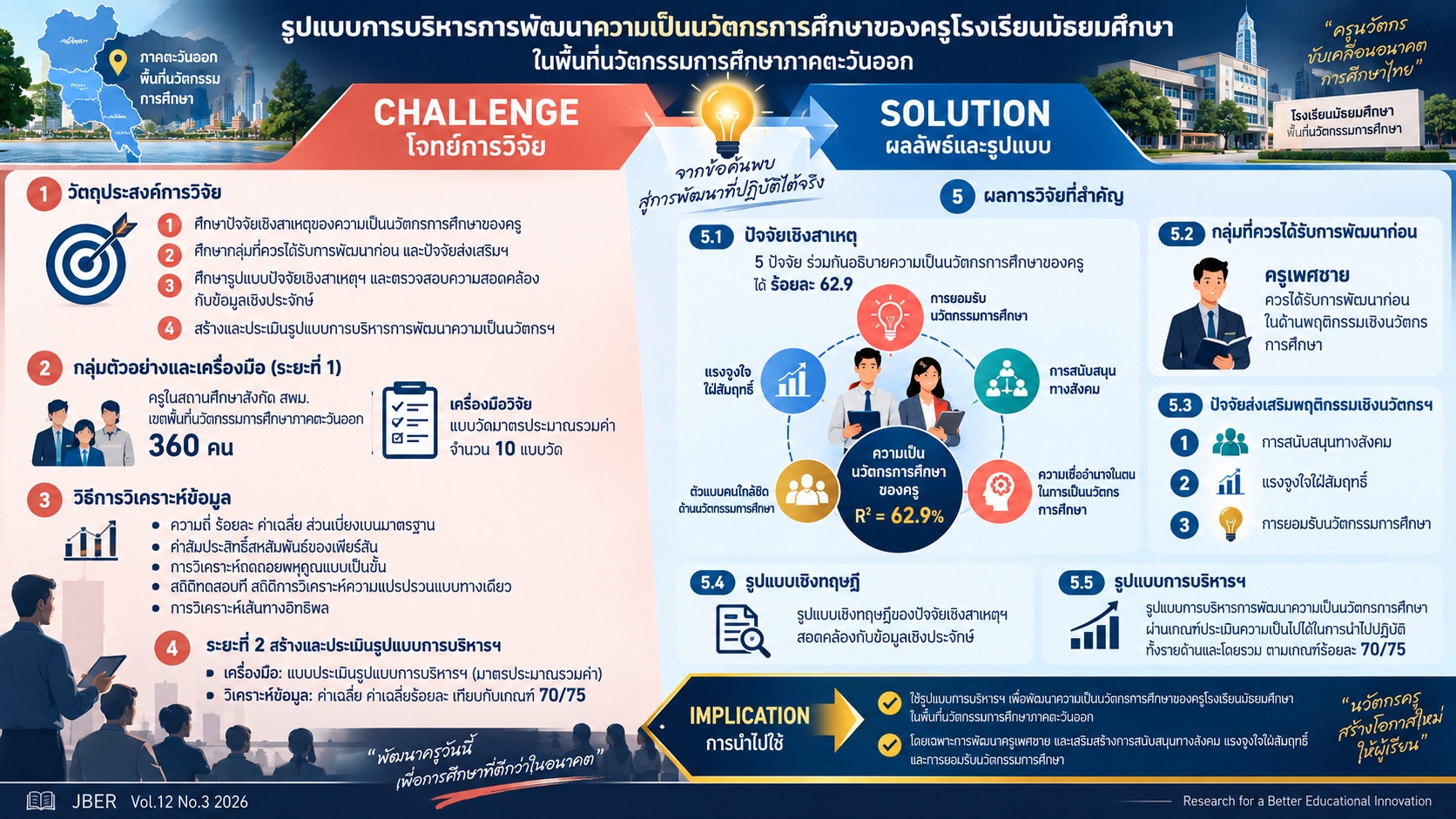
The purposes of this research were to: (1) investigate the causal factors influencing educational innovativeness of secondary school teachers in the Eastern Area Education Sandbox; (2) identify priority groups for development and factors promoting educational innovativeness; (3) examine a causal factor model of educational innovativeness; and (4) develop and evaluate a management model for enhancing educational innovativeness of secondary school teachers in the Eastern Area Education Sandbox. This research employed a two-phase research design. Phase 1 examined causal factors, priority groups, and promoting factors of teachers’ educational innovativeness, and tested the congruence of the theoretical model with empirical data. The sample consisted of 360 secondary school teachers in the Eastern Educational Innovation Area. Data were collected using ten summated questionnaires and analyzed using descriptive statistics, Pearson’s product–moment correlation coefficient, stepwise multiple regression analysis, and path analysis. Phase 2 of the research to develop a management model for enhancing educational innovativeness among secondary school teachers in the Eastern Area Education Sandbox. The feasibility of the model was evaluated by five experts using seven rating-scale questionnaires. The findings result showed, (1) the causal factors influencing educational innovativeness of secondary school teachers in the Eastern Area Education Sandbox that educational innovation adoption, achievement motivation, innovative role models, social support, and self-efficacy this fide us fasted 62.9% of the variance in teachers’ educational innovativeness. (2) Male teachers were identified as the priority group for development, while social support, achievement motivation, and educational innovation adoption were significant promoting factors. (3) The theoretical causal factor model was consistent with empirical data. (4) The proposed management model met the feasibility criteria for practical implementation according to the 70/75 evaluation standards.
Keywords: Management Model of Development, the Educational Innovator, Secondary School Teachers
Downloads
Published
How to Cite
Issue
Section
Categories
License
Copyright (c) 2026 Journal of Buddhist Education and Research (JBER)

This work is licensed under a Creative Commons Attribution-NonCommercial-NoDerivatives 4.0 International License.