Educational Resource Management of Educational Institutions under The Office of The Secondary Education Area Sakon Nakhon
Keywords:
Educational Resource Management, Needs Assessment, Sakon Nakhon Secondary Educational Service Area OfficeAbstract
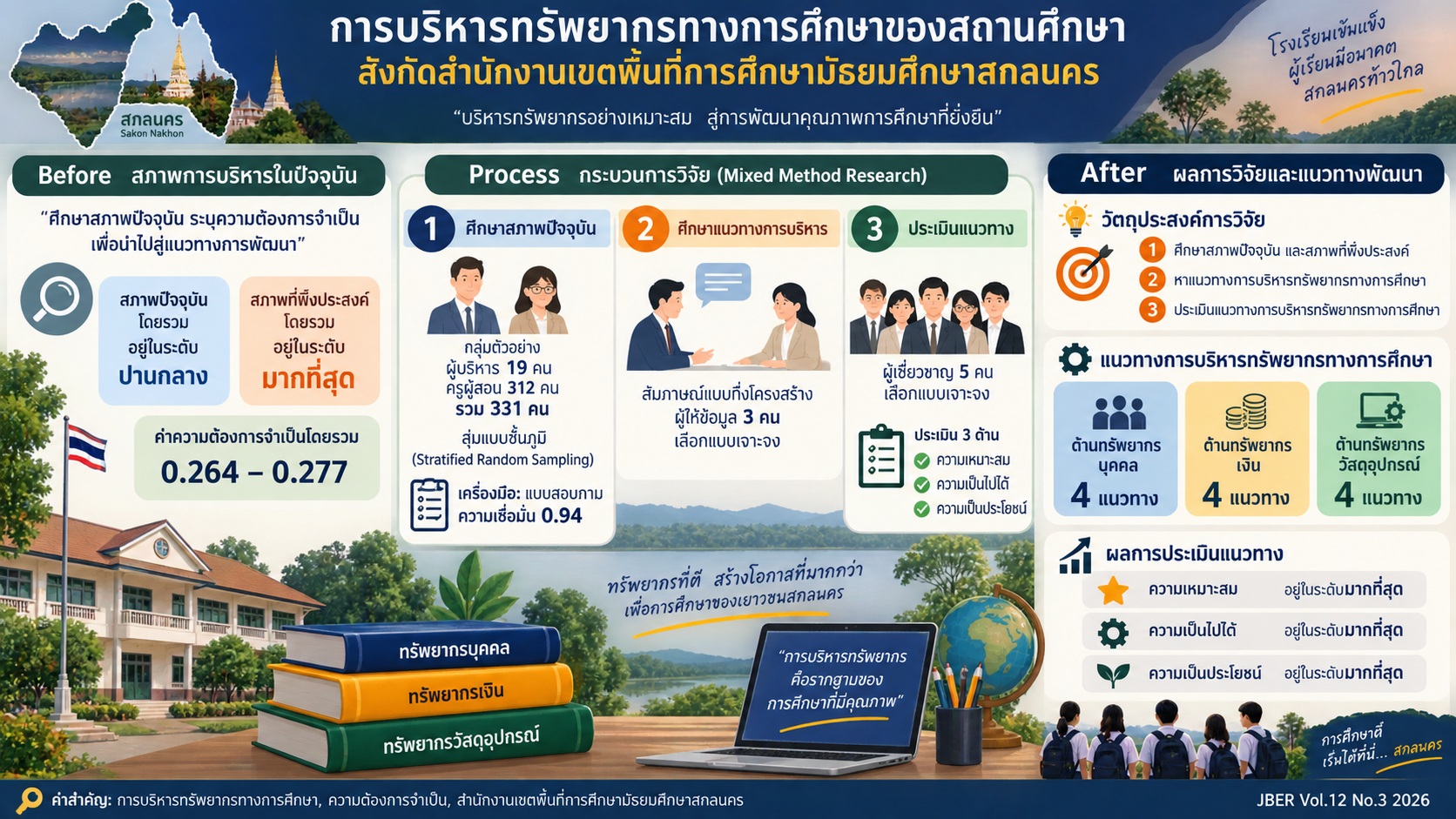
The purposes of this research were 1) examine the current and desirable conditions of educational resource management in educational institutions; 2) develop guidelines for educational resource management in educational institutions; and 3) evaluate the proposed guidelines for educational resource management in educational institutions. This study was conducted in three phases using a mixed-methods research design. Phase 1 focused on investigating the current conditions, desirable conditions, and priority needs in order to analyze the needs for educational resource management in educational institutions. The sample consisted of administrators and teachers, including 19 administrators and 312 teachers, for a total of 331 participants. The sample was selected using stratified random sampling. The research instrument was a questionnaire with a reliability coefficient of 0.94. Phase 2 involved studying guidelines for educational resource management in educational institutions through semi-structured interviews with three key informants, selected by purposive sampling. Phase 3 consisted of evaluating the proposed guidelines for educational resource management in educational institutions by five experts, who were also selected through purposive sampling. The findings revealed that 1) the overall current conditions were at a moderate level, while the overall desirable conditions were at the highest level. The overall priority needs index ranged from 0.264 to 0.277. 2) Educational resource management of schools under the Secondary Educational Service Area Office Sakon Nakhon comprised three aspects. In the area of human resources, four development guidelines were identified. In the area of financial resources, four development guidelines were identified. In the area of material and equipment resources, four development guidelines were identified. 3) The evaluation of the guidelines in terms of appropriateness, feasibility, and usefulness indicated that all aspects were rated at the highest level.
Keywords: Educational Resource Management, Needs Assessment, Sakon Nakhon Secondary Educational Service Area Office
References
Arnold Umandap Mendoza & Eden C. Callo. (2022). Educational Resource Management
as Predictor to Quality of Work-Life. สืบค้นเมื่อ 17 กันยายน 2568, จาก https://papers.ssrn.com/sol3/papers.cfm?abstract_id=4213333
Guskey.T.R. (2000). Evaluating professional development. CA : Corwin Press.
Krejcie, R. V., & Morgan, D. W. (1970). Determining sample size for research activities.
Educational and Psychological Measurement, 30(3), 607–610.
Ke, Y., & Bao, X. (2023). Research on the Management of Educational Resources Based
on Big Data Technology. สืบค้นเมื่อ 17 กันยายน 2568, จาก https://www.researchgate. net/publication/368501699_Research_on_the_Management_of_Educational_ Resources_Based_on_Big_Data_Technology
Okafor, C. J., & Aruoture, R. P. (2022). Influence of Resource Management on School
Effectiveness in Secondary Schools in Edo South Senatorial District. Rivers State University Journal of Education, 25(2), 155–169. สืบค้นเมื่อ 17 กันยายน 2568, จาก https://rsujoe.com.ng/index.php/joe/article/view/140
กกอสัมพันธ์, ธันยรัตน์. (2567). แนวทางพัฒนาการบริหารทรัพยากรทางการศึกษาของวิทยาลัย อาชีวศึกษา สังกัดสำนักงานอาชีวศึกษาจังหวัดกำแพงเพชร. สืบค้นเมื่อ 17 กันยายน 2568, จาก https://so06.tci-thaijo.org/index.php/jra/article/view/268848
กระทรวงศึกษาธิการ. (2562). พระราชบัญญัติการศึกษาแห่งชาติ พ.ศ. 2542 และที่แก้ไขเพิ่มเติม (ฉบับที่ 2) พ.ศ. 2545 และ (ฉบับที่ 3) พ.ศ. 2553 และ (ฉบับที่ 4) พ.ศ. 2562. กรุงเทพฯ: กระทรวงศึกษาธิการ.
จุฑารัตน์ เรณุมาน. (2565). การบริหารทรัพยากรทางการศึกษาของสถานศึกษาสังกัดสำนักงานเขต พื้นที่การศึกษาประถมศึกษาพิษณุโลกเขต 3. สืบค้นเมื่อ 17 กันยายน 2568, จาก https://nuir.lib.nu.ac.th/dspace/bitstream/123456789/5507/3/JutharatRanuman.p df
ณรงค์ฤทธิ์ ประทุมชัย. (2564). แนวทางการพัฒนาการระดมทรัพยากรเพื่อการบริหารจัดการศึกษาใน โรงเรียน สังกัดสำนักงานเขตพื้นที่การศึกษาประถมศึกษามหาสารคาม เขต 3 (วิทยานิพนธ์ปริญญามหาบัณฑิต). มหาวิทยาลัยราชภัฏมหาสารคาม.
เฌอมินทร์ นามเสนาะ. (2566). การบริหารจัดการและการแสวงหาทรัพยากรทางการศึกษาโรงเรียนขนาด เล็กอำเภอสองพี่น้อง จังหวัดสุพรรณบุรี. รายงานการวิจัยนำเสนอในการประชุมวิชาการ ระดับชาติ, ประเทศไทย.
ธีระ รุญเจริญ. (2553). ความเป็นมืออาชีพในการจัดและบริหารการศึกษายุคปฏิรูปการศึกษาเพื่อ ปฏิรูปรอบ 2 และประเมินภายนอกรอบ 3. กรุงเทพฯ: ข้าวฟ่าง.
นคร ตังคะพิภพ. (2549). การระดมทรัพยากรเพื่อการศึกษาของสถานศึกษาขั้นพื้นฐาน. เพชรบุรี: โรงเรียนเบญจมเทพอุทิศ.
รัฐพงษ์ มั่นต่อ. (2564). แนวทางการบริหารทรัพยากรทางการศึกษาของโรงเรียนขนาดเล็กในยุคฐานวิถี ชีวิตใหม่ สังกัดสำนักงานเขตพื้นที่การศึกษาประถมศึกษาอุตรดิตถ์ เขต 1. สืบค้นเมื่อ 17 กันยายน 2568, จาก https://so02.tci-thaijo.org/index.php/JRKSA/ article/view/251476
สุชาดา บรรณกิจ. (2564). การบริหารทรัพยากรทางการศึกษาที่ส่งผลต่อการบริหารงานวิชาการของ สถานศึกษาสังกัดสำนักงานเขตพื้นที่การศึกษามัธยมศึกษา เขต 3. สืบค้นเมื่อ 17 กันยายน 2568, จาก https://so03.tci-thaijo.org/index.php/journal-peace/ article/view/253106
สุธิดา ศิริสวัสดิ์. (2565). สภาพการบริหารทรัพยากรทางการศึกษาของสถานศึกษาในสหวิทยาเขต วิภาวดี สังกัดสำนักงานเขตพื้นที่การศึกษามัธยมศึกษากรุงเทพมหานคร เขต 2. สืบค้น เมื่อ 17 กันยายน 2568, จาก https://so02.tci-thaijo.org/index.php/JRKSA/ article/view/255590
สุมาลี ศรีพุทธรินทร์. (2555). เอกสารคำสอนวิชาการบริหารทรัพยากรการบริหารสถานศึกษา. นครพนม: คณะศิลปะศาสตร์และวิทยาศาสตร์ มหาวิทยาลัยนครพนม.
สำนักงานเลขาธิการสภาการศึกษา. (2562). รูปแบบการระดมทรัพยากรเพื่อการศึกษา. กรุงเทพฯ: พริกหวานกราฟฟิค.
Downloads
Published
How to Cite
Issue
Section
Categories
License
Copyright (c) 2026 Journal of Buddhist Education and Research (JBER)

This work is licensed under a Creative Commons Attribution-NonCommercial-NoDerivatives 4.0 International License.